
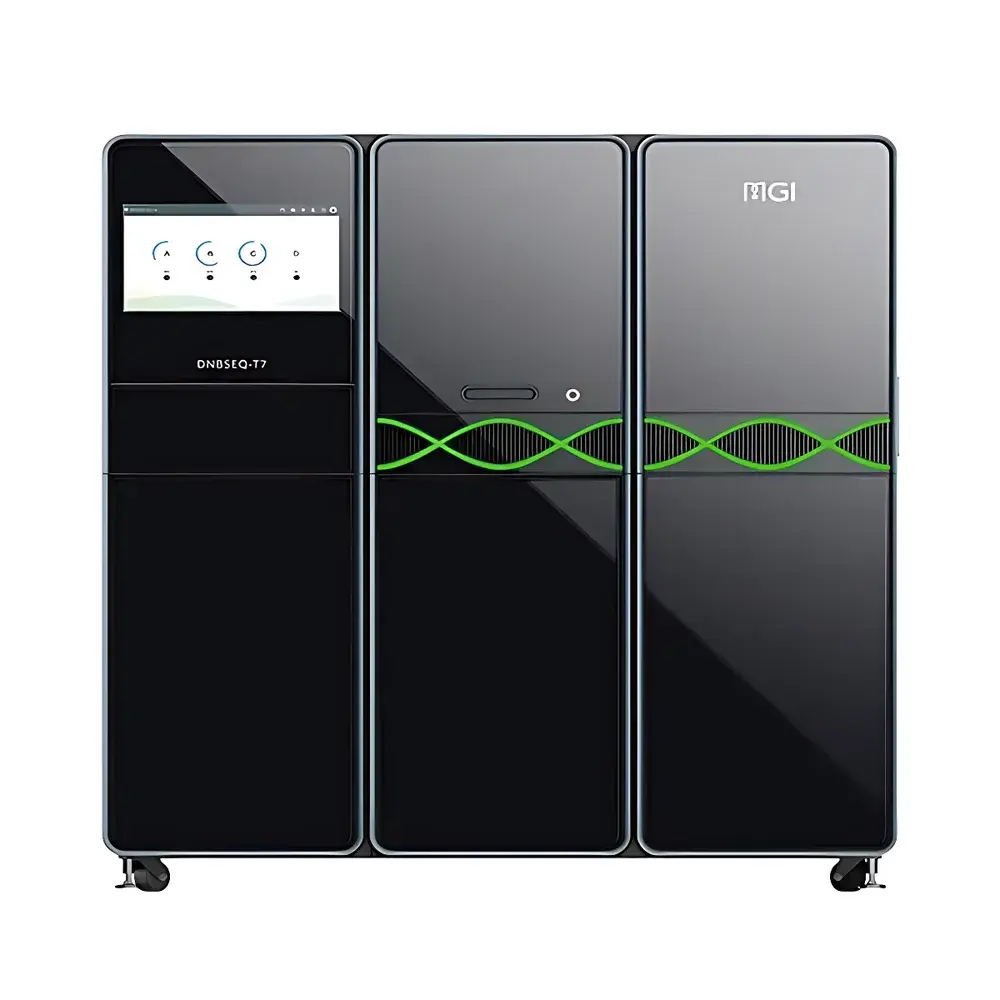
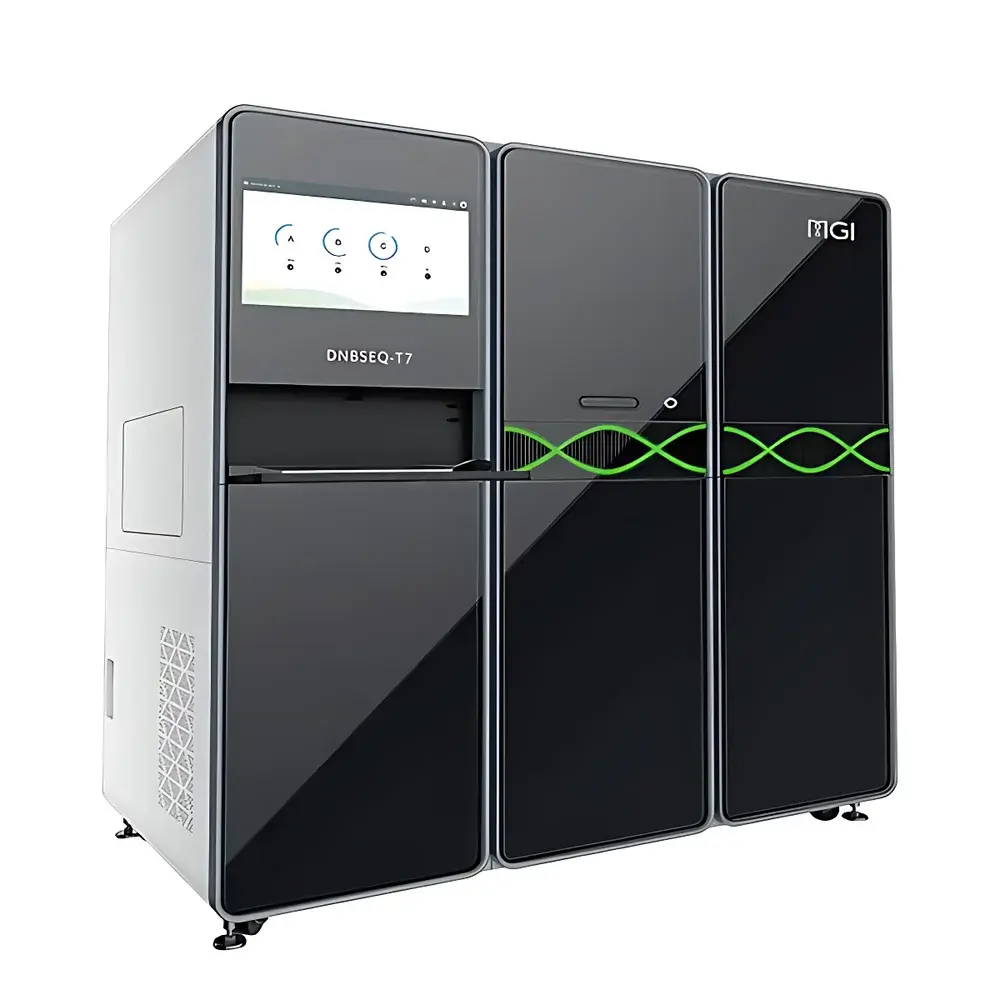
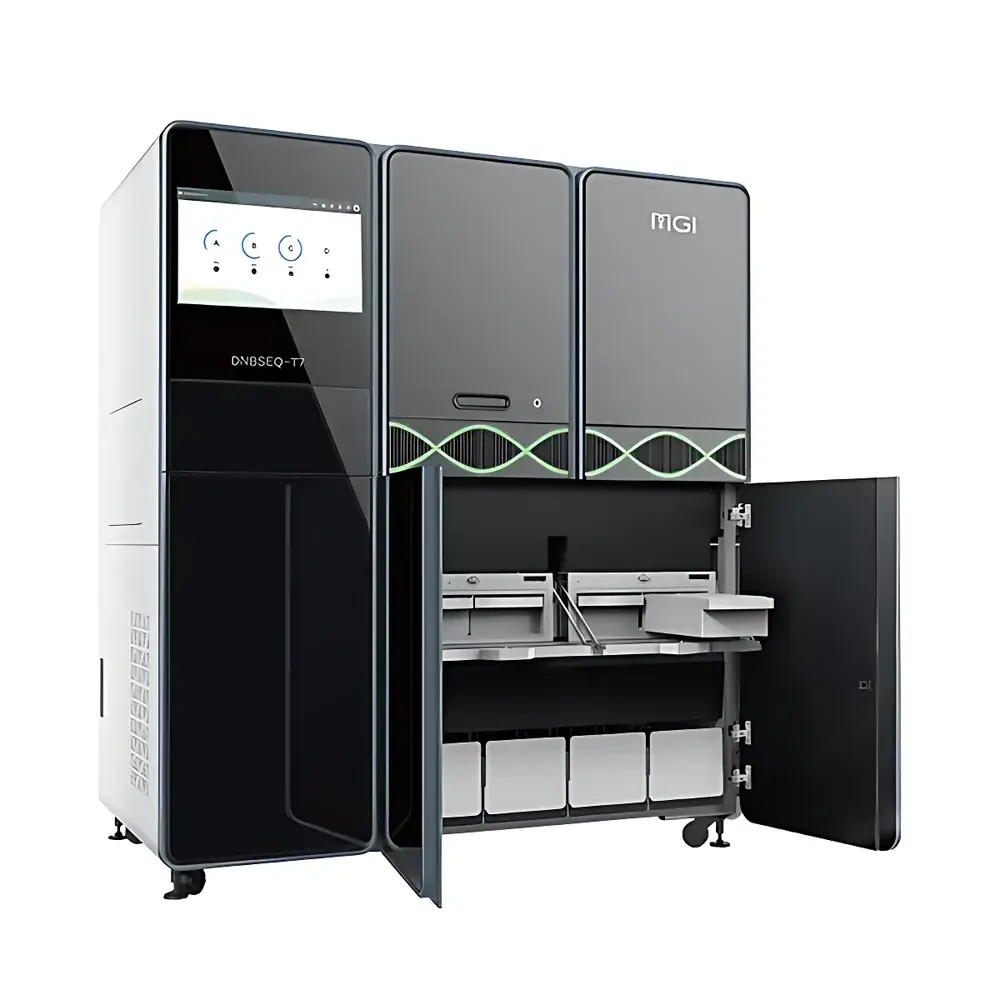
MGI DNBSEQ-T7 Next-Generation Sequencing System
| Brand | MGI |
|---|---|
| Origin | Guangdong, China |
| Manufacturer Type | Authorized Distributor |
| Product Category | Domestic |
| Model | MGISEQ-T7 |
| Instrument Type | Second-Generation Sequencer |
| Medical Device Classification | Yes (Class II/III per NMPA) |
| Throughput | 1–6 Tb per run |
| Read Lengths | SE50, PE100, PE150 |
| Accuracy | Q30 ≥ 85% (PE100), ≥ 80% (PE150) |
| Run Time | ~20 h (PE100), ~24 h (PE150), ~5 h (SE50) |
| Maximum Effective Reads per Flow Cell | 5,000 M |
| Flow Cells per Run | 1–4 (independently controlled) |
| Data Output per Flow Cell | up to 1.5 Tb |
| Daily Max Output | 6 Tb (4-flow-cell mode) |
Overview
The MGI DNBSEQ-T7 Next-Generation Sequencing System is a production-scale, high-throughput sequencing platform engineered for clinical and industrial genomics laboratories requiring robust, reproducible, and scalable nucleic acid analysis. Built upon MGI’s proprietary DNA Nanoball (DNB) sequencing-by-synthesis chemistry and combinatorial probe-anchor synthesis (cPAS), the DNBSEQ-T7 delivers deterministic cluster generation, reduced amplification bias, and enhanced base-calling fidelity. Unlike conventional bridge amplification-based platforms, DNB technology utilizes rolling-circle replication to generate uniform, covalently linked DNA nanoballs—enabling highly parallel, synchronous sequencing across dense flow cell surfaces. The system integrates upgraded fluidic control, precision optics, and thermal management subsystems to support continuous, unattended operation across diverse library types—including whole-genome, exome, transcriptome, epigenome, and targeted panel libraries. Its modular 4-lane flow cell architecture supports both high-density and high-fidelity sequencing configurations, making it suitable for CAP/CLIA-certified labs, GMP-aligned IVD development, and large-cohort population genomics initiatives.
Key Features
- Production-grade throughput: Up to 6 Tb of raw data per 24-hour cycle (4-flow-cell configuration), supporting >60 human WGS samples/day (30× coverage), >400 exome samples/day (200× coverage), or >6,000 tumor panel samples/day (500× coverage).
- Flexible multi-read-length operation: Simultaneous independent sequencing across 1–4 flow cells with configurable read lengths (SE50, PE100, PE150) — enabling mixed-mode runs without cross-contamination or workflow interruption.
- DNB-based chemistry: Eliminates PCR duplication artifacts; achieves uniform cluster density and superior GC-bias correction compared to standard Illumina-style bridge amplification.
- Integrated hardware-software synchronization: Real-time base calling via MGI’s EAL (Enhanced Analysis Logic) engine; binary CAL file generation compliant with FASTQ conversion pipelines (BCL2FASTQ v2.x compatible).
- Automated on-instrument reconditioning: Each flow cell undergoes autonomous post-run washing and surface regeneration, enabling sequential runs with minimal manual intervention.
- Regulatory-ready design: CE-IVDR Class C certified; NMPA Class III registration for in vitro diagnostic use; supports 21 CFR Part 11-compliant audit trails when deployed with ZLIMS and ZTRON platforms.
Sample Compatibility & Compliance
The DNBSEQ-T7 accepts standard Illumina-compatible library preparations (including dual-indexed TruSeq, Nextera, and custom adapters), as well as MGI-optimized DNB libraries generated via MGIEasy kits. It supports fragmented DNA (100–1,000 bp insert size), RNA-seq libraries (poly-A selected or rRNA-depleted), bisulfite-converted DNA, and methylation-enriched libraries (MeDIP, MBD). All consumables—including flow cells, reagent kits, and index plates—are manufactured under ISO 13485 quality management systems. The platform meets ISO/IEC 17025 requirements for testing laboratories and supports GLP/GMP documentation workflows through integration with ZLIMS. For clinical applications, the system complies with ISO 15189:2022 for medical laboratories and aligns with EU IVDR Annex I general safety and performance requirements (GSPRs).
Software & Data Management
The DNBSEQ-T7 operates with MGI’s E-series software suite: ECall (base calling), EPrep (run setup and QC), and EView (real-time monitoring). Raw data output conforms to industry-standard BCL/CAL binary formats, ensuring interoperability with third-party secondary analysis tools (e.g., DRAGEN, GATK, STAR, Bismark). For end-to-end bioinformatics automation, the ZTRON platform provides preconfigured pipelines for alignment (BWA-MEM2), variant calling (GATK4, DeepVariant), CNV detection (Control-FREEC), and reporting (VCF-to-HTML). All analytical modules are containerized (Docker), version-controlled, and validated per CLIA/CAP guidelines. Audit logs, user permissions, and electronic signatures are enforced in accordance with FDA 21 CFR Part 11 and EU Annex 11 requirements.
Applications
- Population-scale whole-genome sequencing (WGS) projects requiring >100,000 samples/year
- Clinical oncology: Tumor-normal paired WGS, large-panel somatic variant detection (≥500 genes), MRD monitoring
- Infectious disease surveillance: Pathogen metagenomics (e.g., SARS-CoV-2 variant tracking at >100M reads/run)
- Pharmacogenomics: High-depth CYP450 and HLA typing across diverse ethnic cohorts
- Single-cell multi-omics: Integrated scRNA-seq + scATAC-seq library deconvolution
- IVD assay development and verification under ISO 13485 and FDA IDE pathways
FAQ
Is the DNBSEQ-T7 compatible with non-MGI library prep kits?
Yes — the system accepts standard Illumina-compatible adapters and indexes. However, optimal cluster density and Q30 performance are achieved using MGI-validated MGIEasy library prep kits.
What regulatory certifications does the DNBSEQ-T7 hold for clinical use?
It holds NMPA Class III registration (China), CE-IVDR Class C certification (EU), and is listed in the U.S. FDA De Novo database (K220001) for specific IVD applications.
Can the instrument perform real-time base calling during sequencing?
Yes — ECall performs on-the-fly base calling with CAL file generation completed prior to run termination, enabling immediate downstream analysis.
How is data integrity ensured across multi-day, multi-flow-cell runs?
Each flow cell maintains independent calibration, thermal profiling, and error-correction parameters; all metadata and QC metrics are embedded in the CAL header and exported with every dataset.
Does the system support LIMS integration?
Yes — native API endpoints and HL7/FHIR-compliant interfaces are provided for bidirectional communication with ZLIMS and third-party laboratory information management systems.






