
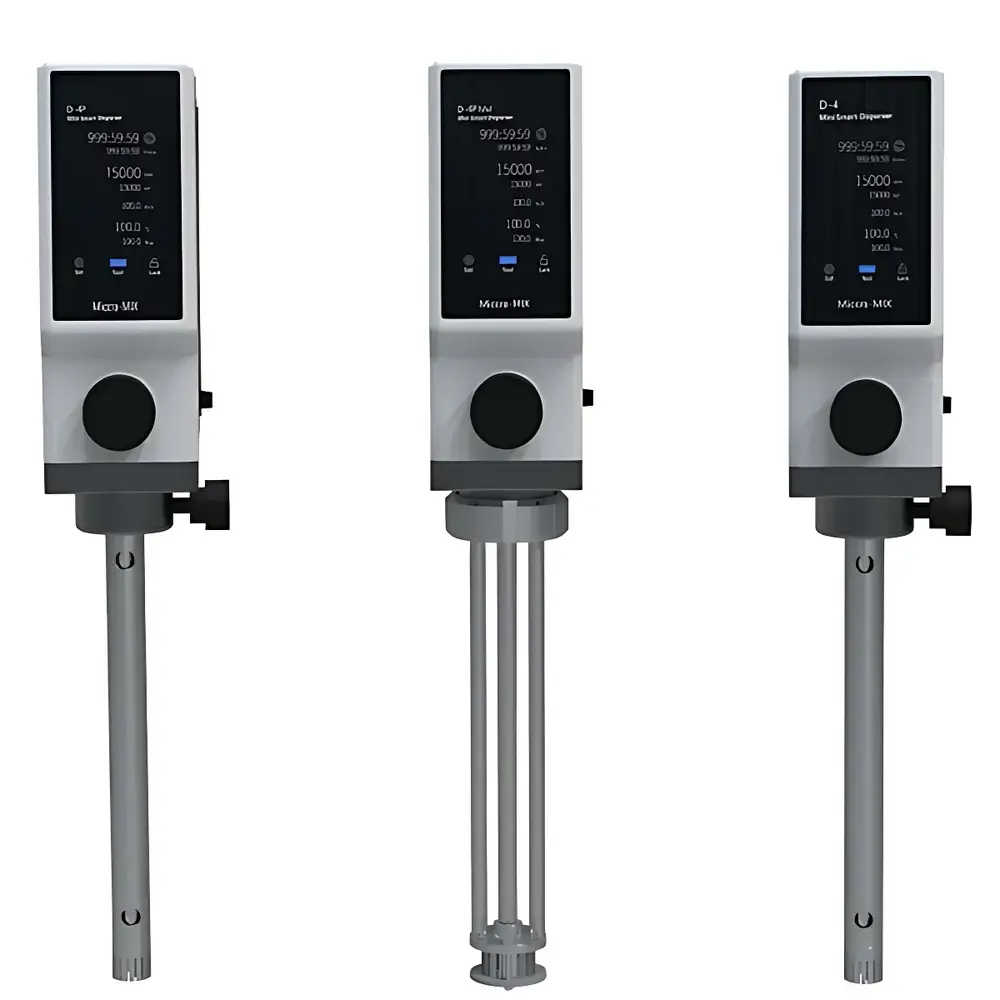
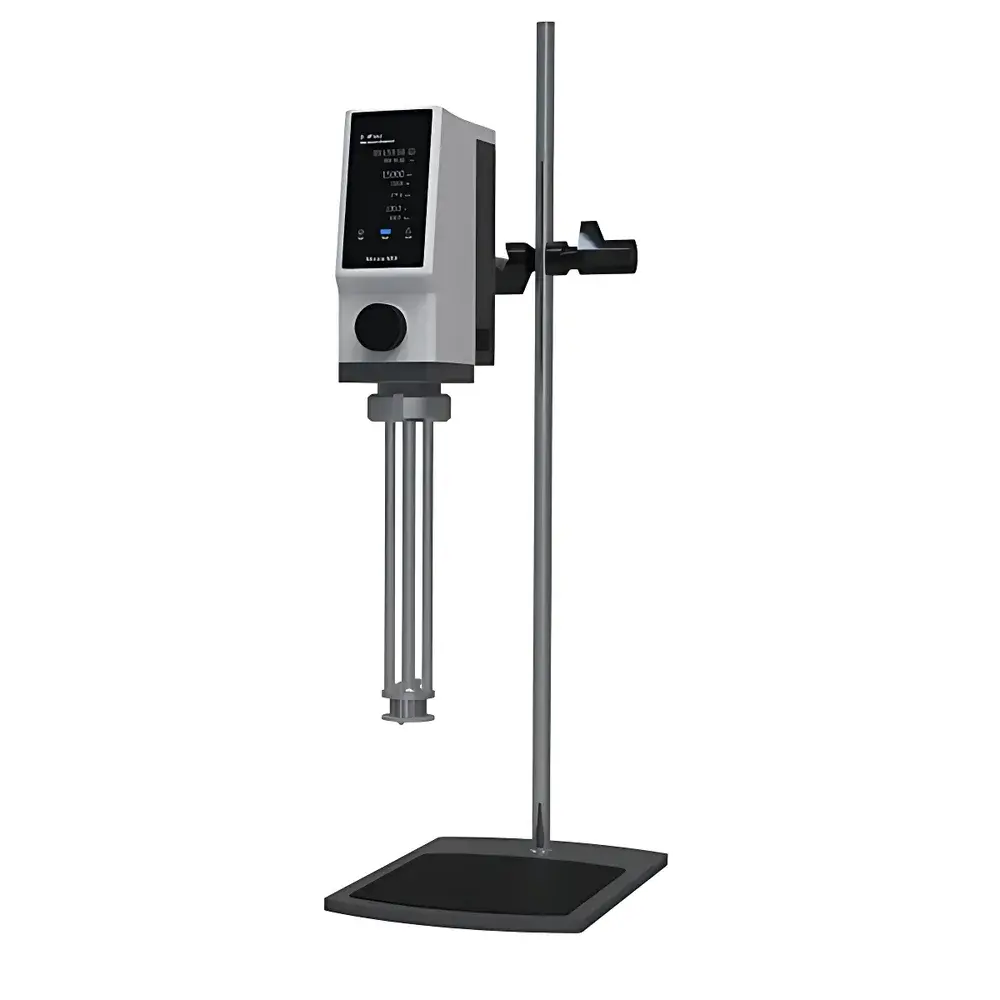
MICCRA Smart Series D-4 Advanced Digital Dispersion Homogenizer
| Brand | MICCRA |
|---|---|
| Origin | Germany |
| Model | D-4 / D-4P / D-4P Mul |
| Type | Probe-type Rotational Homogenizer |
| Dimensions (W×D×H) | 80 × 175 × 230 mm |
| Weight | 3 kg |
| Max. Sample Volume (H₂O) | 2 L (D-4), 5 L (D-4P & D-4P Mul) |
| Max. Viscosity | 8,000 mPa·s |
| Motor | Brushless DC |
| Input/Output Power | 450 / 360 W |
| Speed Range | 3,000–25,000 rpm (D-4), 1,500–15,000 rpm (D-4P/D-4P Mul) |
| Speed Setting Resolution | ±100 rpm |
| Timing Range | 0–999 h 59 min 59 sec |
| Programmable Steps | 6-segment (speed + time per step) |
| Temperature Monitoring | Yes (external probe optional), ±0.5 °C accuracy |
| Screen | 3.5″ TFT capacitive touchscreen |
| IP Rating | IP42 |
| Power Supply | 230 V AC, 50/60 Hz |
| Continuous Duty Cycle | 100% |
| Safety Features | Overload & thermal protection, soft start/stop, screen lock, max. temperature cutoff |
| Connectivity | Integrated Wi-Fi for remote monitoring and control via mobile device |
Overview
The MICCRA Smart Series D-4 Advanced Digital Dispersion Homogenizer is an engineered solution for high-shear mixing, emulsification, cell disruption, and particle size reduction in research and quality control laboratories. Based on proven rotor-stator probe technology—where mechanical energy is transferred via high-speed rotation of a precisely balanced shaft and interchangeable dispersing heads—the D-4 delivers reproducible shear stress profiles across a wide range of viscosities and sample volumes. Designed and assembled in Germany, the system adheres to stringent DIN EN 61000 electromagnetic compatibility standards and conforms to IEC 61010-1 safety requirements for laboratory electrical equipment. Its brushless DC motor ensures consistent torque delivery without carbon brush wear, supporting uninterrupted operation at rated load—critical for extended batch processing or kinetic studies requiring temporal precision.
Key Features
- 3.5″ capacitive TFT touchscreen interface with glove-compatible responsiveness, enabling intuitive parameter entry and real-time status visualization.
- Six-step programmable protocol editor: independently define speed, duration, and temperature threshold per segment—ideal for multi-phase dispersion protocols (e.g., gradual viscosity ramping or staged homogenization).
- Integrated Wi-Fi module compliant with IEEE 802.11 b/g/n standards, allowing secure remote access via iOS/Android applications for live parameter adjustment, session logging, and alarm notification.
- PID-controlled speed regulation with ±100 rpm setpoint accuracy and soft-start/soft-stop functionality to minimize sample splashing, probe vibration, and mechanical shock during acceleration/deceleration.
- Real-time temperature monitoring (with optional Pt100 probe) and configurable upper-limit cutoff—supporting thermal-sensitive applications such as protein extraction or polymer dispersion where exothermic shear must be actively managed.
- IP42-rated enclosure provides protection against solid objects >1 mm and vertically falling water droplets—suitable for standard lab bench environments with routine cleaning protocols.
- Modular probe compatibility: accepts standardized MICCRA dispersing heads (e.g., S-type, X-type, and high-efficiency Y-type) with stainless steel 316L wetted parts certified to ISO 8502-3 for corrosion resistance.
Sample Compatibility & Compliance
The D-4 series accommodates aqueous, organic, and semi-viscous media—including suspensions, colloids, nanoemulsions, and biological lysates—within its validated 2–5 L working volume range (dependent on model and head geometry). All models meet EU Machinery Directive 2006/42/EC and carry CE marking. For regulated environments, the system supports audit-ready documentation workflows when paired with optional GLP-compliant software modules (e.g., electronic logbook export, user-access-level management, and timestamped event history). While not intrinsically rated for ATEX zones, its design complies with ISO 22196 for antimicrobial surface testing when used with appropriate sterilizable probes.
Software & Data Management
The embedded firmware logs all operational events—including start/stop timestamps, speed deviations, temperature excursions, and error codes—with local storage retained for ≥10,000 cycles. Data export is supported via USB-C or Wi-Fi to CSV or XML formats compatible with LIMS integration (e.g., LabWare, STARLIMS). Optional MICCRA LabControl Suite enables automated report generation aligned with ISO/IEC 17025 clause 7.7 (result reporting) and FDA 21 CFR Part 11 compliance through digital signature support, audit trail activation, and role-based user authentication.
Applications
- Preparation of stable nanosuspensions for pharmaceutical formulation development (USP & Ph. Eur. compliant particle size distribution validation).
- Routine QC homogenization of food emulsions (e.g., mayonnaise, dairy analogs) per ISO 660 and AOAC 995.12 methodologies.
- Cell lysis and organelle isolation in molecular biology workflows, including RNP complex preservation under controlled thermal conditions.
- Dispersion of carbon nanotubes, graphene oxide, or metal oxides into polymer matrices for advanced materials characterization (ASTM D792, ISO 1133).
- Viscosity-dependent process optimization in cosmetic emulsion manufacturing, where shear history directly impacts final texture and stability.
FAQ
Is the D-4 suitable for sterile applications?
Yes—when equipped with autoclavable dispersing heads (121 °C, 20 min, Class B cycle) and operated in ISO Class 5–7 environments with validated cleaning procedures.
Can the system interface with PLC-based lab automation networks?
Native Modbus TCP support is available via optional Ethernet gateway module (order code: D-4-ETH-GW), enabling integration into SCADA or MES platforms.
What is the recalibration interval recommendation?
MICCRA recommends annual verification of speed accuracy and temperature sensor drift using NIST-traceable reference instruments; full calibration is performed at authorized service centers per ISO/IEC 17025.
Does the Wi-Fi module support enterprise-grade security protocols?
Yes—it supports WPA2-Enterprise with 802.1X authentication and TLS 1.2 encrypted command transmission.
Are spare parts and service manuals available internationally?
All critical spares (rotor-stator sets, drive shafts, touchscreen assemblies) are stocked in regional hubs across EMEA, APAC, and North America, with technical documentation accessible via MICCRA’s secure customer portal.



