
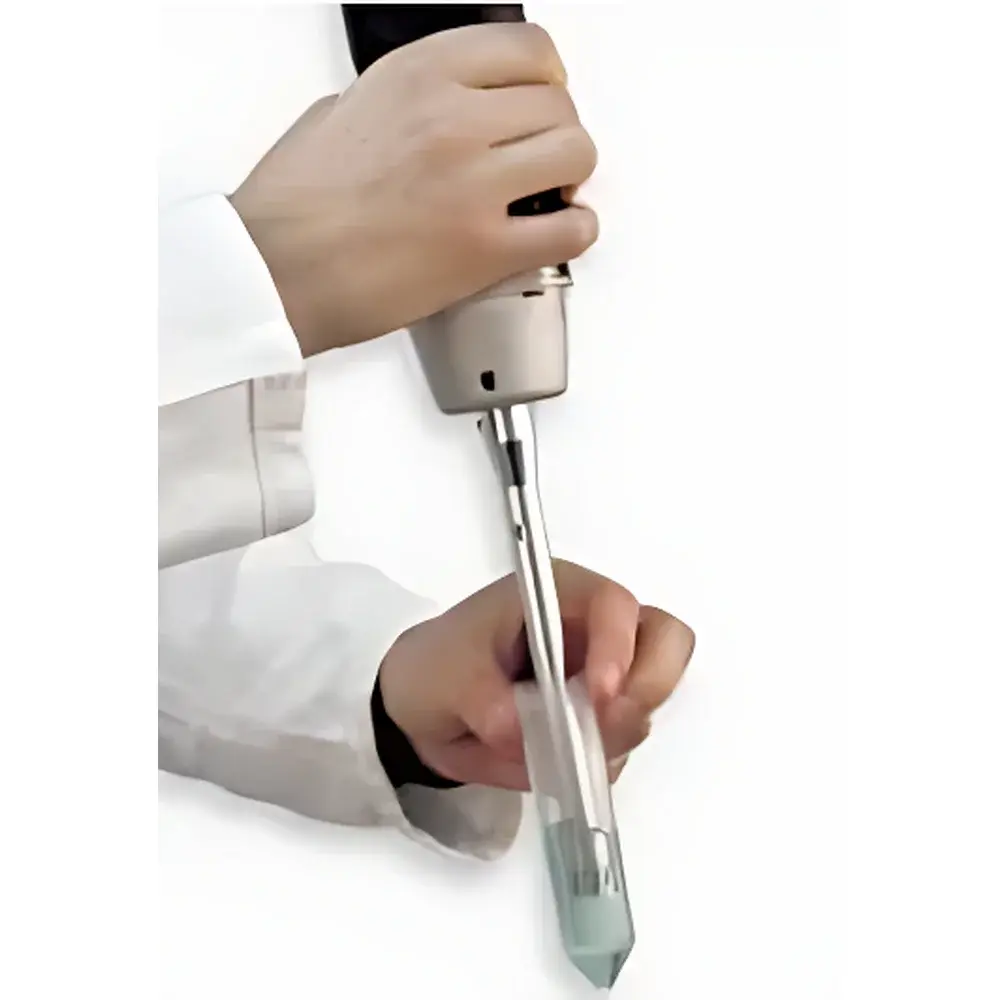
MICCRA Vario High-Performance Dispersing Homogenizer Rotor-Stator Assembly DS-20 Series
| Brand | MICCRA |
|---|---|
| Origin | Germany |
| Model | DS-20 (Stator Outer Diameter: 20 mm) |
| Rotor Outer Diameter | 15 mm |
| Maximum Tip Speed | 30.6 m/s |
| Probe Length | 250 mm |
| Minimum Immersion Depth | 200 mm / 40 mm (depending on configuration) |
| Recommended Sample Volume (Water) | 20–5,000 mL |
| Rotor-Stator Configuration | Shear-Mixing, Emulsification, or Multi-Function |
| Stator Types | Coarse, Fine, Fine-Pin, and Micro-Structured |
| Rotor Types | Shear-Mixing, Emulsification, or Dual-Function |
| Compatibility | Paste, Fibrous, and Liquid Matrices |
| Modular Quick-Change System | Yes |
Overview
The MICCRA Vario DS-20 Series is a modular, high-shear rotor-stator homogenizer probe assembly engineered for precision dispersion, emulsification, and cell disruption in laboratory and pilot-scale applications. Based on Couette flow and controlled turbulent shear principles, the system delivers reproducible mechanical energy input across a broad viscosity and particulate range—from low-viscosity aqueous solutions to highly structured pastes and fibrous suspensions. Designed and manufactured in Germany, the DS-20 platform integrates a standardized 20 mm stator outer diameter with interchangeable rotor geometries and stator configurations—including coarse, fine, fine-pin, and micro-structured variants—enabling method transfer across sample classes without hardware replacement. Its robust stainless-steel construction (AISI 316L), precision-balanced rotors, and optimized hydrodynamic geometry ensure minimal heat generation and high process consistency under continuous operation.
Key Features
- Modular quick-change system enabling tool-free rotor and stator exchange in under 15 seconds—reducing cross-contamination risk and downtime between experiments.
- Four standardized stator types (coarse, fine, fine-pin, micro-structured) paired with three rotor variants (shear-mixing, emulsification, dual-function), supporting method optimization for diverse matrix rheologies.
- Precision-engineered rotor-stator gap control (<150 µm nominal) ensures consistent shear rate distribution and minimizes dead zones during high-speed operation.
- Maximum tip speed of 30.6 m/s at rated motor RPM, delivering effective particle size reduction and droplet breakup down to sub-micron levels in emulsions and colloidal dispersions.
- Probe length of 250 mm with dual immersion depth options (200 mm standard / 40 mm shallow), accommodating both tall narrow vessels and shallow wide containers while maintaining laminar inflow conditions.
- Validated compatibility with viscosities up to 10,000 mPa·s (measured with standard calibration fluids), including fiber-reinforced gels, plant tissue homogenates, and polymer melts.
Sample Compatibility & Compliance
The DS-20 series demonstrates validated performance across heterogeneous biological, pharmaceutical, and industrial matrices: fibrous plant tissues (e.g., leaf homogenization for RNA extraction), viscous pastes (e.g., battery electrode slurries, cosmetic bases), and thermolabile emulsions (e.g., nanoemulsions for oral delivery). All wetted components comply with ISO 8573-1 Class 4 for particulate cleanliness and meet EU Directive 2006/42/EC for machinery safety. Materials conform to FDA 21 CFR §177.2600 for repeated food-contact use and USP for pharmaceutical-grade polymers where applicable. The design supports GLP-compliant workflows through traceable configuration logging when integrated with MICCRA’s certified digital controllers (optional).
Software & Data Management
While the DS-20 probe itself is mechanically driven, it is fully compatible with MICCRA’s D-2000 and D-4000 series digital drive units—equipped with embedded firmware supporting audit-trail-enabled operation logs, torque and RPM profiling, and programmable ramp sequences. Data export adheres to ASTM E2500-13 guidelines for instrument qualification, with CSV and PDF report generation compliant with 21 CFR Part 11 requirements when used with validated electronic signature modules. Firmware updates are delivered via secure HTTPS endpoint with SHA-256 integrity verification.
Applications
- Pre-analytical sample preparation for LC-MS and ICP-MS: homogenization of solid tissues, soils, and composite materials with minimal analyte degradation.
- Formulation development of topical pharmaceuticals and cosmetics: stable oil-in-water and water-in-oil emulsions with narrow polydispersity (PDI <0.2 measured by DLS).
- R&D of advanced materials: dispersion of carbon nanotubes, graphene oxide, and ceramic nanoparticles into polymer matrices.
- Microbial lysis and subcellular fractionation: reproducible membrane disruption in Gram-negative bacteria and yeast without sonication-induced oxidation artifacts.
- Quality control of industrial suspensions: batch-to-batch verification of particle size distribution in pigment concentrates and agrochemical formulations.
FAQ
What is the recommended maximum operating time per cycle for continuous use?
For optimal thermal management and bearing longevity, continuous operation is rated for ≤90 seconds per cycle at full speed, followed by ≥30 seconds of rest—validated per DIN EN 60034-1 thermal class F insulation standards.
Can the DS-20 be autoclaved?
Stainless-steel probe bodies (AISI 316L) withstand standard gravity autoclaving (121°C, 2 bar, 20 min); however, stators with polymer sealing elements require separate validation per ISO 17665-1 and are not included in standard sterilization protocols.
Is rotor balancing certification provided with each unit?
Yes—each DS-20 rotor undergoes dynamic balancing to G2.5 grade (ISO 1940-1) and ships with a traceable certificate of balance, including residual unbalance values and correction plane coordinates.
How does the DS-20 compare to ultrasonic homogenizers for nanoparticle dispersion?
Unlike cavitation-dependent ultrasonics, the DS-20 achieves dispersion via controlled hydrodynamic shear—offering superior scalability, lower thermal load, and no free-radical generation, making it preferable for oxidation-sensitive actives and large-volume processing.
Are spare parts and calibration services available outside Germany?
MICCRA-certified service centers operate in the US, UK, France, Japan, and Singapore; all stators and rotors are serialized and supported by lifetime calibration traceability to PTB (Physikalisch-Technische Bundesanstalt) reference standards.



