
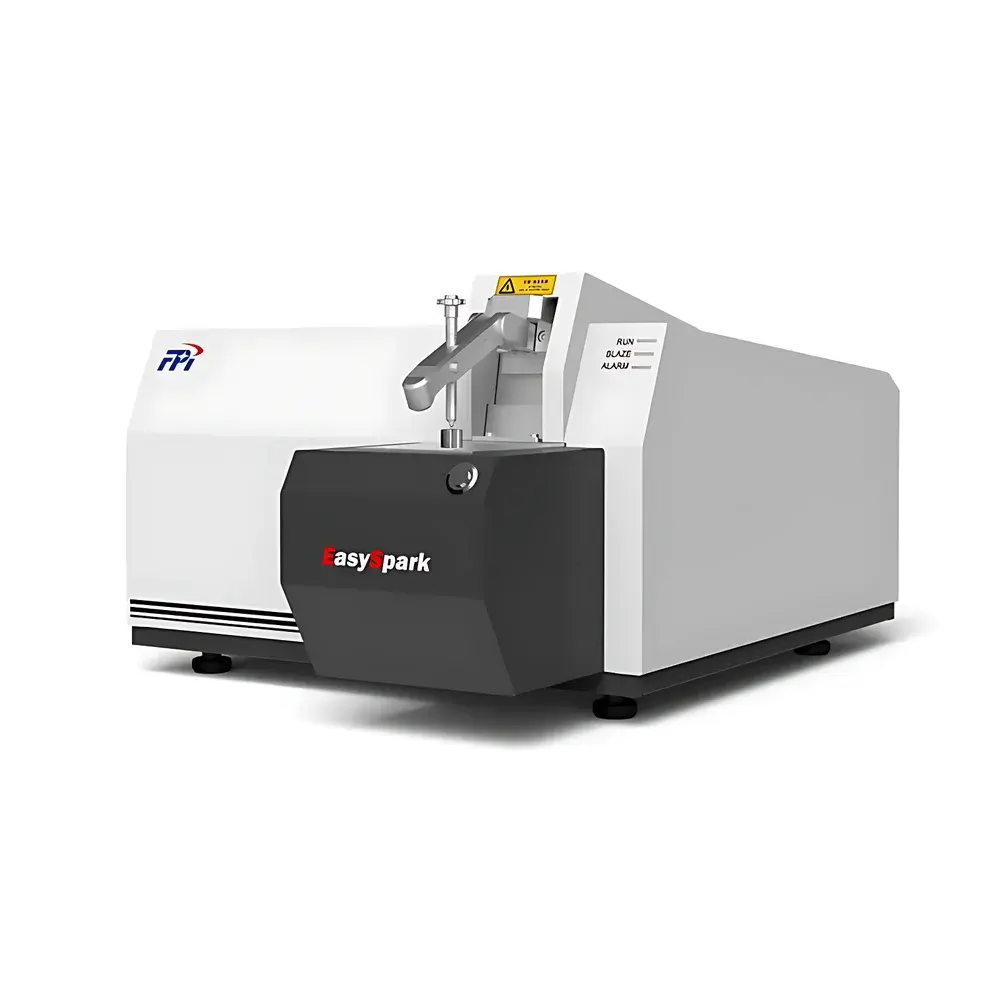
Micheem M4000 CCD Full-Spectrum Spark Optical Emission Spectrometer
| Brand | Micheem / BEIJING MICHEM TECHNOLOGY LTD. |
|---|---|
| Origin | Beijing, China |
| Manufacturer Type | Authorized Distributor |
| Origin Category | Domestic (China) |
| Model | M4000 |
| Pricing | Upon Request |
Overview
The Micheem M4000 is a high-performance full-spectrum spark optical emission spectrometer (OES) engineered for precise, rapid elemental analysis of metallic alloys in industrial and research environments. Based on the principle of spark-induced plasma excitation and wavelength-dispersive detection via charge-coupled device (CCD) array sensors, the instrument captures the complete spectral output (from UV to visible range) generated when a high-energy spark vaporizes and excites surface atoms of a conductive sample. This enables simultaneous multi-element quantification with high spectral resolution and signal-to-noise ratio. Designed for foundry floor, metallurgical laboratory, and R&D facility deployment, the M4000 delivers robust analytical performance under variable ambient conditions—without requiring vacuum pumping systems—thanks to its proprietary sealed argon circulation chamber technology, which maintains an ultra-low partial pressure equivalent to ≤10⁻³ Pa in the UV-optical path.
Key Features
- Patented sealed argon circulation system: Eliminates need for continuous high-flow argon purge; reduces consumable gas usage by up to 70% versus conventional spark OES systems while sustaining optimal UV transmission (175–200 nm) for accurate C, P, S, N, and B determination.
- Full-spectrum CCD detection architecture: Equipped with multiple high-quantum-efficiency CCD detectors arranged along a Paschen–Runge optical mount, enabling real-time acquisition across the entire spectral range without mechanical scanning.
- Digital programmable pulse spark source: Fully solid-state, maintenance-free ignition system with adjustable current, frequency, and pre-spark delay parameters—optimized for reproducible excitation of Fe-, Al-, Cu-, Ni-, Zn-, and Mg-based matrices.
- Open-type low-volume spark stand: Minimized internal cavity volume reduces argon consumption per analysis; integrated four-channel argon flush effectively evacuates oxide particulates and prevents electrode contamination.
- Thermostatically stabilized optical chamber: Maintained at constant temperature (±0.1 °C) via active cooling/heating control, ensuring long-term wavelength calibration stability and minimizing thermal drift.
- Real-time intelligent spectral drift correction: Continuously monitors reference line intensities during measurement sequences and applies dynamic pixel-level wavelength recalibration—reducing frequency of full standardization by ≥60% and extending calibration validity to ≥8 hours under routine operation.
Sample Compatibility & Compliance
The M4000 supports direct analysis of solid, electrically conductive metal samples—including castings, ingots, rolled plates, machined parts, and wire rods—with diameters from 10 mm to 50 mm and thicknesses ≥3 mm. Optional custom fixtures accommodate irregular geometries (e.g., valves, turbine blades, fasteners). The system complies with ISO 11577:2020 (Metallic materials — Spark discharge atomic emission spectrometry), ASTM E415-22 (Standard Test Method for Analysis of Carbon and Low-Alloy Steel by Spark Atomic Emission Spectrometry), and meets essential requirements for GLP-compliant laboratories. Data integrity features include audit-trail-enabled user access logs, electronic signatures, and configurable retention policies aligned with FDA 21 CFR Part 11 readiness.
Software & Data Management
Controlled by MichSoft™ v5.2 analytical software, the M4000 provides intuitive workflow-driven operation—from method setup and calibration management to report generation and statistical process control (SPC) charting. All spectra are stored in vendor-neutral HDF5 format with embedded metadata (operator ID, timestamp, instrument configuration, environmental conditions). Software supports automated QC checks against control charts, outlier detection using Grubbs’ test, and export to LIMS via ASTM E1384-compliant XML or CSV interfaces. Calibration models are traceable to NIST SRM-certified reference materials (e.g., NIST 1250a, 1251a, 1252a), and uncertainty budgets are calculated per ISO/IEC 17025:2017 Annex A.3 guidelines.
Applications
- Primary and secondary metallurgy: Real-time melt composition monitoring for carbon steels, stainless grades, aluminum alloys (e.g., 6061, 7075), copper-nickel bronzes, and titanium alloys.
- Foundry quality assurance: Rapid verification of alloy grade conformity (e.g., ASTM A48, EN 1559) and rejection of off-spec heats prior to casting.
- Aerospace & power generation: Trace element screening (Sn, As, Pb, Bi) in superalloys and heat-resistant steels per AMS 2277 and ASTM E353.
- Automotive component manufacturing: In-line verification of plating thickness and substrate composition for brake calipers, engine blocks, and transmission housings.
- Research & development: High-resolution spectral library building for novel alloy design, phase transformation studies, and inclusion analysis correlation.
FAQ
What base materials can the M4000 analyze?
The M4000 N-type model covers 175–520 nm and supports Fe, Al, Cu, Ni, Co, Ti, and Zn-based alloys. The S-type (200–520 nm) is optimized for non-ferrous applications including Al, Cu, and Mg alloys.
Is vacuum pumping required for UV element analysis?
No. The sealed argon circulation system maintains UV-transmissive conditions equivalent to 10⁻³ Pa vacuum, eliminating mechanical vacuum pumps and associated maintenance.
How often does the instrument require recalibration?
With real-time drift correction enabled, full standardization intervals extend to 8+ hours under stable operating conditions; daily drift checks using certified control samples are recommended.
Can the M4000 integrate with existing factory MES or LIMS?
Yes—via configurable OPC UA server, ASTM E1384 XML export, or direct database write-through to SQL-based enterprise systems.
What safety certifications does the M4000 hold?
Complies with IEC 61000-6-2 (EMC immunity), IEC 61000-6-4 (EMC emissions), and IEC 61010-1 (safety requirements for electrical equipment for measurement).




