
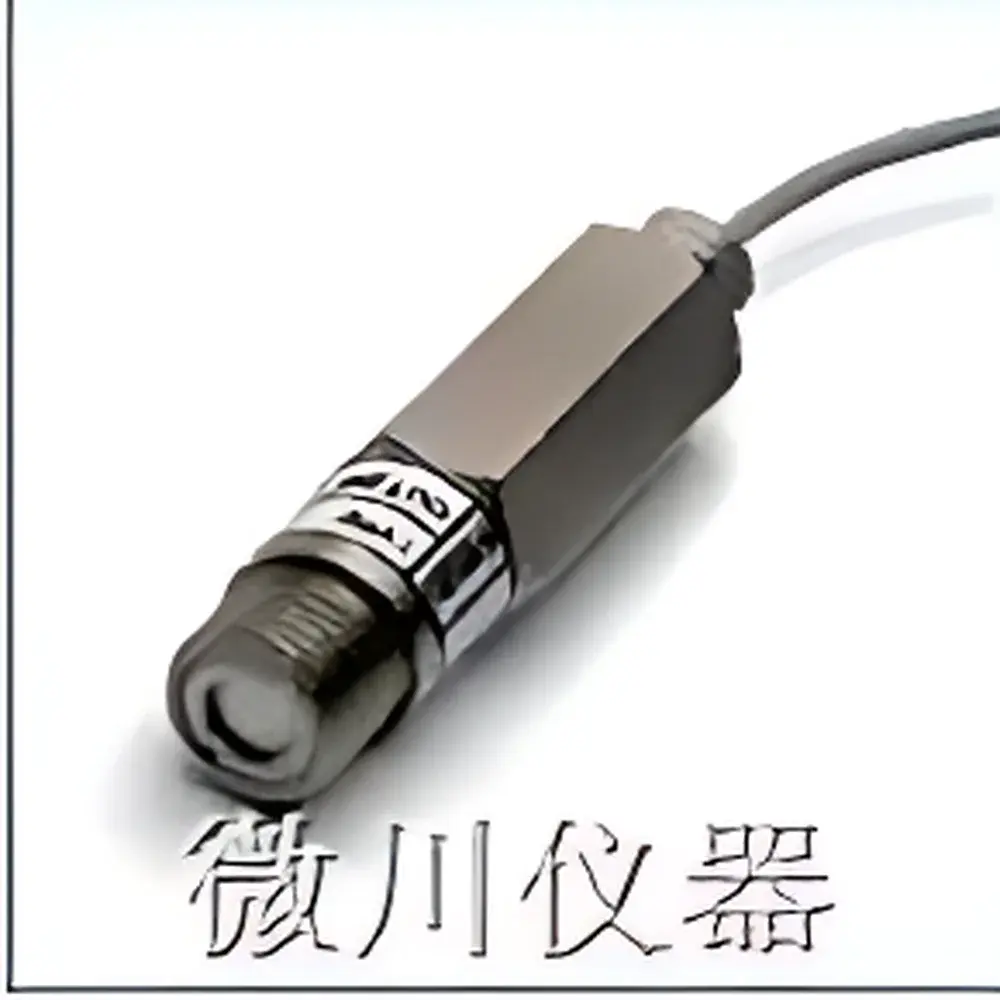
Michell Instruments SF52 Dew Point Transmitter
| Brand | Michell |
|---|---|
| Origin | United Kingdom |
| Model | SF52 |
| Product Type | Online Dew Point Transmitter |
| Measurement Principle | Chilled Mirror–Compensated Semiconductor Sensor |
| Operating Temperature Range | -40 to +60 °C |
| Accuracy (Dew Point) | < ±2 °C |
| Repeatability | < ±0.5 °C |
| Stability | < 1 °C/year |
| Response Time (T90) | < 10 s |
| Output Signals | 4–20 mA, 0–1 V, 0–5 V, or 0–10 V |
| Supply Voltage | 8–30 V DC (14–30 V DC required for 0–10 V output) |
| Power Consumption | 9 mA + load current |
| Supply Voltage Effect | ±0.005 %RH/V |
| Dew Point Range | -40 to +60 °C |
| Absolute Humidity Range | 0 to 200 g/m³ |
| Accuracy (Absolute Humidity) | 0.4 to 3 g/m³ (dependent on measured value) |
| Pressure Rating | Up to 20 bar (gauge) |
| Filter Type | Buffered flow-compensated sintered stainless-steel filter |
Overview
The Michell Instruments SF52 Dew Point Transmitter is an industrial-grade online dew point measurement solution engineered for continuous, high-stability monitoring in compressed air, natural gas, petrochemical, and semiconductor process environments. Unlike conventional capacitive or polymer-based sensors, the SF52 employs a temperature-compensated metal-oxide semiconductor sensing element calibrated against chilled-mirror reference methodology—ensuring traceable accuracy across its full -40 to +60 °C dew point range. Its robust 316 stainless-steel housing and integral pressure-rated design (up to 20 bar) enable direct in-line installation without external sample conditioning systems, minimizing lag time and eliminating condensation-related drift. The transmitter operates under ISO 8573-1 Class 2–4 air quality compliance requirements and supports integration into plant-wide SCADA and DCS architectures via standard analog outputs.
Key Features
- Chilled-mirror referenced semiconductor sensor with integrated temperature compensation for long-term stability (<1 °C/year drift)
- True online capability: rated for direct insertion into pressurized lines up to 20 bar (gauge), eliminating need for external sampling loops or pressure regulators
- Buffered sintered stainless-steel filter assembly minimizes sensitivity to flow rate variations—critical for unregulated or pulsating gas streams
- Multi-output flexibility: selectable 4–20 mA, 0–1 V, 0–5 V, or 0–10 V analog signals; configurable via DIP switches or optional handheld configurator
- Wide operating ambient temperature range (-40 to +60 °C) with internal thermal management to prevent cold surface condensation during low-dew-point measurements
- Low power consumption (9 mA base + load current) and wide supply voltage tolerance (8–30 V DC) simplify integration into existing control cabinets
Sample Compatibility & Compliance
The SF52 is validated for use with non-corrosive, non-particulate-laden gases including compressed air, nitrogen, argon, natural gas (dry), and instrument air per ISO 8573-1:2010 Annex A. It is not recommended for use with aggressive gases (e.g., H₂S, Cl₂, NH₃), solvent vapors, or aerosol-laden streams without upstream filtration and conditioning. The device conforms to EN 61326-1 (EMC for industrial environments), EN 61000-6-2/6-4, and carries CE marking for EU market deployment. While not intrinsically safe certified, it may be installed in Zone 2 hazardous areas when housed in appropriate Ex d or Ex e enclosures per IEC 60079-0 and IEC 60079-1. Calibration traceability follows UKAS-accredited procedures aligned with ISO/IEC 17025.
Software & Data Management
The SF52 operates as a standalone analog transmitter and does not require embedded firmware updates or host software for basic operation. Configuration—including output scaling, damping, and unit selection (°C dp, g/m³, %RH)—is performed via front-panel DIP switches or using the optional Michell Handheld Configurator (HHC-2). All configuration parameters are retained in non-volatile memory. For system-level data logging and alarm management, the 4–20 mA output is compatible with third-party PLCs, DCS historians, and FDA 21 CFR Part 11-compliant data acquisition platforms when paired with audit-trail-enabled controllers. Optional Modbus RTU interface modules (sold separately) enable digital communication for remote diagnostics and multi-parameter trending.
Applications
- Compressed air drying validation in pharmaceutical manufacturing (aligned with ISO 8573-1 Class 2–4 and EU GMP Annex 1 requirements)
- Moisture monitoring in natural gas transmission pipelines prior to LNG liquefaction or custody transfer
- Inert gas blanketing control in chemical reactors and storage tanks
- Process gas drying verification in semiconductor fab tool purge lines (N₂, Ar)
- Quality assurance of desiccant and membrane dryers in industrial facilities
- Environmental chamber humidity profiling where dew point stability exceeds relative humidity repeatability
FAQ
Is the SF52 suitable for measuring dew point in natural gas containing hydrocarbons?
The SF52 is validated for dry natural gas (water-only measurement); presence of heavy hydrocarbons (> C₅) or liquid-phase condensables may coat the sensor surface and degrade accuracy. Use requires upstream coalescing filtration and hydrocarbon removal per AGA Report No. 10.
What calibration interval is recommended for GxP-regulated environments?
Michell recommends annual calibration against a NIST-traceable chilled mirror hygrometer; in critical pharmaceutical applications, semi-annual calibration with documented uncertainty budgets is common practice per ASTM E2654 and ISO/IEC 17025.
Can the SF52 output both dew point and relative humidity simultaneously?
No—the SF52 provides a single user-selected analog output (either dew point temperature or relative humidity). Dual-parameter output requires separate transmitters or a digital interface module with Modbus support.
Does the SF52 require zero or span gas for field calibration?
No—its semiconductor sensor is factory-calibrated and stabilized; field verification uses dry nitrogen or saturated salt solutions per ISO 4885; no gas standards or adjustment screws are required during routine operation.




