
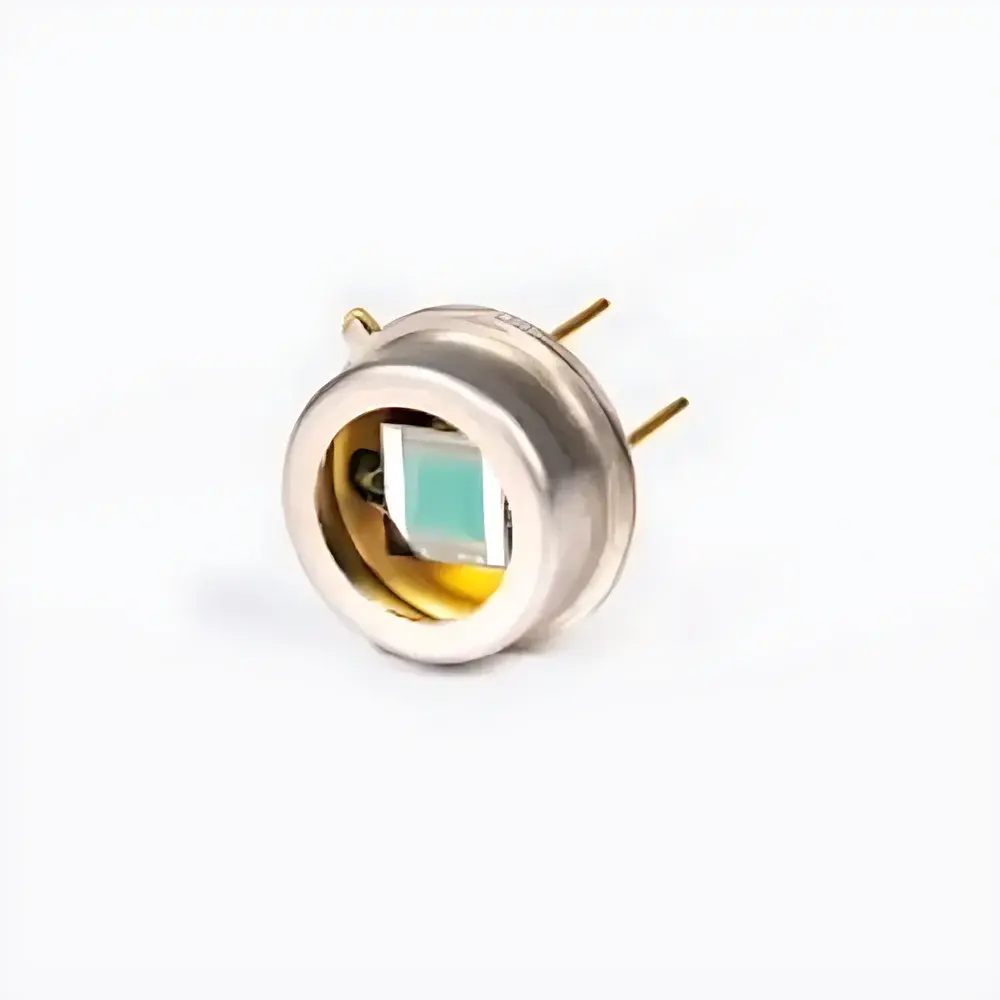
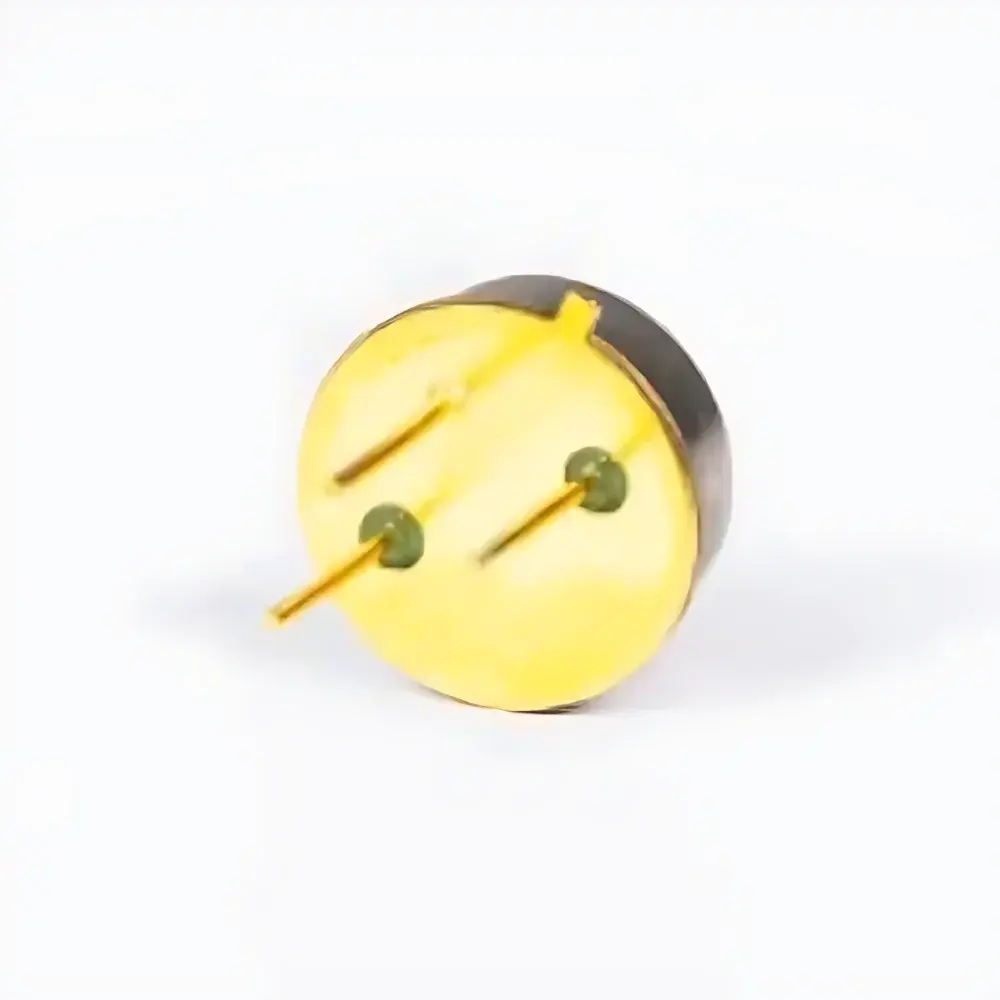
Micro-Hybrid JSIR350-4-AL-C-D5.8-0-0 MEMS Infrared Blackbody Source
| Brand | Micro-Hybrid |
|---|---|
| Origin | Germany |
| Model | JSIR350-4-AL-C-D5.8-0-0 |
| Spectral Range | 2–15 µm |
| Emitter Chip Size | 2.2 × 2.2 mm |
| Rated Power | 0.65 W |
| Membrane Temperature | 610 ± 30 °C (max. 850 °C) |
| Lifetime | >100,000 h |
| Recommended Drive Mode | Constant Power |
| Package | TO-39 Metal Can |
| Max. Housing Temperature | 185 °C |
| Illumination Type | External Illumination |
| Light Source Type | Infrared Blackbody Source |
Overview
The Micro-Hybrid JSIR350-4-AL-C-D5.8-0-0 is a surface-micromachined (MEMS) infrared blackbody source engineered for stable, repeatable thermal emission across the mid-wave to long-wave infrared (MWIR–LWIR) spectrum (2–15 µm). Unlike traditional filament-based or ceramic IR sources, this device employs a thermally isolated silicon microbridge structure with a high-emissivity thin-film resistor deposited on a suspended membrane. When driven at constant power, the membrane reaches a precisely controllable equilibrium temperature—610 ± 30 °C under nominal operation—with peak spectral radiance governed by Planck’s law. Its compact TO-39 hermetic metal package ensures mechanical robustness and thermal stability in laboratory, industrial, and field-deployable optical systems. Designed for integration into FTIR spectrometers, gas analyzers, calibration benches, and non-contact thermometry setups, the JSIR350-4-AL-C-D5.8-0-0 delivers high spatial coherence, low temporal drift (<0.5% RMS over 8 h), and negligible warm-up time (<200 ms to 95% of steady-state output).
Key Features
- MEMS-based microbridge architecture with integrated high-emissivity (ε > 0.95) resistive heater and thermal isolation
- Stable blackbody-like spectral radiance profile compliant with Planckian distribution in 2–15 µm range
- Compact TO-39 metal-can package rated for continuous operation up to 185 °C housing temperature
- Low power consumption (0.65 W nominal) and high electro-optical efficiency (>15% radiant output in LWIR)
- Extended operational lifetime exceeding 100,000 hours under recommended constant-power drive conditions
- Minimal thermal mass enables rapid thermal response and compatibility with pulsed or modulated drive schemes
- No moving parts, no outgassing, and no spectral degradation over time—suitable for vacuum and cleanroom environments
Sample Compatibility & Compliance
The JSIR350-4-AL-C-D5.8-0-0 is compatible with standard optical breadboards, collimation mounts, and fiber-coupled interfaces via its 5.8 mm aperture (D5.8 designation). Its external illumination geometry supports free-space beam delivery to spectrometers, interferometers, and detector test stations. The device complies with RoHS 2015/863/EU and REACH (EC) No. 1907/2006 directives. While not certified to IEC 61000-6-3 (EMC) or ISO 17025 as a standalone instrument, it meets functional requirements for use in ISO/IEC 17025-accredited calibration labs when integrated into validated optical measurement chains. Its stable output enables traceable radiometric calibration per ASTM E1256-22 (Standard Test Methods for Radiation Thermometers) and supports NIST-traceable reference source protocols.
Software & Data Management
As a passive thermal emitter, the JSIR350-4-AL-C-D5.8-0-0 requires no embedded firmware or digital interface. It operates with standard DC or low-frequency AC constant-power drivers (e.g., Keithley 2450, Yokogawa GS200). For system-level integration, users typically implement closed-loop temperature monitoring using an external thermopile or RTD sensor mounted near the TO-39 base, feeding data into LabVIEW, Python (PyVISA), or MATLAB control environments. All calibration curves—including spectral radiance vs. drive power, membrane temperature vs. housing temperature, and aging-induced drift profiles—are provided in manufacturer-supplied technical documentation (Rev. D, 2023) and are compatible with radiometric modeling tools such as MODTRAN and SMARTS. Audit trails for calibration events may be maintained in accordance with FDA 21 CFR Part 11 when deployed in GxP-compliant analytical workflows.
Applications
- Reference source for radiometric calibration of uncooled microbolometer arrays and HgCdTe detectors
- Benchtop validation of Fourier-transform infrared (FTIR) spectrometer wavelength accuracy and signal-to-noise performance
- In-situ emissivity characterization of coatings and thin films in vacuum deposition chambers
- Gas sensing system development for CO₂, CH₄, N₂O, and VOC detection in the 3–5 µm and 8–12 µm atmospheric windows
- Thermal imaging system MTF and NETD testing under controlled background irradiance conditions
- Education and research in infrared physics, radiative heat transfer, and MEMS thermal design
FAQ
What drive method is recommended—and why?
Constant-power driving is recommended to maintain stable membrane temperature and minimize spectral drift; voltage or current drive introduces sensitivity to resistance variation with temperature.
Can the source be operated in vacuum?
Yes—the TO-39 metal-glass hermetic seal and absence of organic binders or epoxies make it suitable for UHV environments (<10⁻⁶ mbar) without outgassing concerns.
Is spectral calibration data included with the unit?
Yes—each unit ships with a factory-measured spectral radiance curve (at 610 °C, 0.65 W), uncertainty budget, and temperature coefficient matrix.
How does ambient temperature affect output stability?
Housing temperature must remain ≤185 °C; active heatsinking or PID-controlled cold plates are advised when ambient exceeds 50 °C to prevent thermal runaway.
What is the maximum permissible modulation frequency?
Due to thermal time constant (~150 ms), square-wave modulation above 3 Hz results in <10% amplitude attenuation; sinusoidal drive is effective up to ~10 Hz with phase lag compensation.



