
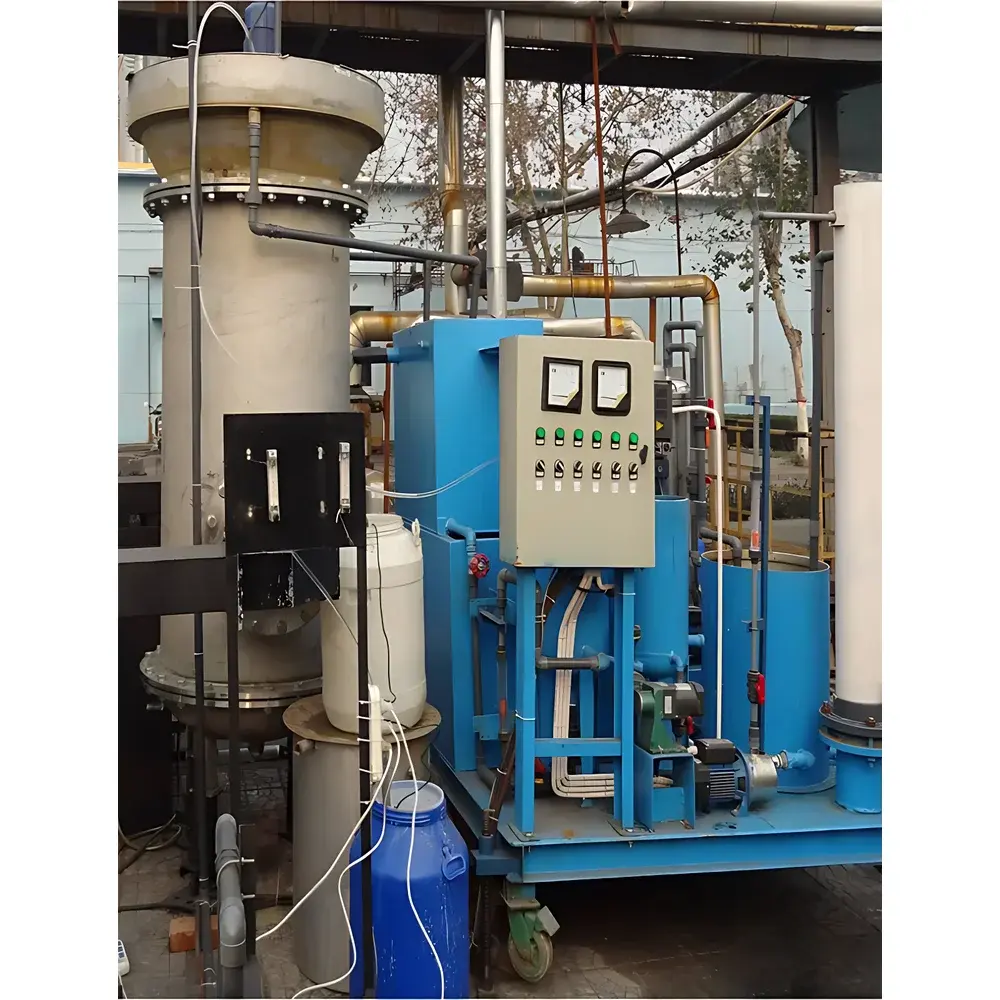
Micro-Tac Catalytic Oxidation System
| Brand | New Biolink |
|---|---|
| Origin | Beijing, China |
| Manufacturer Type | Authorized Distributor |
| Product Origin | Domestic (China) |
| Model | Micro-Tac |
| Sample Processing | Wastewater Treatment |
| Core Technology | Integrated Fenton-based Advanced Oxidation Process (AOP) with Microwave Acceleration and Rare-Earth Metal Catalyst |
Overview
The Micro-Tac Catalytic Oxidation System is an engineered advanced oxidation platform designed for laboratory-scale and pilot-scale treatment of recalcitrant industrial wastewater. It operates on a synergistic physicochemical principle combining modified Fenton chemistry, microwave-assisted reaction acceleration, and heterogeneous catalysis using rare-earth metal–doped catalysts. Unlike conventional Fenton processes—which rely solely on Fe²⁺/H₂O₂ under acidic conditions—the Micro-Tac system achieves significantly enhanced hydroxyl radical (•OH) generation kinetics and quantum yield through controlled microwave irradiation (2.45 GHz, non-ionizing) and stabilized catalytic surfaces. This enables rapid oxidative cleavage of aromatic rings, C–Cl bond scission, and depolymerization of refractory macromolecules—critical for pretreatment or polishing of pharmaceutical intermediates, dye synthesis effluents, coking plant wastewater, and other high-COD, low-biodegradability streams.
Key Features
- Triple-mechanism oxidation architecture: integrated Fenton reagent delivery, pulsed microwave energy coupling (100–800 W adjustable), and fixed-bed rare-earth catalyst modules (Ce–La–Fe composite oxides)
- Automated pH and H₂O₂ dosing control with real-time redox potential (ORP) feedback loop to maintain optimal •OH generation window (pH 2.5–4.0)
- Compact benchtop footprint (600 × 500 × 750 mm) with corrosion-resistant 316L stainless steel reactor vessel and quartz microwave-transparent reaction chamber
- Thermal management system ensuring isothermal operation (< ±2 °C deviation) during extended cycles, critical for reproducible radical kinetics
- No sludge generation: catalytic regeneration cycle extends catalyst lifetime beyond 500 operational hours without performance decay
- Compliance-ready design: supports audit trails, parameter logging, and user-access levels per GLP/GMP-aligned workflows
Sample Compatibility & Compliance
The Micro-Tac system is validated for aqueous matrices containing phenolic compounds (e.g., phenol, cresols), nitroaromatics (e.g., nitrobenzene, dinitrotoluene), chlorinated organics (e.g., trichlorobenzene, chlorophenols), and high-molecular-weight synthetic dyes. It accommodates influent COD concentrations from 500 to 15,000 mg/L and handles suspended solids up to 100 mg/L without pre-filtration. All wetted components meet ASTM A240 and ISO 8502-3 standards. The system’s operational protocol aligns with EPA Method 415.3 (oxidizable organic carbon) and supports data integrity requirements under FDA 21 CFR Part 11 when paired with compliant software modules.
Software & Data Management
Equipped with embedded Linux-based controller running New Biolink’s Oxidation Control Suite (v3.2), the system records time-stamped parameters—including microwave power output, solution temperature, ORP, pH, H₂O₂ concentration, and cumulative energy input—at 1-second intervals. Export formats include CSV and PDF reports compliant with ISO/IEC 17025 documentation standards. Audit trail functionality logs all user actions (login/logout, parameter edits, start/stop commands) with digital signature verification. Remote monitoring via Ethernet or optional Wi-Fi module enables integration into centralized lab information management systems (LIMS).
Applications
- Pretreatment of biotoxic wastewater prior to biological treatment—enabling ring-opening of benzene derivatives and detoxification of nitro- and chloro-substituted aromatics
- Polishing step after activated sludge or MBR systems to meet stringent discharge limits (e.g., China’s GB 8978-1996 Class I, EU Industrial Emissions Directive Annex I)
- R&D support for catalyst screening, kinetic modeling of •OH-mediated degradation pathways, and optimization of H₂O₂ stoichiometry
- Validation studies for regulatory submissions requiring demonstration of abiotic degradation efficiency under defined AOP conditions
- Training platform for graduate-level environmental engineering courses on advanced oxidation process design and radical reaction mechanisms
FAQ
What types of wastewater are most suitable for Micro-Tac treatment?
Industrial effluents with persistent aromatic structures, halogenated organics, or conjugated double bonds—especially those exhibiting low BOD₅/COD ratios (<0.2) and resistance to conventional biological treatment.
Does the system require acidification or neutralization steps?
Yes—optimal Fenton-driven oxidation occurs at pH 2.5–4.0; integrated acid dosing (H₂SO₄) and post-treatment alkali addition (NaOH/Ca(OH)₂) modules are available as configurable options.
Can catalyst performance be monitored in real time?
Catalyst activity is inferred indirectly via ORP trends and H₂O₂ decomposition rate; periodic offline ICP-MS analysis of leached metals is recommended for long-term validation.
Is microwave exposure shielded to meet occupational safety standards?
The reactor chamber complies with IEC 61000-4-3 (EMC immunity) and EN 50147-1 (microwave leakage <1 mW/cm² at 5 cm distance), certified by SGS Beijing.
How is system calibration verified?
Calibration is performed using NIST-traceable ORP and pH reference solutions; H₂O₂ sensor validation follows AOAC 992.15 spectrophotometric methodology.



