
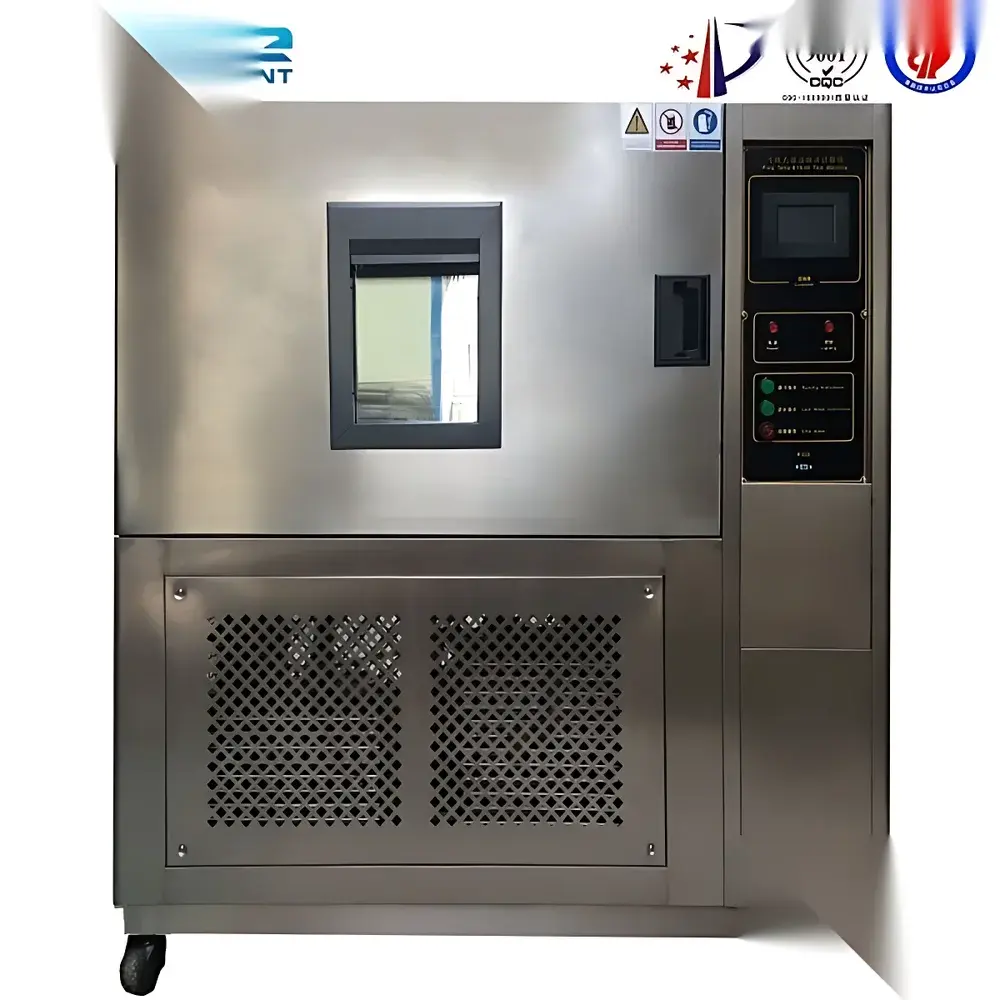
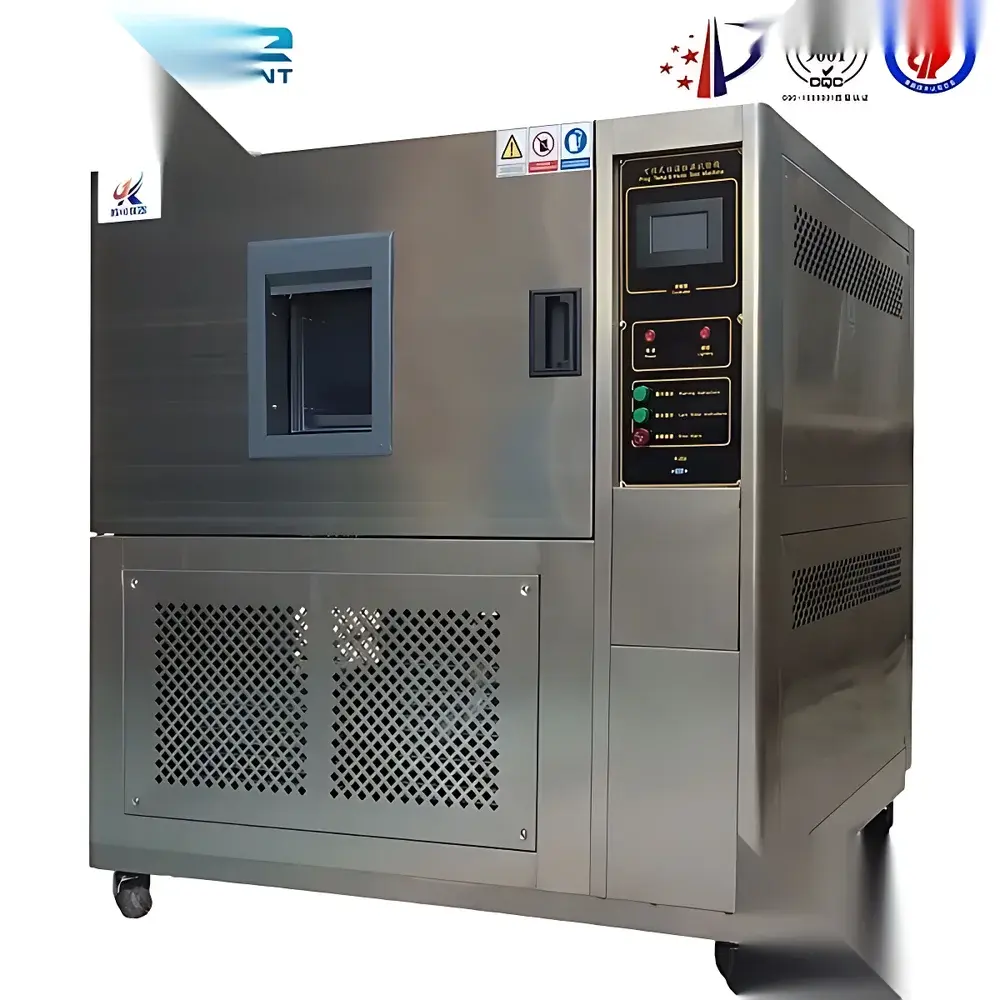
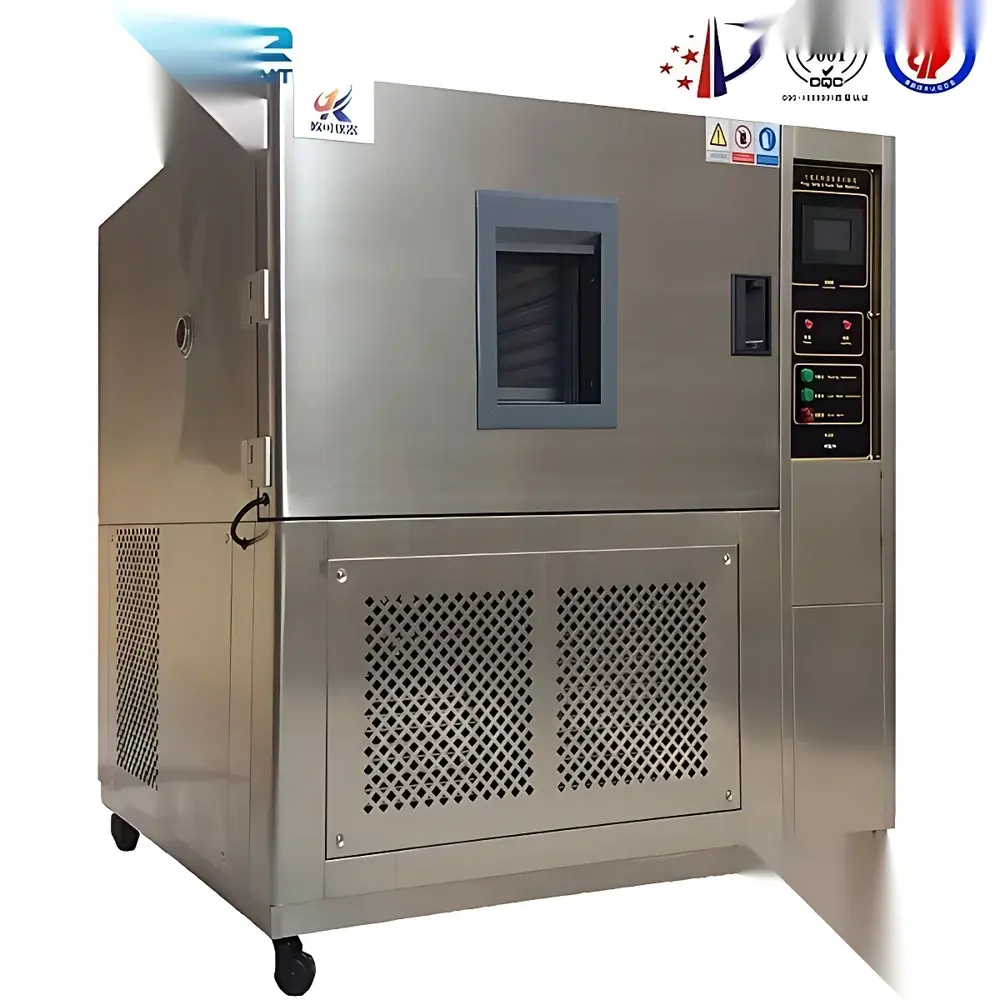
Microcomputer-Controlled Temperature and Humidity Environmental Test Chamber
| Brand | OEM / Custom Brand |
|---|---|
| Origin | Imported |
| Manufacturer Type | Authorized Distributor |
| Temperature Range | –40 °C to +150 °C (standard) |
| Humidity Range | 30–98% RH (standard) |
| Temperature Resolution | 0.01 °C |
| Humidity Resolution | 0.1% RH |
| Temperature Uniformity | ±0.5 °C |
| Temperature Deviation | ≤±2 °C |
| Humidity Deviation | ≤±2.5% RH |
| Heating Rate | 2.0–3.0 °C/min |
| Cooling Rate | 0.7–1.0 °C/min |
| Control System | TEMI880 Color LCD Touchscreen Programmable Controller |
| Power Supply | 380 V ±5%, 50 Hz, 3P+N+G (customizable to 220 V) |
| Interior Material | SUS304 Stainless Steel |
| Exterior Material | SUS304 Stainless Steel or A3 Steel with Electrostatic Powder Coating |
| Compliance | GB10589, GB10592, GB11158, GB/T5170.2, GB/T5170.5, GB2423.1, GB2423.2, GB2423.22, GB2424.1 |
Overview
The Microcomputer-Controlled Temperature and Humidity Environmental Test Chamber is an engineered precision system designed for simulating controlled climatic conditions in laboratory and industrial quality assurance environments. Based on forced-air convection thermodynamics and dual-channel PID-controlled refrigeration/dehumidification and steam/humidification subsystems, it delivers stable, repeatable thermal and hygrometric profiles across wide operational ranges. Its architecture supports both steady-state conditioning (e.g., long-term storage simulation) and dynamic cycling (e.g., temperature-humidity profile ramping per IEC 60068-2-1, -2-2, -2-30), making it suitable for reliability validation of electronic components, automotive modules, polymer packaging, pharmaceutical primary packaging, and aerospace-grade composites.
Key Features
- Compact footprint design optimized for space-constrained laboratories — minimum floor area requirement without compromising internal usable volume.
- Large transparent observation window with double-layer low-emissivity heated glass to prevent condensation, enabling real-time visual monitoring of test specimens under operational conditions.
- High-capacity integrated water reservoir with drawer-type modular access for rapid draining, cleaning, and maintenance — reduces downtime and ensures consistent humidity generation performance.
- Multi-layer safety architecture including over-temperature cutoff, compressor high-pressure protection, phase-sequence monitoring, door interlock, and independent humidity sensor fault detection — compliant with IEC 61000-6-2 EMC immunity requirements.
- Intuitive TEMI880 color touchscreen controller featuring 100-step programmable profiles, real-time trend logging, alarm history with timestamped event records, and USB data export capability.
- Robust chamber construction: interior chamber walls, floor, and ceiling fabricated from mirror-finished SUS304 stainless steel; exterior housing available in either corrosion-resistant SUS304 or powder-coated A3 steel — both rated for continuous operation in ambient environments up to 35 °C and 80% RH.
Sample Compatibility & Compliance
This environmental test chamber accommodates standard test specimens up to 500 mm × 500 mm × 500 mm (W×D×H) in the base configuration, with custom internal dimensions available upon request. Load-dependent thermal response characteristics are documented per ISO 16750-4 Annex B and ASTM D4332 — all published heating/cooling rates reflect air-bath performance under no-load, 25 °C ±6 °C ambient conditions. For regulatory traceability, the system supports GLP-compliant operation via optional audit trail extension (user login, parameter change logging, and report signature fields). It meets mandatory national standards GB10589, GB10592, GB11158, and verification methodologies outlined in GB/T5170.2 (temperature) and GB/T5170.5 (humidity), and is routinely deployed in facilities requiring alignment with IEC 60068-2 series, MIL-STD-810H Method 502.7 (temperature), and Method 507.6 (humidity).
Software & Data Management
The TEMI880 controller provides embedded real-time data acquisition at configurable intervals (1–60 seconds), storing up to 10,000 data points internally. Export formats include CSV and PDF reports with embedded chamber ID, operator ID, test program name, start/end timestamps, and deviation alerts. Optional PC-based software (available as licensed add-on) enables remote monitoring via Ethernet, centralized fleet management, automated report generation aligned with 21 CFR Part 11 requirements (electronic signatures, audit trails, role-based access control), and integration with LIMS platforms through OPC UA or Modbus TCP protocols. All firmware updates are digitally signed and verified prior to installation.
Applications
- Accelerated aging studies of lithium-ion battery cells under combined thermal-hygrometric stress.
- Validation of moisture barrier integrity in flexible medical device packaging per ISO 11607-1.
- Thermal shock screening of solder-joint reliability in PCB assemblies (JEDEC JESD22-A104).
- Stability testing of active pharmaceutical ingredients (APIs) per ICH Q1A(R2) guidelines.
- Environmental stress screening (ESS) of avionics hardware per RTCA DO-160 Section 4 (temperature) and Section 8 (humidity).
- Material coefficient of thermal expansion (CTE) characterization via dimensional metrology under controlled gradients.
FAQ
What is the difference between “air temperature change rate” and “specimen temperature change rate”?
Air temperature change rate refers to the average rate at which chamber air temperature transitions between setpoints under no-load conditions, as defined in GB/T5170.2. Specimen temperature change rate depends on mass, thermal conductivity, geometry, and mounting method — it is always slower and must be empirically validated for each test article.
Can this chamber operate continuously at –70 °C?
Yes — models equipped with cascade refrigeration systems (optional –120 °C configuration) support uninterrupted operation at –70 °C. Continuous sub-zero operation requires cooling water supply within 10–28 °C range and stable pressure of 0.1–0.3 MPa.
Is calibration certificate included with shipment?
A factory-as-built calibration report (traceable to NIM, China) is provided. Full ISO/IEC 17025-accredited calibration with uncertainty budget is available as a separate service.
Does the system support remote diagnostics?
Standard Ethernet interface enables ping-based connectivity checks and basic status polling. Advanced remote diagnostics (including live controller screen mirroring and log analysis) require optional service contract and secure VPN configuration.
How is humidity controlled below 30% RH?
Below 30% RH, dehumidification relies on deep-cooling condensation combined with reheating of dried air — optional desiccant-assisted dry air purge module is available for extended low-RH stability.



