
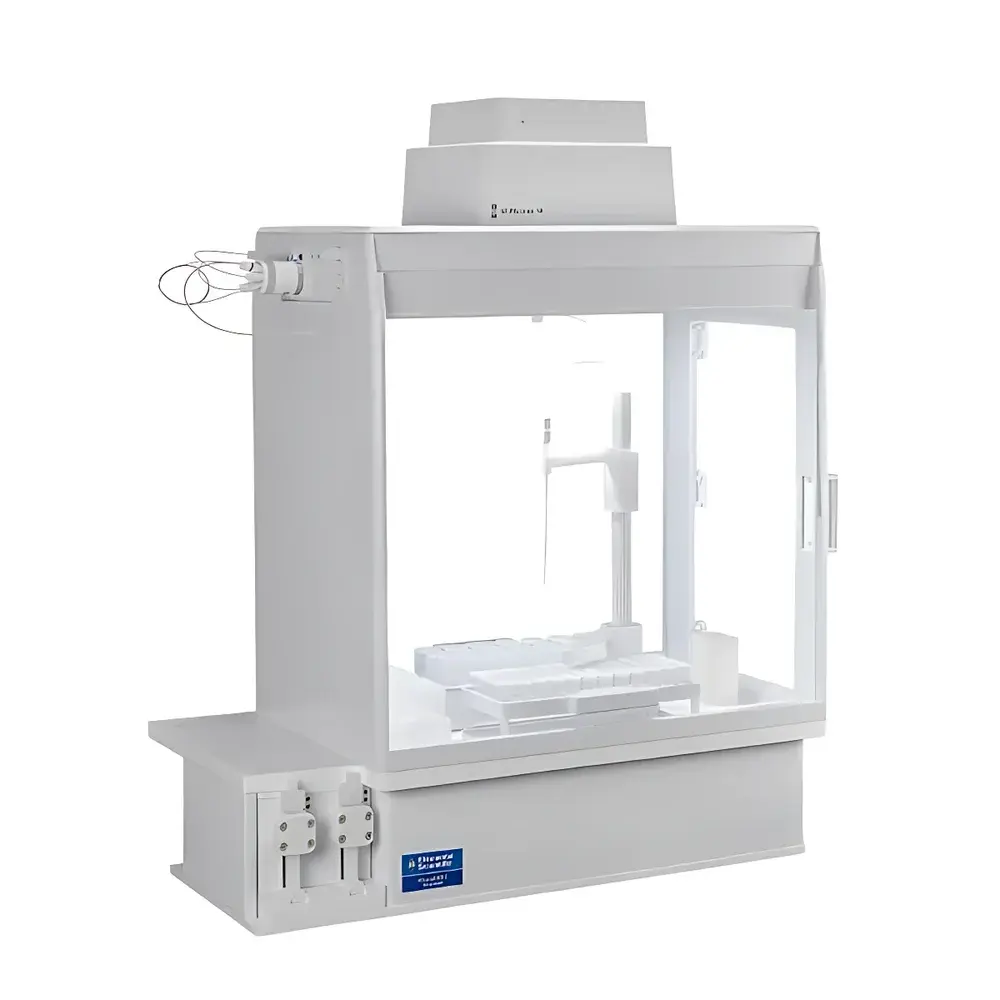
microFAST Single Cell Single-Cell/Single-Particle Sample Introduction System
| Brand | ESI |
|---|---|
| Origin | USA |
| Manufacturer Type | Manufacturer |
| Origin Category | Imported |
| Model | microFAST Single Cell |
| Price | Upon Request |
Overview
The microFAST Single Cell Single-Cell/Single-Particle Sample Introduction System is a purpose-engineered front-end solution for inductively coupled plasma mass spectrometry (ICP-MS) designed to enable quantitative elemental analysis of individual biological cells and synthetic nanoparticles. Unlike conventional nebulization systems optimized for bulk liquid samples, this system operates on the principle of discrete particle introduction—where each cell or nanoparticle is transported intact through a low-pressure, low-shear pneumatic pathway and delivered sequentially into the ICP plasma. This approach preserves cellular integrity, prevents lysis or dissolution during transport, and ensures stoichiometric fidelity between the native sample and the measured ion signal. It supports high-resolution single-cell metallomics, nanotoxicology studies, metal-based drug uptake quantification (e.g., Pt-based chemotherapeutics, Gd-labeled contrast agents), and trace metal mapping in heterogeneous biological suspensions.
Key Features
- Ultra-low-pressure sample introduction (<50 psi at flow rates of 1–50 µL/min), minimizing mechanical stress on fragile biological entities
- High transmission efficiency (>70% typical for 5–20 µm particles; validated per ASTM D8294-21 guidelines for aerosol delivery consistency)
- Modular architecture comprising three core components: microFAST Single-Cell Autosampler, CytoNeb Single-Cell Nebulizer, and CytoSpray Single-Cell Spray Chamber
- Inert PFA fluidic path throughout—chemically resistant to acidic digestates, chelating agents, and biocompatible buffers
- Minimal internal and dead volume (<2 µL total system dispersion volume), enabling rapid washout and carryover <0.1% between injections
- Compatible with all major commercial ICP-MS platforms via standardized torch interface (includes integrated quartz ICP-MS torch assembly)
Sample Compatibility & Compliance
The system accommodates particles ranging from ~5 nm (e.g., metallic quantum dots) to >100 µm (e.g., large primary immune cells or engineered microbeads), with demonstrated performance across suspension densities of 10³–10⁶ particles/mL. Cell viability post-introduction is routinely verified via trypan blue exclusion and flow cytometry. All components meet ISO 9001-certified manufacturing standards and are compliant with GLP/GMP documentation requirements for regulated bioanalytical workflows. The autosampler firmware supports 21 CFR Part 11-compliant audit trails, electronic signatures, and user-access-level controls when integrated with validated LIMS environments.
Software & Data Management
The microFAST platform is controlled via ESI’s proprietary Synergy Control Suite—a Windows-based application supporting method-driven scheduling, real-time pressure/flow monitoring, and synchronized data logging with vendor ICP-MS acquisition software (e.g., Thermo Fisher Qtegra, Agilent MassHunter, PerkinElmer NexION Software). Raw transient signals are exported in .csv and .mzML formats for downstream processing in R-based packages (e.g., SCENIC, Cytofkit) or MATLAB-based deconvolution algorithms. Time-stamped metadata—including nebulizer gas pressure, sample injection volume, dwell time per event, and carryover correction factors—is embedded directly into output files to support FAIR (Findable, Accessible, Interoperable, Reusable) data principles.
Applications
- Quantitative single-cell metal content profiling (e.g., Fe, Zn, Cu homeostasis in hematopoietic stem cells)
- Nanoparticle biodistribution and intracellular accumulation kinetics (e.g., Au, Ag, TiO₂ NPs in macrophage models)
- Pharmacokinetic assessment of metallodrugs (e.g., cisplatin uptake heterogeneity across tumor cell subpopulations)
- Reference material development for single-particle ICP-MS calibration (per ISO/IEC 17025-accredited protocols)
- Multi-elemental co-localization studies using isotopically enriched tags (e.g., ¹⁰³Rh, ¹⁴¹Pr, ¹⁷⁵Lu in CyTOF-inspired workflows)
FAQ
What is the minimum viable cell size supported by the CytoNeb nebulizer?
The CytoNeb nebulizer has been empirically validated for intact transport of particles ≥500 nm; optimal performance is observed between 1–20 µm for mammalian cells.
Can the system be used with viscous or serum-containing media?
Yes—sample viscosity up to 3 cP is accommodated without modification; higher viscosities require dilution or optional capillary pre-filtration modules.
Is the microFAST autosampler compatible with 96-well or 384-well plate formats?
Yes—it supports ANSI/SLAS-standard microplates with programmable X-Y-Z positioning and variable aspiration depth control.
How is system performance verified prior to routine use?
ESI provides a certified verification kit including NIST-traceable Au nanoparticle standards (60 nm, 100 nm) and bovine red blood cell suspensions for throughput, sensitivity, and event discrimination validation.
Does the CytoSpray chamber require active cooling or external gas regulation?
No—it operates passively with standard Ar make-up gas; independent compensation gas inlet allows fine-tuning of aerosol velocity without modifying main nebulizer gas flow.






