
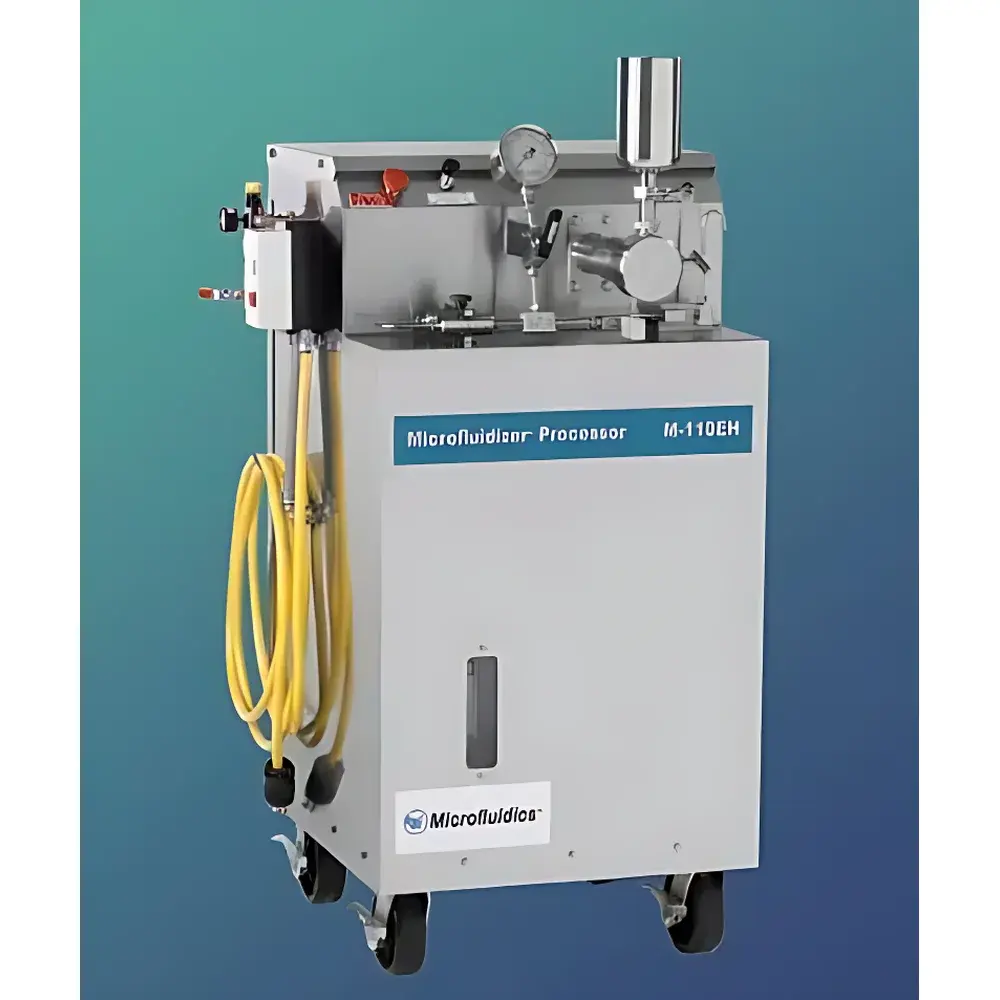
Microfluidics M-110EH High-Pressure Microfluidizer Homogenizer
| Origin | USA |
|---|---|
| Manufacturer Type | Authorized Distributor |
| Origin Category | Imported |
| Model | M-110EH |
| Quotation | Upon Request |
| Max Pressure | 30,000 psi (207 MPa) |
| Max Flow Rate | 450 mL/min |
| Max Feed Temperature | 75 °C |
| Power Supply | 3-Phase, 380 V, 5 HP (3.7 kW) |
| Fluid Path Volume | 100 mL |
| Compressed Air Requirement | 35–150 psi, 1 SCFM at 50 psi, Dew Point: 0–35 °F |
| Minimum Sample Volume | 120 mL |
| Dimensions | 73 × 87 × 148 cm |
| Weight | 205 kg |
| Compliance | CE Certified |
Overview
The Microfluidics M-110EH High-Pressure Microfluidizer Homogenizer is a precision-engineered hydraulic homogenization system designed for laboratory-scale development, pilot-scale validation, and small-batch GMP-compliant production. Unlike conventional valve-based high-pressure homogenizers, the M-110EH employs a fixed-geometry Interaction Chamber™ (IXC) technology—patented by Microfluidics International Corporation (now part of Precision NanoSystems)—to generate consistent, ultra-high shear rates under precisely controlled pressure conditions (2,500–30,000 psi). This mechanism enables reproducible nano-scale particle size reduction via controlled fluid acceleration, collision, and cavitation within the microchannel geometry. The device operates on the principle of microfluidic impingement: two high-velocity streams intersect at defined angles inside the diamond-based IXC, delivering uniform energy input per unit volume. This architecture ensures exceptional batch-to-batch consistency and eliminates the variability associated with wear-prone mechanical valves. It is widely deployed in biopharmaceutical process development—including liposome extrusion, mRNA-LNP formulation, protein nanoparticle synthesis, and cell lysis—where particle size distribution (PSD), polydispersity index (PDI), and structural integrity are critical quality attributes.
Key Features
- Diamond-coated Interaction Chamber™ (IXC) with patented fixed-geometry design—resistant to erosion, chemical corrosion, and thermal degradation; enables >10,000 operating hours without performance drift
- Stable pressure control across full range (2,500–30,000 psi) with real-time digital monitoring and closed-loop feedback regulation
- Integrated temperature management system with jacketed sample path and external chiller interface (±0.5 °C stability over 60-min continuous operation)
- Single-pass microbial cell disruption achieving ≥95% lysis efficiency for E. coli, yeast, and mammalian cells—preserving intracellular biomolecules from thermal or enzymatic degradation
- Scalable process parameters: lab-scale results demonstrate linear correlation (R² > 0.99) with pilot (M-110Y) and production-scale (M-725) systems—validated per ICH Q5A and USP <1043>
- CIP (Clean-in-Place) and SIP (Steam-in-Place) compatibility: fully autoclavable fluid path (up to 121 °C, 2 bar); validated per ASME BPE-2023 surface finish standards (Ra ≤ 0.4 µm)
- CE-marked electrical architecture compliant with EN 61000-6-2 (EMC immunity) and EN 61000-6-4 (EMC emission) standards
Sample Compatibility & Compliance
The M-110EH accommodates a broad spectrum of formulations—from low-viscosity aqueous buffers to high-solid-content suspensions (up to 40% w/w) and highly immiscible oil-in-water or water-in-oil emulsions. It has been successfully applied to lipid nanoparticle (LNP) formulation (e.g., siRNA and mRNA delivery systems), nanocrystal suspension stabilization, polymeric micelle generation, and exosome isolation workflows. All wetted surfaces are constructed from 316L stainless steel and sapphire/diamond composites, meeting USP Class VI and ISO 10993-5 biocompatibility requirements. Process data integrity complies with FDA 21 CFR Part 11 when integrated with validated LIMS or MES platforms—audit trails, electronic signatures, and role-based access control are supported through optional software modules. The system satisfies GLP and GMP documentation requirements for preclinical and clinical manufacturing stages.
Software & Data Management
The M-110EH operates via an embedded industrial PLC with a 7-inch HMI touchscreen interface supporting multi-language operation (English, German, Japanese, Chinese). All critical process parameters—including pressure, flow rate, inlet/outlet temperature, total processed volume, and cycle count—are logged at 1 Hz resolution and exportable as CSV or PDF reports. Optional Ethernet/IP or Modbus TCP connectivity enables integration into centralized SCADA or PAT (Process Analytical Technology) frameworks. Data archiving adheres to ALCOA+ principles (Attributable, Legible, Contemporaneous, Original, Accurate, Complete, Consistent, Enduring, Available), with encrypted local storage and configurable retention policies. Firmware updates follow a controlled change management protocol aligned with ISO 13485:2016 clause 7.5.6.
Applications
- Preparation of sub-100 nm lipid nanoparticles for nucleic acid delivery (mRNA, siRNA, CRISPR-Cas ribonucleoproteins)
- Size reduction and stabilization of poorly soluble drug compounds into nanosuspensions per USP <1151>
- Cell lysis for recombinant protein recovery without protease activation or endotoxin release
- Homogenization of vaccine adjuvants (e.g., squalene-based emulsions) under sterile conditions
- Manufacturing of uniform polymer nanoparticles for controlled-release applications
- Production of nanoemulsions for topical and oral delivery with narrow PDI (<0.15)
FAQ
What is the minimum viable sample volume for method development?
The recommended minimum volume is 120 mL to ensure stable pressure build-up and representative chamber residence time; however, method scouting can be performed with 60 mL using a calibrated bypass loop.
Is the Interaction Chamber compatible with organic solvents such as chloroform or DMSO?
Yes—the diamond-sapphire IXC exhibits inertness toward halogenated hydrocarbons, polar aprotic solvents, and acidic/basic aqueous media (pH 1–13); solvent compatibility must be verified against elastomer seals (Viton® or Kalrez® options available).
Can the M-110EH be integrated into a closed, sterile processing line?
Yes—equipped with tri-clamp sanitary fittings (ISO 2852), SIP-rated actuators, and aseptic disconnect couplings; validation protocols for steam sterilization (121 °C, 20 min) are provided in the IQ/OQ documentation package.
Does the system support GMP audit readiness out-of-the-box?
The base configuration includes electronic logbooks, user access levels, and parameter lockout functions; full 21 CFR Part 11 compliance requires optional software licensing and site-specific validation support.
How frequently does the Interaction Chamber require replacement?
Under standard aqueous buffer operation at ≤20,000 psi, the diamond IXC typically exceeds 8,000 operational hours before measurable PSD shift (>5% increase in D90); wear life is extended significantly with proper pre-filtration (≤5 µm) and avoidance of abrasive particulates.



