
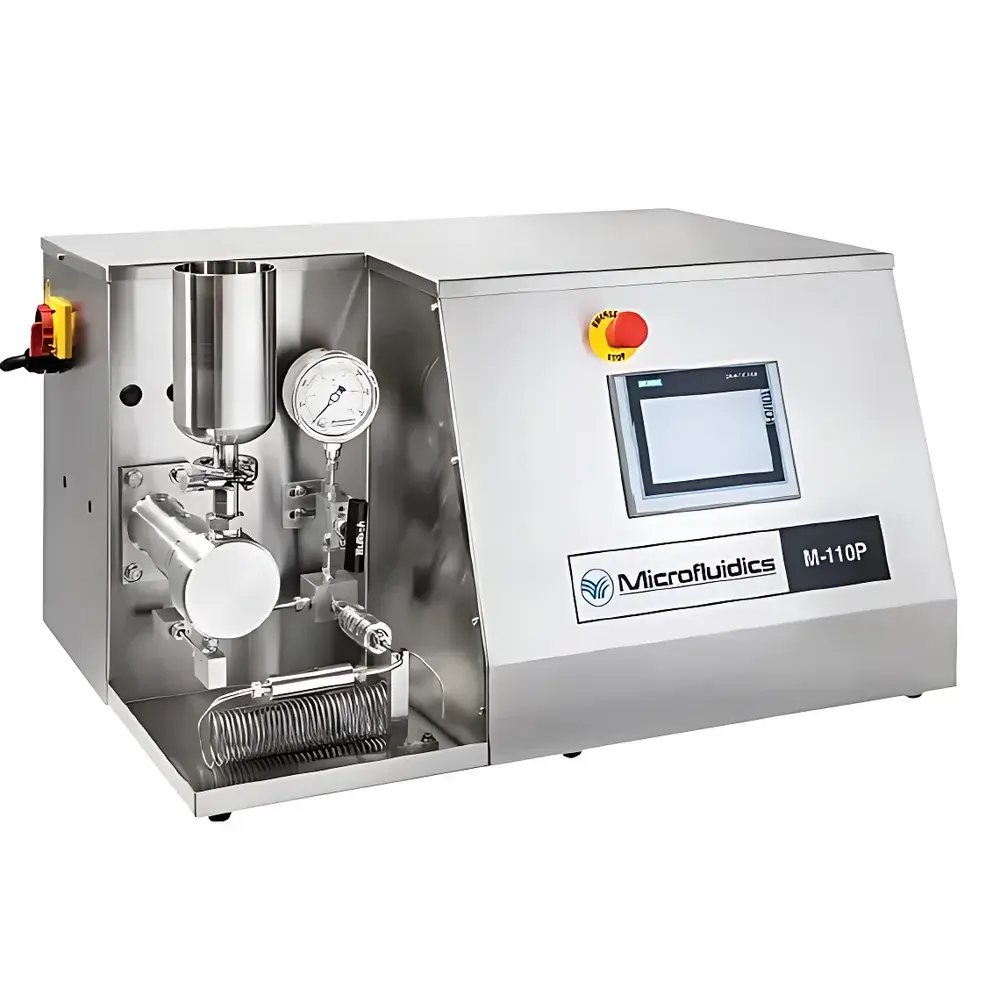
Microfluidics M-110Pv3 High-Pressure Microfluidizer
| Brand | Microfluidics |
|---|---|
| Origin | USA |
| Model | M-110Pv3 |
| Instrument Type | High-Pressure Homogenizer |
| Max Operating Pressure | 30,000 psi |
| Flow Rate | Up to 120 mL/min |
| Processing Volume Range | 30–5000 mL |
| Dimensions (W×D×H) | 940 × 710 × 560 mm |
| Interaction Chamber Material | Synthetic Diamond |
| Interaction Chamber Dimensions | ≥80 mm length, ≥30 mm diameter |
| Compliance | CE, cGMP-Compatible Design |
| Chamber Architecture | Fixed-geometry, zero-moving-parts, no consumables |
Overview
The Microfluidics M-110Pv3 is a precision-engineered high-pressure microfluidizer designed for scalable, reproducible nano-scale homogenization and cell disruption in regulated laboratory and pilot-scale environments. It operates on the principle of controlled fluid shear and cavitation within a fixed-geometry interaction chamber—where two opposing high-velocity fluid streams collide at precisely defined angles under ultra-high pressure (up to 30,000 psi). Unlike valve-based homogenizers, the M-110Pv3 employs a synthetic diamond interaction chamber with invariant internal geometry, eliminating variability from wear, calibration drift, or dynamic flow restrictions. This architecture ensures consistent energy input per pass, enabling true linear scale-up from benchtop development to clinical manufacturing batches. The system is purpose-built for applications demanding stringent particle size control, narrow polydispersity, and process traceability—including formulation of lipid nanoparticles (LNPs), liposomes, albumin-bound nanotherapeutics, nanoemulsions, and sub-200 nm colloidal suspensions.
Key Features
- Fixed-geometry synthetic diamond interaction chamber (≥80 mm length, ≥30 mm diameter) providing zero moving parts, no consumables, and long-term dimensional stability.
- PLC-integrated touchscreen HMI with real-time pressure, temperature, and flow monitoring; all operational parameters logged automatically with timestamped audit trails.
- In-line temperature control system enabling precise thermal management during processing—critical for thermolabile biologics and heat-sensitive excipients.
- Modular feed vessel options: open-top 400 mL and 2 L 316L stainless steel vessels, plus pressurized 2 L and 7 L closed-loop vessels rated for full-system operating pressure.
- CE-marked and engineered to support cGMP-compliant workflows, including configurable user access levels, electronic signatures, and data export compliant with FDA 21 CFR Part 11 requirements.
- Typical process efficiency: >95% particle size reduction in ≤3 passes for formulations such as paclitaxel-albumin nanoparticles and siRNA-loaded LNPs.
Sample Compatibility & Compliance
The M-110Pv3 accommodates aqueous, organic, and biphasic systems across viscosities up to 500 cP. It is routinely validated for sterile filtration-compatible processing of parenteral nanomedicines and has been cited in multiple peer-reviewed studies supporting ISO 13485 and USP environmental control requirements. The 316L stainless steel wetted path and diamond chamber meet ASTM F86 surface finish standards for implantable-grade materials. All firmware and data handling protocols are architected to align with GLP/GMP documentation integrity expectations, including immutable raw data storage, version-controlled method files, and full change history tracking.
Software & Data Management
The embedded control software provides deterministic batch execution, with programmable multi-step pressure ramps, dwell times, and inter-pass cooling intervals. Process data—including pressure transients, inlet/outlet temperatures, total processed volume, and cumulative energy input—is stored locally in CSV and SQLite formats. Optional integration with LabVantage LIMS or Empower CDS enables automated metadata tagging and electronic batch record (EBR) generation. Audit trail functionality records every parameter modification, user login/logout event, and alarm condition with cryptographic time stamping—fully satisfying regulatory expectations for data integrity under ALCOA+ principles.
Applications
- Preclinical and clinical-grade production of lipid nanoparticles for mRNA delivery.
- Scalable preparation of PEGylated liposomes with mean particle size <100 nm and PDI <0.12.
- Albumin nanoparticle synthesis via desolvation-homogenization coupling, achieving >90% encapsulation efficiency for hydrophobic payloads.
- Cell lysis of Gram-negative bacteria and yeast without protease contamination—validated for inclusion bodies recovery.
- Stabilization of nano-suspensions for poorly water-soluble drugs (BCS Class II/IV), meeting ICH Q5C stability criteria over 24-month accelerated studies.
FAQ
What distinguishes the M-110Pv3’s interaction chamber from conventional valve homogenizers?
The synthetic diamond chamber features a permanent, non-adjustable geometry—eliminating pressure-dependent flow restriction variability and ensuring identical shear profiles across all operating pressures.
Can the system be qualified for GMP manufacturing?
Yes—the platform supports IQ/OQ/PQ documentation packages, and its deterministic operation, data integrity controls, and material certifications enable direct use in Phase I–III clinical supply chains.
Is remote monitoring or predictive maintenance supported?
While the base system does not include cloud connectivity, its Ethernet-enabled PLC supports Modbus TCP integration with facility SCADA systems for real-time KPI dashboards and scheduled maintenance alerts based on cumulative operating hours.
What validation support is provided for pharmaceutical users?
Microfluidics supplies chamber performance qualification (CPQ) test reports, material certificates of conformance (CoC), and standard operating procedure (SOP) templates aligned with ISO 20957 and ASTM E2500.



