
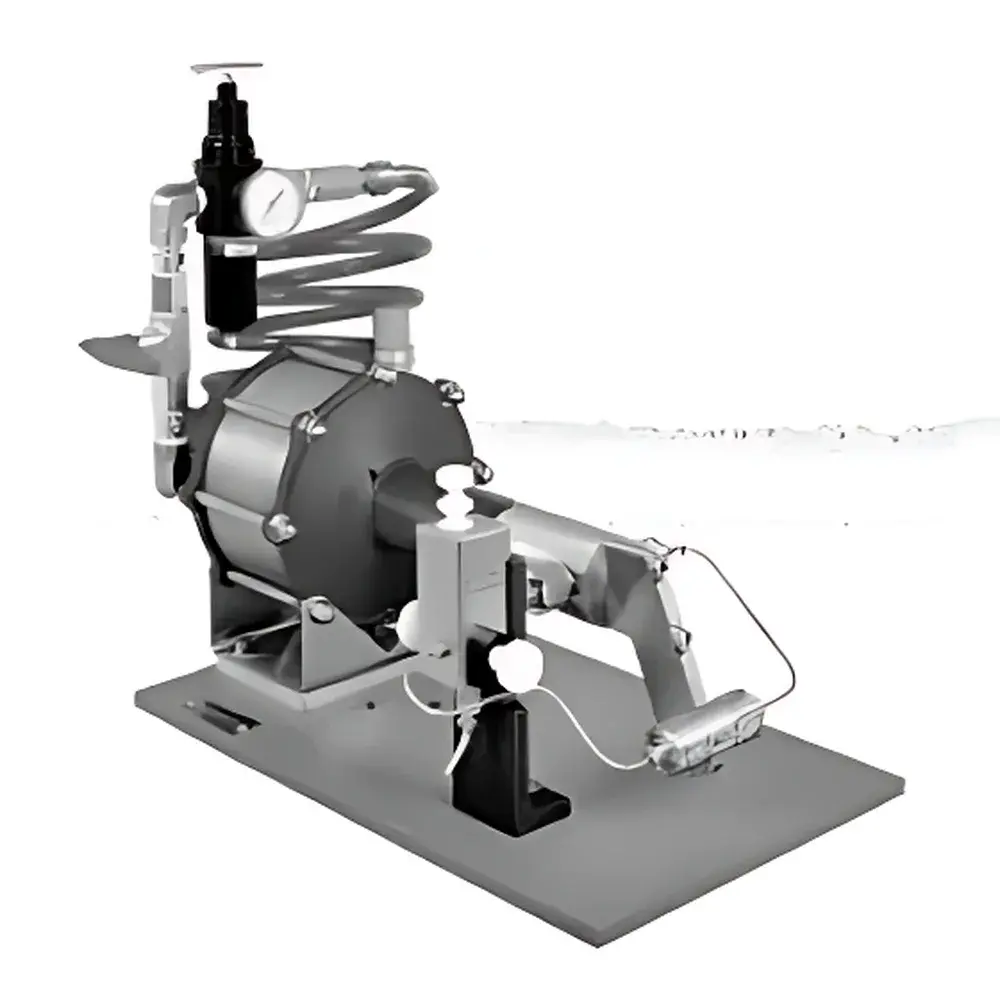
Microfluidics M-110S High-Pressure Microfluidic Nanohomogenizer
| Origin | USA |
|---|---|
| Manufacturer Type | Authorized Distributor |
| Origin Category | Imported |
| Model | M-110S |
| Instrument Type | High-Pressure Homogenizer |
| Operating Pressure Range | 3,000–23,000 psi (20.7–158.6 MPa) |
| Flow Rate | 200–600 mL/min |
| Max Feed Temperature | 75 °C |
| Minimum Sample Volume | 14 mL |
| Compressed Air Requirement | 120 psi @ 50 scfm, dew point 0–35 °F, 15 hp (11 kW) |
| Dimensions | 58 × 53 × 58 cm |
| Weight | 25 kg |
| Interaction Chamber | Fixed-geometry microchannel stainless steel |
| Cooling | Integrated portable chiller system |
Overview
The Microfluidics M-110S is a benchtop high-pressure microfluidic nanohomogenizer engineered for reproducible, scalable nanoparticle processing in R&D and pilot-scale environments. Unlike conventional valve-based homogenizers, the M-110S employs a fixed-geometry interaction chamber—fabricated from precision-machined stainless steel—to generate controlled fluid shear, cavitation, and impact forces under pressures up to 23,000 psi (158.6 MPa). This patented microfluidization principle ensures consistent energy delivery per unit volume, enabling sub-100 nm particle size reduction with narrow polydispersity index (PDI < 0.1) across diverse formulations. Its pneumatic drive system utilizes standard laboratory compressed air (120 psi), eliminating hydraulic oil contamination risks and simplifying integration into GLP-compliant labs. Designed for biopharmaceutical and advanced material development, the M-110S bridges the gap between exploratory formulation and cGMP manufacturing by maintaining identical process mechanics from 14 mL lab batches to multi-liter production runs.
Key Features
- Fixed-geometry stainless steel interaction chamber with no moving parts—ensures absolute process repeatability and eliminates wear-related parameter drift
- Minimum sample requirement of 14 mL, delivering ≥12 mL recoverable processed volume—ideal for precious biologicals and early-stage API candidates
- Single-pass cell disruption efficiency exceeding 95% for bacterial, yeast, and mammalian cells—preserving intracellular integrity without protease activation or thermal denaturation
- Integrated portable cooling system with temperature monitoring—maintains feed stream at ≤75 °C to prevent thermal degradation of thermolabile compounds
- 25 mL stainless steel reservoir with sanitary quick-connect fittings—compatible with USP Class VI elastomers and autoclavable components
- Linear scalability validated per ASTM E2919-20 guidelines—process parameters (pressure, flow rate, pass count) translate directly to Microfluidics’ industrial-scale M-725 and M-140 systems
- ATEX-compliant enclosure (Category 3D) with pressure relief mechanisms—certified for use in non-hazardous laboratory zones per IEC 60079-0
Sample Compatibility & Compliance
The M-110S processes aqueous, organic, and biphasic systems—including liposomes, polymeric nanoparticles, nanoemulsions, protein suspensions, viral vectors, and cell lysates—without solvent residue or metal leaching. All wetted surfaces are electropolished 316L stainless steel (Ra ≤ 0.4 µm), compliant with FDA 21 CFR Part 211 and ISO 13485 requirements for medical device manufacturing. The system supports IQ/OQ documentation packages aligned with GAMP 5 and meets key pharmacopeial standards: USP <729> for droplet size distribution in emulsions, USP <1788> for subvisible particle analysis, and ISO 13320:2020 for laser diffraction validation. Full audit trails—including pressure logs, cycle counts, and temperature timestamps—are exportable in CSV format for regulatory submission.
Software & Data Management
While the M-110S operates via intuitive manual controls (pressure regulator, flow valve, cycle timer), it integrates seamlessly with optional Microfluidics ProcessLog™ software for automated parameter recording and SOP-driven operation. ProcessLog captures real-time pressure profiles, total processed volume, and thermal history—enabling correlation of mechanical input with final particle morphology (e.g., TEM/SEM validation). All data files conform to ALCOA+ principles (Attributable, Legible, Contemporaneous, Original, Accurate, Complete, Consistent, Enduring, Available) and support 21 CFR Part 11-compliant electronic signatures when deployed on validated Windows OS platforms.
Applications
- Nanomedicine: Liposomal doxorubicin, siRNA-loaded lipid nanoparticles, and PEGylated micelles requiring <100 nm mean diameter and low PDI
- Vaccine development: Viral vector purification, adjuvant dispersion (e.g., squalene-in-water emulsions), and exosome isolation
- Industrial catalysis: Metal-organic framework (MOF) nanoparticle synthesis and supported catalyst dispersion
- Food science: Nanoencapsulated nutraceuticals (curcumin, resveratrol) and cold-stable dairy emulsions
- Materials science: Graphene oxide dispersion, quantum dot stabilization, and ceramic nanopowder deagglomeration
FAQ
What is the maximum allowable viscosity for processing with the M-110S?
Viscosity should not exceed 500 cP at processing temperature; higher viscosities require pre-dilution or heated feed lines to maintain laminar flow through the microchannels.
Can the M-110S be used for continuous processing?
It is designed for batch-mode operation with discrete cycles; however, sequential batches can be executed with automated feed systems (e.g., syringe pump integration) for quasi-continuous throughput.
Is the interaction chamber replaceable, and what is its service life?
Chambers are field-replaceable consumables with a rated lifetime of ≥500 hours at 20,000 psi; performance verification via DLS before and after extended use is recommended.
Does the system comply with ISO 14644-1 Class 5 cleanroom requirements?
The M-110S itself is not cleanroom-rated, but it may be installed in ISO 5 environments when housed in laminar flow enclosures and operated with sterile-filtered feed lines.
How is process consistency verified between lab and production scales?
Microfluidics provides scale-up protocols based on constant specific energy input (kJ/L), validated using in-line dynamic light scattering (DLS) and transmission electron microscopy (TEM) cross-correlation per ICH Q5A(R2) comparability guidelines.



