
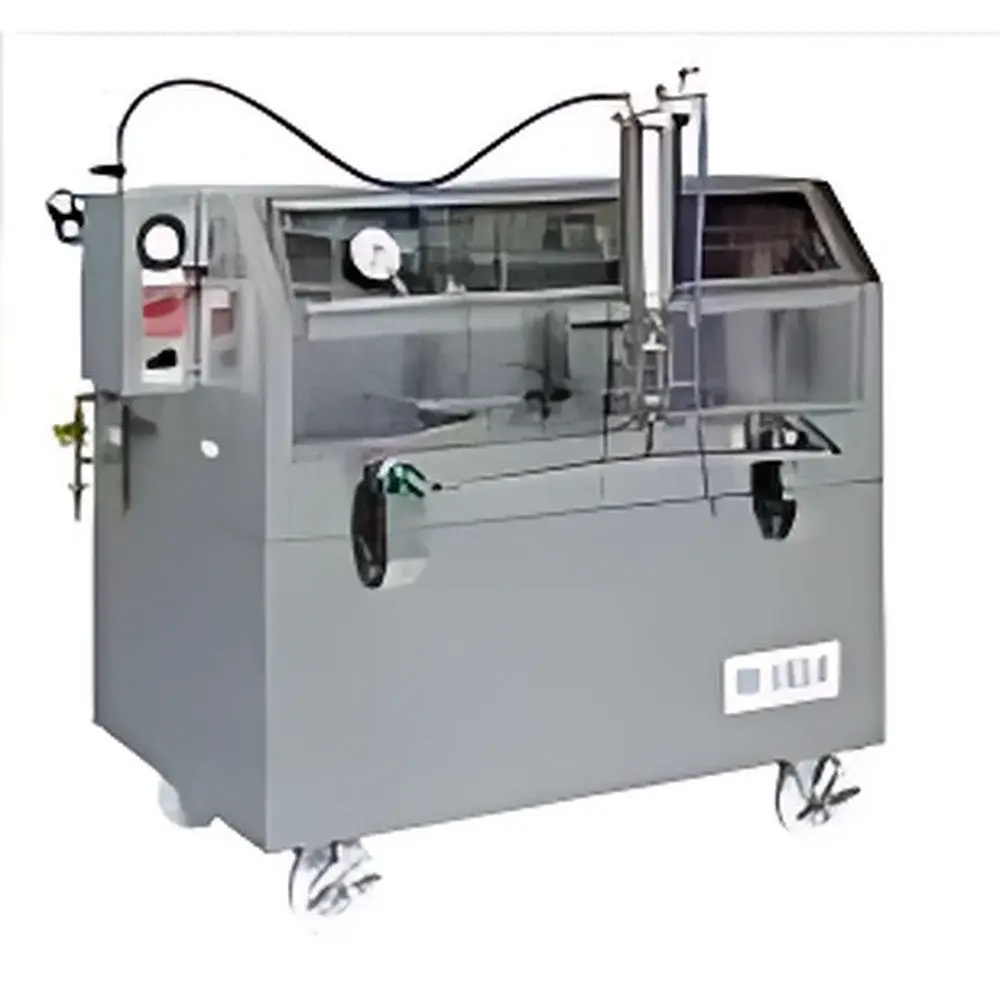
Microfluidics M-210EH High-Pressure Microfluidizer® Nanoscale Dispersion System
| Origin | USA |
|---|---|
| Manufacturer Type | Authorized Distributor |
| Origin Category | Imported |
| Model | M-210EH |
| Pricing | Available Upon Request |
Overview
The Microfluidics M-210EH High-Pressure Microfluidizer® Nanoscale Dispersion System is an engineered platform for scalable, reproducible nano- and submicron particle formation via controlled high-shear fluid mechanics. Unlike conventional valve-based homogenizers, the M-210EH employs a fixed-geometry Interaction Chamber™ (IXC) — a patented microchannel architecture that subjects process streams to precisely defined shear, cavitation, and impact forces under constant pressure. This principle ensures consistent energy input per unit volume, enabling deterministic control over particle size distribution (PSD), colloidal stability, and structural integrity of biologics or sensitive actives. Designed for laboratory-to-production continuity, the M-210EH serves as a bridge between R&D feasibility studies and GMP-compliant manufacturing workflows in pharmaceuticals, nanomaterials, and functional food development.
Key Features
- Fixed-geometry Interaction Chamber™ (IXC): Patented ceramic or diamond-coated microfluidic channels deliver repeatable, geometry-dependent shear profiles — eliminating variability inherent in adjustable valve systems.
- Three-tier pressure architecture: Configurable across M-210A (2,500–12,000 psi), M-210B (4,000–18,000 psi), and M-210C (6,000–30,000 psi) variants — enabling optimization for viscosity, thermal sensitivity, and target particle size.
- Dual positive-displacement intensifier pumps: Maintain pressure stability within ±1.5% across full flow range, critical for statistical process control and regulatory documentation.
- Integrated CIP-ready design: Full online cleaning-in-place capability without disassembly; compatible with validated cleaning protocols per FDA 21 CFR Part 11 and EU Annex 11 requirements.
- High-efficiency cell disruption: Achieves ≥95% lysis efficiency in single-pass mode for bacterial, yeast, and mammalian cells — preserving intracellular protein integrity and minimizing proteolytic degradation.
- Scalable linear correlation: Process parameters (pressure, flow rate, pass number) demonstrate direct geometric and dynamic similarity from lab-scale (1 L) to pilot (10–100 L) and production (≥500 L) volumes — supported by Microfluidics’ Scale-Up Validation Toolkit.
Sample Compatibility & Compliance
The M-210EH processes diverse formulations including oil-in-water and water-in-oil emulsions, polymer nanoparticle suspensions, liposomal drug carriers, nanocrystal dispersions, and solid-in-liquid colloids with viscosities up to 10,000 cP. It accommodates thermolabile biologics through integrated hydraulic oil and product-side cooling circuits — maintaining bulk temperature rise below 5°C per pass under standard operating conditions. The system complies with CE Machinery Directive 2006/42/EC and meets essential safety requirements for Class III equipment per ISO 13850. Documentation packages support IQ/OQ/PQ execution and are structured to align with ICH Q5C, USP , and ASTM D7924-15 for nanoparticle dispersion characterization.
Software & Data Management
Equipped with Microfluidics’ proprietary ControlSuite™ v4.2, the M-210EH provides real-time monitoring of pressure (±0.5% FS), flow rate (±1.0% reading), inlet/outlet temperatures, and pump cycle count. All operational data — including timestamped parameter logs, alarm history, and user access records — are stored locally with optional encrypted export to networked LIMS or MES platforms. Audit trail functionality satisfies FDA 21 CFR Part 11 requirements for electronic records and signatures, including role-based access control, electronic signature capture, and immutable log archiving.
Applications
- Nanomedicine: Preparation of uniform liposomes, polymeric micelles, and lipid nanoparticles (LNPs) for mRNA delivery — validated for batch-to-batch consistency in clinical trial material synthesis.
- Materials Science: Exfoliation of 2D nanomaterials (e.g., graphene oxide, MXenes), dispersion of carbon nanotubes, and stabilization of quantum dot suspensions.
- Biotechnology: High-yield intracellular protein extraction, organelle isolation, and viral vector purification without surfactant addition.
- Food & Nutrition: Production of nanoemulsified nutraceuticals (e.g., curcumin, resveratrol), transparent beverage emulsions, and cold-process dairy alternatives.
- Quality Control: Reference-grade dispersion for particle sizing calibration standards (ISO 22412) and rheological benchmarking of complex fluids.
FAQ
What distinguishes the M-210EH’s Interaction Chamber™ from conventional homogenizing valves?
The fixed-geometry IXC eliminates mechanical wear-induced drift and delivers invariant shear history per fluid element — enabling true first-principles process modeling and long-term reproducibility.
Can the M-210EH be integrated into a GMP manufacturing suite?
Yes — it supports full validation documentation, 21 CFR Part 11 compliance, and seamless integration with SCADA and MES systems via Modbus TCP or OPC UA.
Is minimum sample volume truly limited to 1 gallon (3.8 L)?
While nominal minimum is 3.8 L for stable flow dynamics, Microfluidics offers optional low-volume adapters (down to 500 mL) with recalibrated pressure compensation algorithms.
How does the system manage heat generation during high-pressure processing?
Dual independent cooling circuits regulate both hydraulic oil temperature (±0.5°C) and product stream temperature (±1.0°C) via PID-controlled chillers — preventing thermal denaturation of proteins or polymers.
Does Microfluidics provide scale-up support beyond equipment supply?
Yes — certified Process Engineers deliver end-to-end scale-up services including formulation assessment, parameter mapping, risk analysis (FMEA), and regulatory filing support (IND/IMPD dossiers).



