
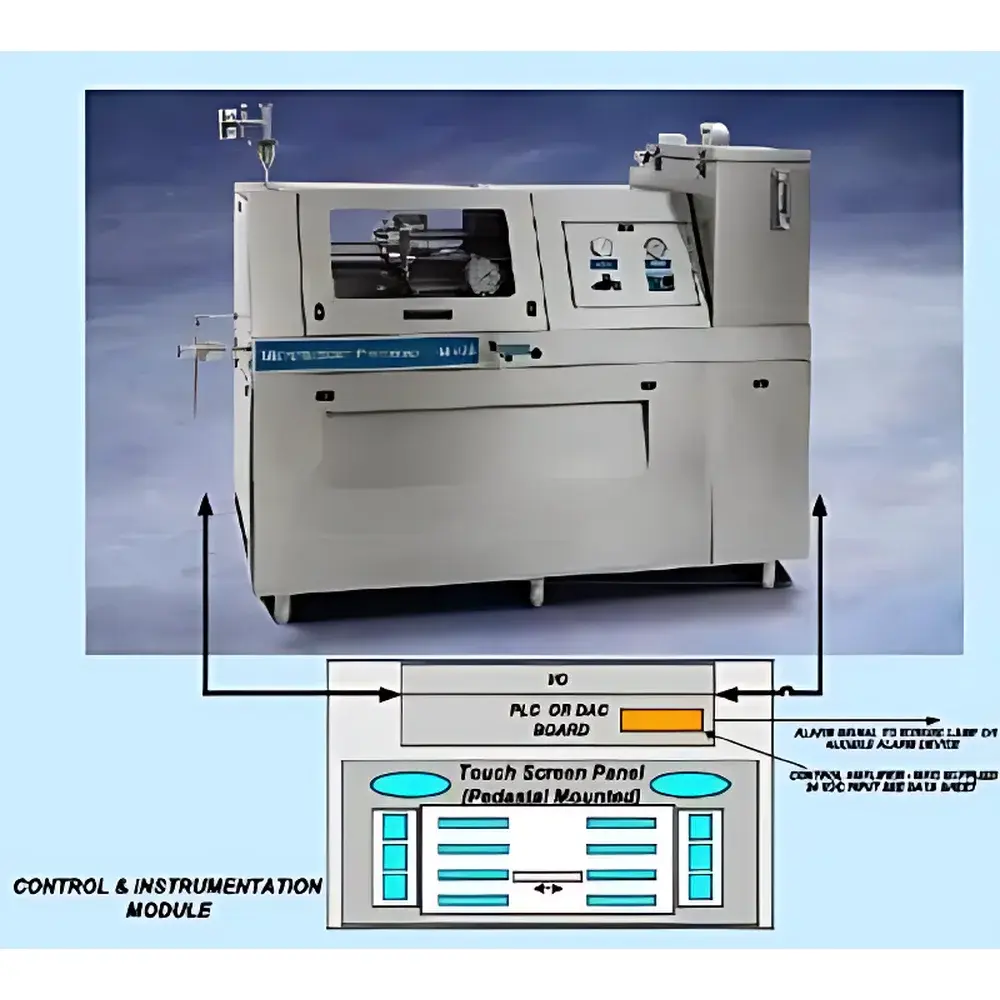
Microfluidics M-700 Series High-Pressure Microfluidizer Homogenizer
| Origin | USA |
|---|---|
| Manufacturer Type | Authorized Distributor |
| Origin Category | Imported |
| Model | M-700 Series |
| Pricing | Available Upon Request |
| Max Operating Pressure | 40,000 psi |
| Max Flow Rate | 15.6 L/min |
| Inlet Temperature Range | Up to 75 °C |
| Power Supply | 3-phase, 380 V, 15–50 HP |
| Compressed Air Requirement | 50–150 psi, 1 SCFM at 50 psi, dew point 0–35 °F |
| Dimensions | 74 × 180 × 145 cm |
| Weight | 675–900 kg |
| Cavity Material | Patented Diamond-Embedded Fixed-Geometry Interaction Chamber |
| Construction | Fully Stainless Steel (316L) |
| Cleaning & Sterilization | CIP/SIP Capable |
Overview
The Microfluidics M-700 Series High-Pressure Microfluidizer Homogenizer is an industrial-grade, hydraulically driven homogenization system engineered for scalable, reproducible nanoscale particle and droplet size reduction. Unlike conventional valve-based homogenizers, the M-700 leverages a fixed-geometry, diamond-reinforced interaction chamber—protected under U.S. Patent—to subject fluid streams to precisely controlled shear, cavitation, and impact forces within microchannels. This patented architecture ensures consistent energy dissipation per unit volume, enabling deterministic control over final particle size distribution (PSD) in the sub-100 nm range. Designed for continuous or batch operation, the system operates at pressures up to 40,000 psi (275.8 MPa), delivering high-throughput processing for GMP-compliant manufacturing environments in biopharmaceuticals, nanomedicine, and advanced materials synthesis.
Key Features
- Patented diamond-embedded interaction chamber with invariant geometry—ensures zero drift in process parameters across thousands of operating hours and eliminates wear-induced variability in PSD.
- Three scalable configurations (M-7115, M-7125, M-7250) offering 15 HP (11.1 kW), 25 HP (18.5 kW), and 50 HP (37 kW) hydraulic power outputs, supporting flow rates from 4.74 to 15.6 L/min.
- Integrated automatic temperature control system maintains inlet fluid temperature within ±1 °C across the full operational range (up to 75 °C), critical for thermolabile biologics and lipid-based formulations.
- Full stainless steel (ASTM A276 Type 316L) wetted-path construction compliant with ASME BPE-2022 surface finish standards (Ra ≤ 0.4 µm) and FDA 21 CFR Part 11-ready audit trail functionality when paired with optional Microfluidics Control Suite software.
- CIP (Clean-in-Place) and SIP (Sterilize-in-Place) capability—validated per ISO 13408-1—enables automated cleaning cycles without disassembly, reducing downtime and contamination risk in aseptic processing suites.
- Dual-pump configuration standard on M-7250 model enhances volumetric throughput while maintaining pressure stability under variable backpressure conditions typical in inline filtration or multi-stage processing.
Sample Compatibility & Compliance
The M-700 Series accommodates a broad spectrum of viscous and sensitive formulations—including liposomal suspensions (e.g., doxorubicin HCl liposomes), oil-in-water and water-in-oil nanoemulsions, polymeric nanoparticles (PLGA, chitosan), protein therapeutics, viral vectors, and whole-cell lysates. Its narrow residence time distribution (< 100 ms) minimizes thermal and mechanical degradation, preserving structural integrity of biomolecules. The system meets requirements for GLP and GMP environments: all models support IQ/OQ/PQ documentation packages aligned with ASTM E2500-13 and ICH Q5A(R2). Electrical safety complies with UL 61010-1 and CE EN 61000-6-4; compressed air interfaces conform to ISO 8573-1 Class 2:2:2 for pharmaceutical-grade air quality.
Software & Data Management
Optional Microfluidics Control Suite v5.x provides real-time monitoring of pressure, flow rate, temperature, and motor load via calibrated transducers traceable to NIST standards. All operational data—including setpoints, alarms, and event logs—are timestamped and stored with role-based access control (RBAC) and electronic signature support per 21 CFR Part 11 Annex 11. Batch records are exportable in CSV and PDF/A-1b formats for regulatory submission. Remote diagnostics via secure TLS 1.2 connection enable predictive maintenance alerts based on hydraulic efficiency decay trends.
Applications
- Nanoparticle formulation: Reduction of drug crystals, polymeric micelles, and inorganic colloids to <50 nm with narrow PDI (<0.1 measured by DLS).
- Liposome extrusion alternative: Production of unilamellar liposomes (50–120 nm) with encapsulation efficiency >92% and long-term colloidal stability (>12 months at 4 °C).
- Cell disruption: Quantitative lysis of Gram-negative bacteria (E. coli), yeast (S. cerevisiae), and mammalian cells (CHO, HEK293) without protease activation or nucleic acid shearing.
- Emulsion stabilization: Generation of thermodynamically stable nanoemulsions for topical delivery, agrochemical actives, and food-grade carriers.
- Viral vector processing: Gentle yet effective homogenization of lentiviral and AAV suspensions prior to ultrafiltration/diafiltration, preserving infectivity titer.
FAQ
What distinguishes the M-700’s interaction chamber from conventional homogenizing valves?
The fixed-geometry diamond chamber eliminates erosion-related performance drift and delivers repeatable energy input per pass—unlike adjustable valves whose orifice geometry changes with wear.
Can the M-700 be integrated into a closed, sterile manufacturing train?
Yes—fully validated CIP/SIP protocols, ASME BPE-compliant tubing connections, and steam-compatible seals enable direct integration with bioreactors, TFF systems, and fill-finish lines.
Is process scalability from lab to production linear?
Yes—Microfluidics provides scale-up correlation tools based on constant specific energy input (kJ/L), validated across M-110 (lab), M-610 (pilot), and M-700 (production) platforms.
Does the system support regulatory filing documentation?
All models ship with comprehensive validation templates (IQ/OQ/PQ), material certifications (EN 10204 3.1), and calibration certificates traceable to national metrology institutes.
What maintenance intervals are recommended for sustained GMP compliance?
Preventive maintenance every 500 operating hours includes transducer recalibration, hydraulic fluid analysis, and chamber integrity inspection—documented in the built-in maintenance log.



