
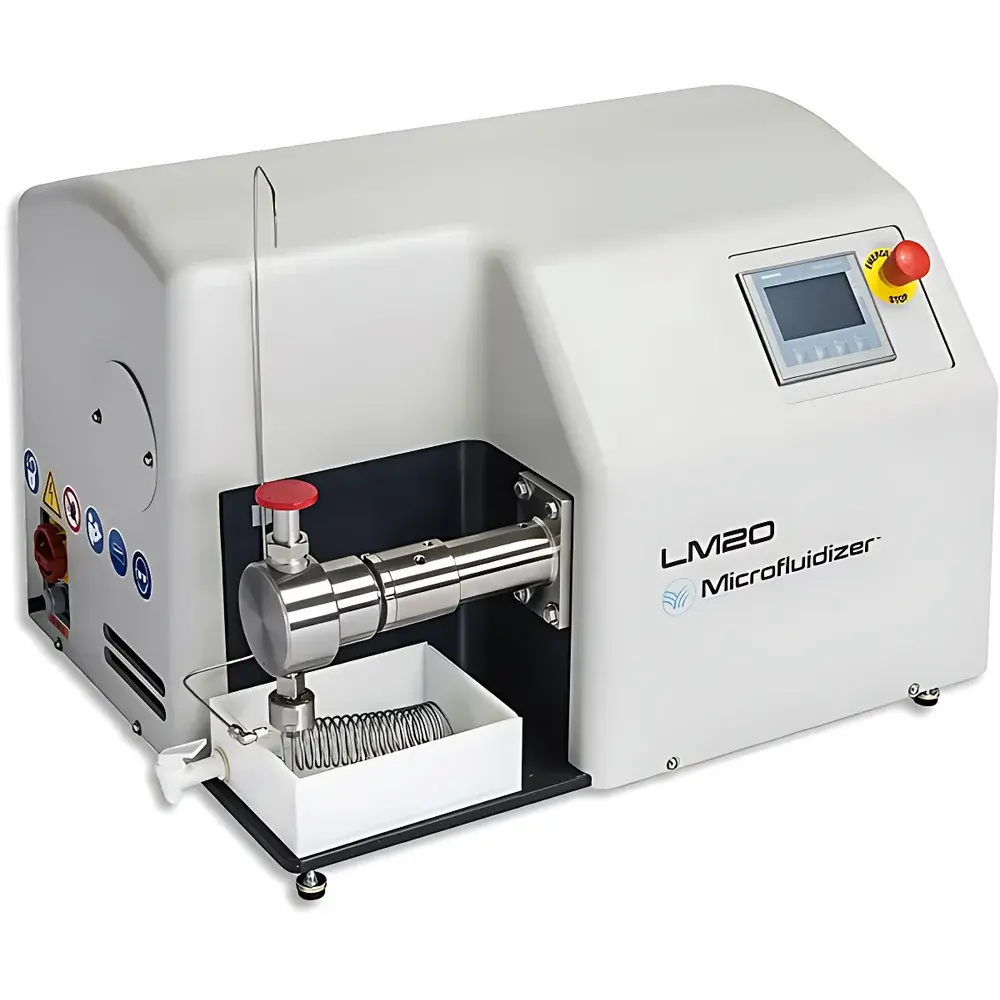
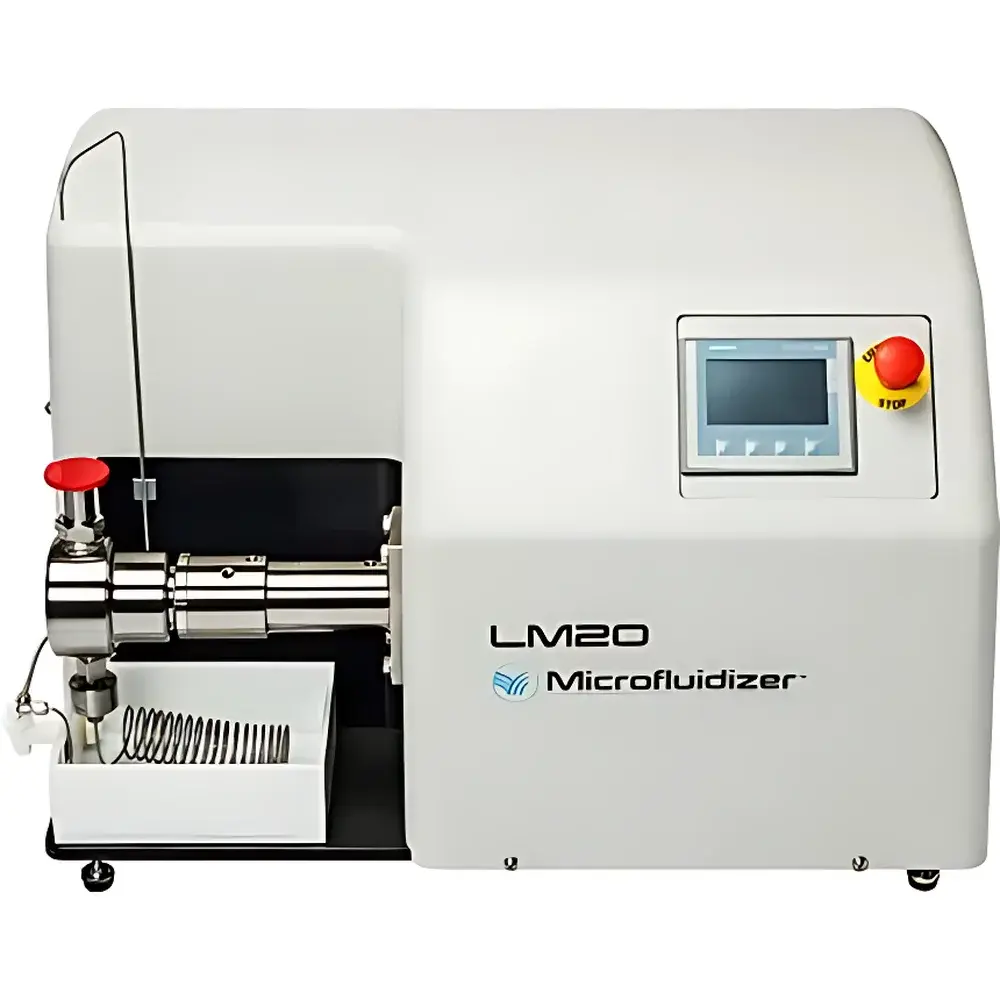
Microfluidics LM20 High-Pressure Microfluidic Homogenizer
| Brand | Microfluidics |
|---|---|
| Origin | USA |
| Model | LM20 |
| Instrument Type | High-Pressure Microfluidic Homogenizer |
| Dimensions (W×D×H) | 580 × 840 × 660 mm |
| Processing Volume Range | 14–5000 mL |
| Maximum Operating Pressure | 30,000 psi |
| Flow Rate | 60–100 mL/min |
| Minimum Sample Volume | 14 mL |
| Feed Temperature Limit | 75 °C |
| Sound Pressure Level | <80 dB(A) |
| Weight | 114 kg |
| Compliance | CE, cGMP-Compatible Design, On-Line CIP/SIP Capable |
Overview
The Microfluidics LM20 High-Pressure Microfluidic Homogenizer is an engineered platform for scalable, reproducible nano-scale particle size reduction and uniform dispersion processing. It operates on the principle of microfluidization—where sample suspension is forced under ultra-high pressure through precisely engineered microchannels within a fixed-geometry interaction chamber (typically fabricated from synthetic diamond or ceramic), inducing intense shear, cavitation, and impact forces. Unlike conventional rotor-stator or valve-based homogenizers, the LM20 delivers consistent fluid dynamics due to its constant geometry and laminar flow path, enabling exceptional batch-to-batch reproducibility and linear scalability from lab to pilot or clinical manufacturing. Designed specifically for applications demanding stringent control over particle size distribution (PSD), polydispersity index (PDI), and structural integrity—such as liposomal drug delivery systems, protein-based nanoparticles, lipid nanoparticles (LNPs), and cell lysates—the LM20 serves as a critical unit operation in GMP-aligned development workflows.
Key Features
- Diamond-based fixed-geometry interaction chamber ensures long-term dimensional stability, chemical inertness, and resistance to erosion—even with abrasive or high-viscosity formulations.
- PLC-integrated touchscreen interface with real-time pressure, temperature, and flow monitoring; supports automated method storage and recall for up to 99 protocols.
- Minimal sample requirement (as low as 14 mL) reduces material consumption during early-stage formulation screening and enables efficient use of high-value biologics or APIs.
- Thermally managed hydraulic circuit minimizes adiabatic heating; combined with optional external cooling jackets, maintains feed temperature ≤75 °C—critical for thermolabile proteins, enzymes, and nucleic acid complexes.
- On-board Clean-in-Place (CIP) and Steam-in-Place (SIP) compatibility supports rapid turnaround between batches and fulfills essential requirements for multi-product laboratory environments operating under cGMP-aligned practices.
- CE-marked construction with reinforced safety interlocks, pressure relief valves, and acoustic enclosure design (<80 dB(A)) ensures operator safety and compliance with EU Machinery Directive 2006/42/EC.
Sample Compatibility & Compliance
The LM20 accommodates a broad spectrum of aqueous and organic-phase suspensions, including but not limited to liposomal dispersions, polymeric nanoparticles, protein aggregates, viral vectors, bacterial and mammalian cell lysates, emulsions (O/W and W/O), and colloidal silica. Its robust architecture tolerates viscosities up to 10,000 cP and suspended solids content up to 40% w/v. The system meets key regulatory expectations for pharmaceutical process development: it supports ALCOA+ data integrity principles through time-stamped, user-logged operational records; facilitates audit-ready documentation aligned with FDA 21 CFR Part 11 when integrated with validated LIMS or ELN platforms; and conforms to ISO 22000 (food), ISO 13485 (medical devices), and ICH Q5A/Q5B guidelines for biological product characterization.
Software & Data Management
The embedded control software provides full traceability of all critical process parameters—including pressure ramp profiles, total pass count, cumulative processing time, and chamber temperature history. All data are saved in CSV and PDF formats with SHA-256 checksums for integrity verification. Optional Ethernet/IP connectivity allows integration into centralized SCADA or MES systems. For advanced analytics, raw pressure and flow datasets can be exported for statistical process control (SPC) evaluation, DoE modeling, or correlation with downstream characterization (e.g., DLS, TEM, HPLC-SEC). Audit trails include operator ID, timestamp, parameter modifications, and alarm events—fully compliant with GLP/GMP documentation standards.
Applications
- Preparation of sub-100 nm liposomes for mRNA vaccine delivery and small-molecule encapsulation.
- Production of albumin-bound nanoparticles (e.g., nab-paclitaxel analogs) with narrow PDI (<0.15) and high encapsulation efficiency.
- Disruption of Gram-negative and Gram-positive bacteria, yeast, and insect cells without denaturation of intracellular proteins or plasmids.
- Stabilization of oil-in-water nanoemulsions for nutraceutical and cosmetic actives.
- Generation of uniform metal oxide colloids (e.g., TiO₂, SiO₂) for catalysis and electronic ink formulation.
- Scale-down modeling for tech transfer to industrial-scale Microfluidizer® processors (e.g., M-110P, M-725).
FAQ
What is the minimum viable sample volume for method development on the LM20?
The system is validated for reliable processing down to 14 mL per run, enabling statistically meaningful formulation iterations using limited quantities of clinical-grade excipients or APIs.
Can the LM20 be used for sterile processing?
Yes—when equipped with SIP-capable chambers and tubing sets, and operated within a Grade C/D cleanroom environment, the LM20 supports aseptic processing of sterile drug products under Annex 1-compliant conditions.
How does the LM20 compare to piston-gap homogenizers in terms of particle size control?
Unlike variable-gap valve systems subject to wear-induced drift, the LM20’s fixed-geometry microchannel delivers invariant shear rate profiles across thousands of cycles—resulting in superior PSD repeatability and reduced need for post-processing filtration.
Is remote monitoring or predictive maintenance supported?
Via optional OPC UA or Modbus TCP modules, real-time sensor telemetry (pressure decay trends, motor current draw, thermal gradients) can be fed into cloud-based condition monitoring platforms for failure mode prediction and preventive servicing scheduling.



