
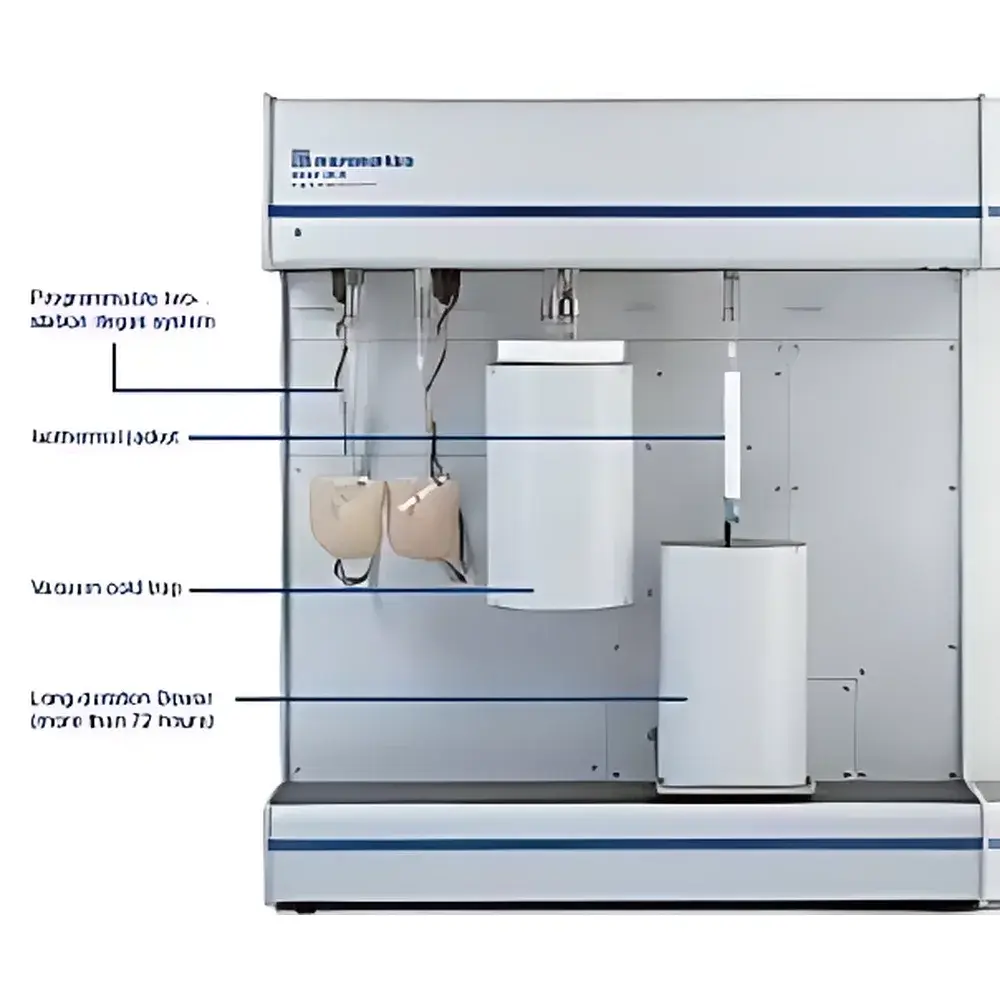
Micromeritics ASAP 2020 Accelerated Surface Area and Porosimetry System
| Brand | Micromeritics |
|---|---|
| Origin | USA |
| Manufacturer Type | Authorized Distributor |
| Origin Category | Imported |
| Model | ASAP 2020 |
| Pricing | Available Upon Request |
Overview
The Micromeritics ASAP 2020 is a high-precision, fully automated surface area and porosimetry analyzer engineered for rigorous physical adsorption characterization using the static volumetric (manometric) method. It quantifies specific surface area, pore size distribution (PSD), pore volume, and adsorption energetics by measuring equilibrium gas uptake across a controlled pressure range at cryogenic temperatures—typically using N₂ at 77 K, Ar at 87 K, or CO₂ at 273 K. The system operates on the fundamental principles of Brunauer–Emmett–Teller (BET) theory for surface area determination and Barrett–Joyner–Halenda (BJH), Density Functional Theory (DFT), and Non-Local DFT (NLDFT) models for mesopore and micropore analysis. Its design emphasizes metrological integrity: temperature-stabilized sample and reference manifolds, isothermal jacketing to maintain constant liquid nitrogen level during extended analyses, and ultra-high vacuum architecture ensure reproducibility ≤ ±1% RSD for BET surface area and ≤ ±0.1 Å resolution in the micropore region (3.5–20 Å).
Key Features
- Fully automated operation with no front-panel controls—entire workflow (degassing, equilibration, adsorption/desorption isotherm acquisition, data reduction) managed via proprietary MicroActive software
- Dual independent degassing stations: each capable of heating up to 450 °C under high vacuum (≤1×10⁻⁶ torr), equipped with dedicated two-stage mechanical pumps and cold traps to prevent condensable contamination of vacuum lines
- Single analysis station with triple-pressure sensor array (1 torr, 10 torr, 1000 torr full-scale), enabling high-resolution measurement from p/p₀ ≈ 1×10⁻⁸ to 0.995
- Three-pump vacuum architecture: primary mechanical pump for rough vacuum, dry scroll pump for intermediate vacuum, and turbomolecular pump for ultra-high vacuum (<1×10⁻⁷ torr)
- Large-capacity 3.0 L Dewar flasks for both degassing and analysis—supports uninterrupted 72-hour micropore analysis without liquid nitrogen refills
- Patented isothermal jacket system maintains stable liquid nitrogen level in both sample and saturation pressure tubes, eliminating thermal drift during long-duration isotherms
- Programmable servo-controlled evacuation valves and unidirectional sealing plugs prevent powder fluidization (“boiling”) and atmospheric recontamination during sample transfer
- Nine independent gas inlet ports support N₂, Ar, CO₂, CO, H₂, Kr, CH₄, C₂H₆, and refrigerants—enabling flexible probe molecule selection per application
Sample Compatibility & Compliance
The ASAP 2020 accommodates standard 6 mm and 9 mm OD glass sample tubes, compatible with powders, granules, monoliths, and thin-film substrates. It meets ASTM D3663 (BET surface area), ISO 9277 (surface area by gas adsorption), and ISO 15901-2 (pore size distribution by gas adsorption) requirements. Data acquisition and processing comply with GLP/GMP traceability standards: audit trails, electronic signatures, and 21 CFR Part 11–ready software configuration are available upon validation. All hardware components—including pressure transducers, temperature sensors, and vacuum gauges—are NIST-traceable and calibrated per ISO/IEC 17025 protocols.
Software & Data Management
MicroActive software provides integrated isotherm modeling, including BET, Langmuir, t-plot, αs-plot, BJH, DH, Dollimore-Healy, and advanced DFT/NLDFT kernel libraries covering slit, cylindrical, and spherical pore geometries with multiple adsorbate–surface interaction models. It delivers full PSD (0.35–5000 Å), surface energy distribution (SED), isosteric heat of adsorption (via Clausius–Clapeyron), and Freundlich–Temkin isotherm fitting. Raw data export supports CSV, XML, and ASTM E1358-compliant formats; batch processing, report templating, and SQL database integration enable enterprise-level data governance.
Applications
The system serves as a core characterization tool in catalysis (e.g., zeolite, MOF, and supported metal catalysts), energy materials (hydrogen storage media, battery electrode carbons, fuel cell membranes), pharmaceuticals (excipient surface heterogeneity, amorphous content assessment), environmental science (activated carbon pore tuning, soil sorption studies), and advanced ceramics (sintering density correlation, nanoparticle agglomeration analysis). Its H₂ adsorption capability (up to 100 bar optional upgrade) supports DOE-relevant hydrogen storage benchmarking per SAE J2718.
FAQ
What adsorption theories and models are embedded in the ASAP 2020 software?
BET, Langmuir, t-plot, αs-plot, BJH, DH, Dollimore–Healy, DFT, NLDFT, QSDFT, and surface energy distribution (SED) models—all accessible via MicroActive.
Can the instrument perform both physisorption and chemisorption on the same platform?
Yes—the ASAP 2020 can be upgraded with TPD/TPO modules and pulse chemisorption accessories to support combined physisorption–chemisorption workflows.
Is liquid nitrogen handling automated?
No manual refilling is required during analysis: the 3.0 L Dewar enables up to 72 hours of continuous operation at 77 K; auto-fill systems are available as optional accessories.
Does the system support regulatory-compliant data archiving?
Yes—when configured with validated MicroActive software, it supports 21 CFR Part 11 compliance, including user access control, electronic signatures, and immutable audit trails.
What is the smallest detectable surface area and pore volume?
Surface area detection limit: 0.0005 m²/g (using Kr at 77 K); pore volume detection limit: 0.0001 cm³/g.



