
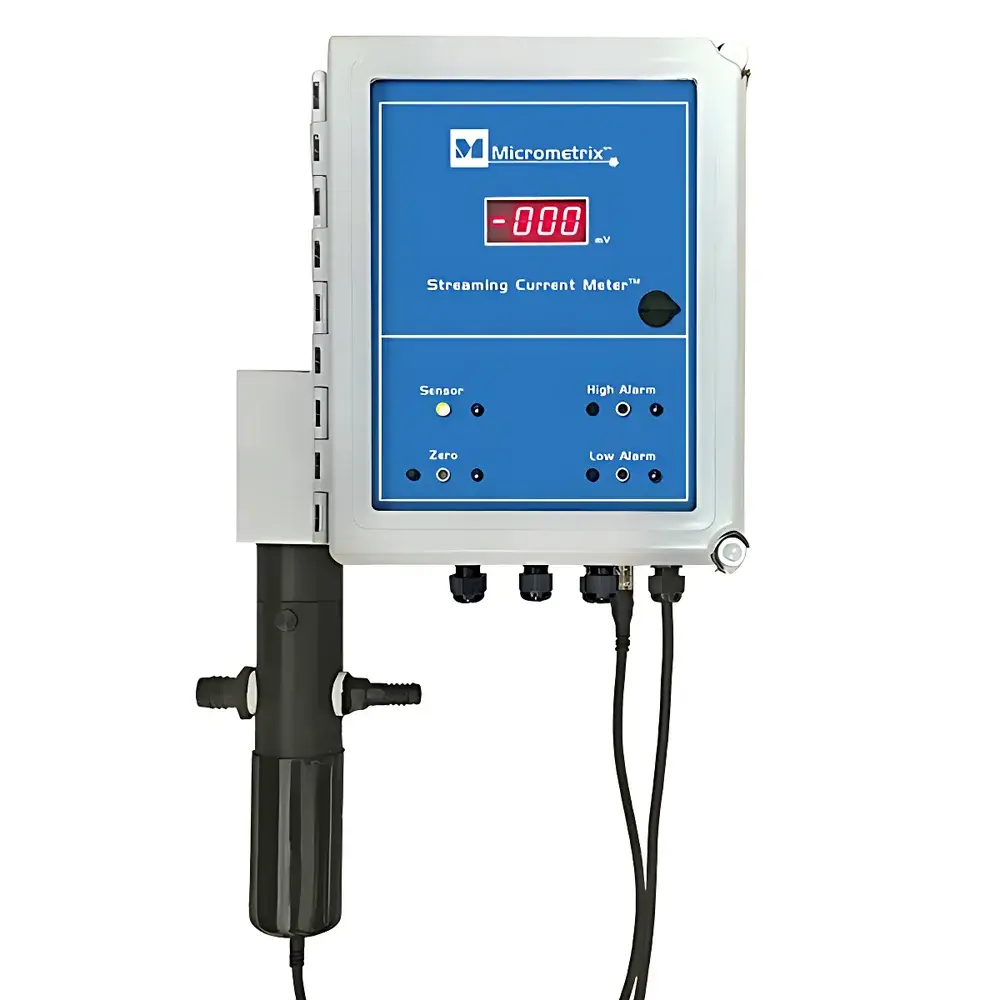
Micrometrix SCM-1 Streaming Current Monitor
| Brand | Micrometrix |
|---|---|
| Origin | USA |
| Model | SCM-1 |
| Measurement Range | −1000 to +1000 mV |
| Output | 4–20 mA, ±10 V, 0–10 V |
| Display | LED, millivolt resolution |
| Flow Rate | 1 L/min (standard), 5 GPM (optional) |
| Inlet/Outlet | 1/2″ barb inlet, 3/4″ barb outlet |
| Response Time | 1 second |
| Accuracy | ±0.1% of full scale |
| Enclosure | NEMA 4X, IP65 |
| Power | 230 VAC |
| Probe Materials | Delrin®, 316 stainless steel, PTFE |
| Sensor Serviceability | Replaceable piston, disposable PTFE sleeve, field-swappable electrodes |
| Communication | Modbus RTU (optional) |
| Alarm Outputs | Dual SPDT relays with adjustable setpoints |
| Zero & Sensitivity Adjustment | Front-panel accessible, continuous analog tuning |
| Diagnostic Indication | Flashing LED status indicator |
Overview
The Micrometrix SCM-1 Streaming Current Monitor is an industrial-grade, in-line electrokinetic sensor system engineered for real-time measurement and control of streaming current (SC) — a direct indicator of colloidal charge stability in water and wastewater treatment processes. Based on the principle of electrokinetic potential generation at solid–liquid interfaces under controlled laminar flow, the SCM-1 quantifies the net surface charge of suspended particles by measuring the voltage differential induced across a precision-machined flow cell. This parameter — commonly reported as Streaming Current Density (SCD) — correlates strongly with coagulant demand, floc formation efficiency, and overall coagulation–flocculation performance. Unlike optical or turbidimetric methods, streaming current measurement provides early, chemically specific feedback on charge neutralization dynamics, enabling proactive dosing control before turbidity or particle count deviations occur. The SCM-1 is designed for permanent installation in raw water, clarified effluent, or filter influent streams, supporting both municipal drinking water plants and industrial wastewater facilities operating under strict regulatory compliance frameworks.
Key Features
- Field-serviceable probe architecture with modular, tool-free disassembly — no specialized tools required for routine maintenance
- Disposable PTFE-lined flow sleeves and replaceable pistons ensure long-term measurement fidelity without recalibration drift
- Dual independent electrode replacement capability preserves probe longevity and minimizes downtime
- Integrated zero-point adjustment and continuous sensitivity tuning via front-panel controls for process-specific calibration
- NEMA 4X/IP65 non-metallic enclosure rated for outdoor, wet, and corrosive environments — includes tamper-resistant locking provisions
- Multi-output interface: isolated 4–20 mA analog output, ±10 V and 0–10 V DC signals, plus optional Modbus RTU serial communication
- Self-diagnostic functionality with status-indicating LED and relay-based high/low alarm outputs with user-defined setpoints
- Sub-second response time (<1 s) enables closed-loop feedback control integration with SCADA or DCS systems
Sample Compatibility & Compliance
The SCM-1 accepts aqueous samples across a broad conductivity range (20–2000 µS/cm) and pH 4–11, making it compatible with surface water, groundwater, tertiary effluents, and membrane concentrate streams. Its Delrin® and 316 stainless steel wetted parts meet NSF/ANSI Standard 61 requirements for potable water contact. The flow cell design conforms to ASTM D5893-17 (Standard Test Method for Streaming Current Detection) and supports GLP/GMP-aligned data integrity through traceable zero/sensitivity adjustments and diagnostic logging. While not intrinsically safe, the unit may be installed in Class I, Division 2 hazardous locations when housed in approved enclosures per NEC Article 500.
Software & Data Management
The SCM-1 operates as a standalone analog transmitter but integrates seamlessly into plant-wide automation infrastructures. When equipped with the optional Modbus RTU module, it supports register-level access to live SC values, diagnostic flags, and alarm states — compatible with leading SCADA platforms including Siemens Desigo, Honeywell Experion, and Emerson DeltaV. All analog outputs are internally scaled and linearized; no external signal conditioning is required. The instrument maintains audit-ready operational history via LED-based fault codes and relay event timestamps, satisfying basic FDA 21 CFR Part 11 record-keeping prerequisites when paired with compliant historian systems.
Applications
- Optimization of coagulant (e.g., alum, ferric chloride, polyaluminum chloride) dosing in conventional and direct filtration plants
- Real-time monitoring of charge reversal during over-dosing events to prevent restabilization of colloids
- Control logic input for automated chemical feed pumps in adaptive dosing strategies
- Performance validation of membrane pretreatment systems prior to ultrafiltration or reverse osmosis
- Troubleshooting seasonal variations in raw water treatability (e.g., NOM spikes, algal blooms)
- Regulatory reporting support for coagulation efficiency benchmarks under EPA Clean Water Act guidelines
FAQ
What is the difference between SCM-1 and SCM-2?
The SCM-1 is the base model optimized for indoor or sheltered installations with standard NEMA 12 housing; the SCM-2 features a fully sealed NEMA 4X/IP65 non-metallic enclosure rated for direct outdoor exposure and harsh environmental conditions.
Can the SCM-1 be used for seawater or brackish water applications?
No — elevated ionic strength (>5,000 µS/cm) suppresses measurable streaming current response; the instrument is validated only for freshwater and low-salinity wastewater matrices.
Is calibration required after replacing the PTFE sleeve or piston?
No — the mechanical and electrical design ensures repeatable baseline performance; only zero-point verification is recommended post-maintenance.
Does the unit support HART protocol?
No — HART is not supported; only 4–20 mA analog and optional Modbus RTU are available communication options.
What maintenance interval is recommended for routine operation?
Inspect PTFE sleeve condition every 3–6 months depending on suspended solids loading; replace piston and sleeve annually or after 5,000 operating hours, whichever occurs first.







