
Micronit LOC-1 Microfluidic Droplet Generator Platform
| Brand | Micronit |
|---|---|
| Origin | Netherlands |
| Manufacturer Type | Authorized Distributor |
| Product Category | Imported |
| Model | LOC-1 |
| Price Range | USD 6,800 – 13,600 (est.) |
| Chip Interface | Standard Glass-Based Microfluidic Cartridge |
| Fluidic Control Compatibility | Pressure-Driven (e.g., MFCS) or Syringe Pump-Based |
| Optical Transparency | Full Visible to NIR Transmission |
| Material | Borosilicate Glass (HF-etched, Cleanroom-Fabricated) |
| Surface Treatments | Native Hydrophilic or Fluoropolymer-Coated Hydrophobic |
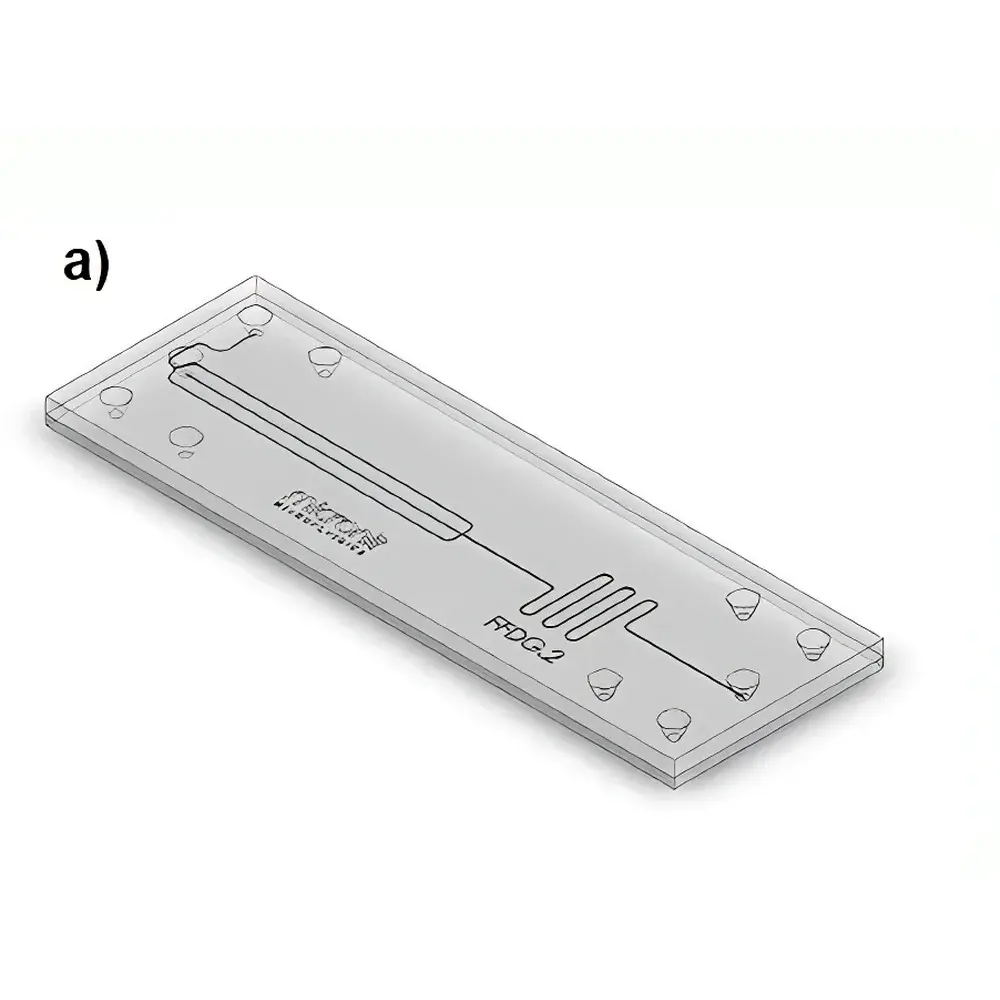
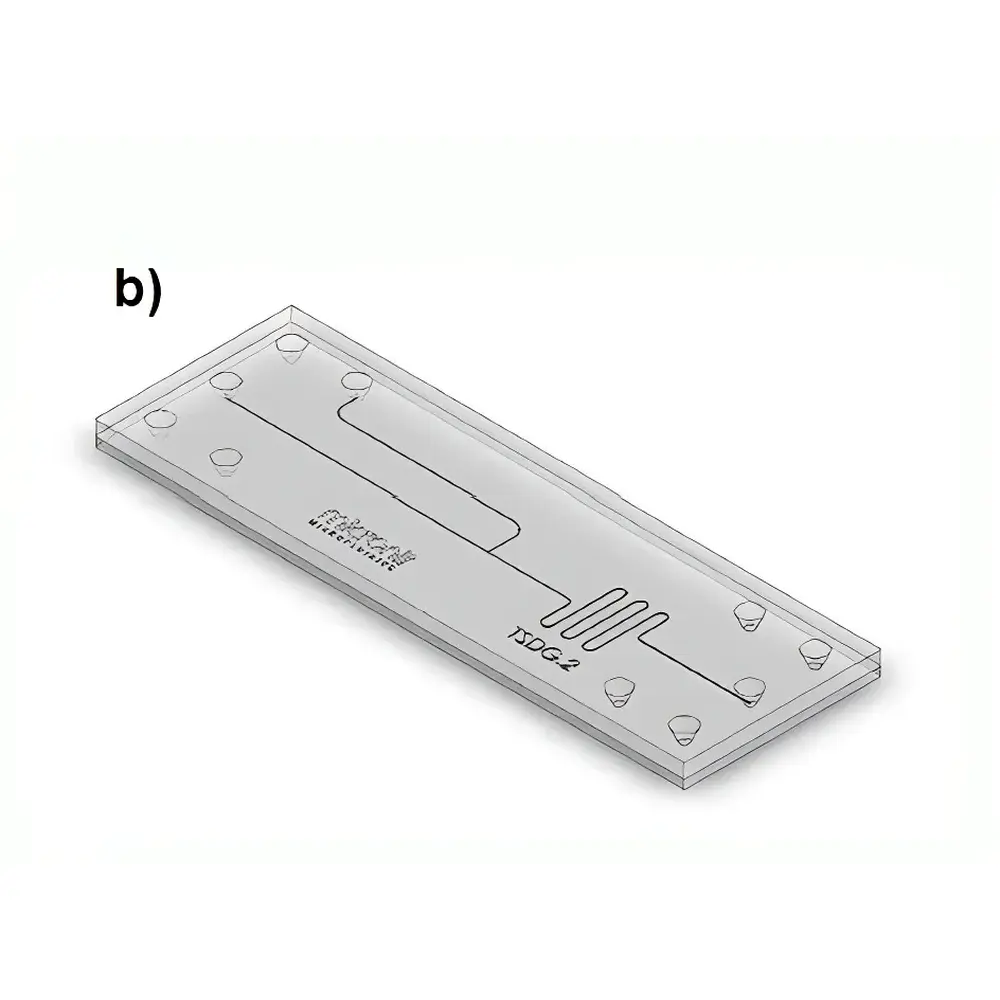
| Chip Architectures | T-Junction and Flow-Focusing (Cross-Junction) Configurations |
| Customization Support | CAD-Based Design-to-Manufacturing Workflow (Lead Time: 4–5 Weeks) |
Overview
The Micronit LOC-1 Microfluidic Droplet Generator Platform is a precision-engineered experimental system designed for the controlled, reproducible generation of monodisperse microdroplets in the 10–500 µm diameter range. It operates on the principle of hydrodynamic flow focusing or interfacial shear-induced droplet breakup—governed by laminar co-flow dynamics within microfabricated glass channels. Unlike bulk emulsification methods, this platform enables deterministic control over droplet size, polydispersity index (PDI < 0.05 typical), generation frequency (0.1–10,000 Hz), and phase composition via precise modulation of volumetric flow ratios, interfacial tension, and channel geometry. The core component—the LOC-1 cartridge—is fabricated using deep reactive ion etching (DRIE) and anodic bonding in Class 100 cleanroom facilities, ensuring sub-micron dimensional fidelity, surface roughness < 5 nm RMS, and long-term chemical inertness toward organic solvents, aqueous buffers, and biological media.
Key Features
- Borosilicate glass microfluidic chips with certified optical clarity (transmission >92% from 350–2500 nm), enabling real-time high-resolution microscopy, fluorescence monitoring, and inline spectroscopic characterization.
- Two standardized chip architectures: T-junction for high-throughput droplet generation (>10⁴ droplets/min) and flow-focusing (cross-junction) for ultra-low polydispersity and fine-tuned size control under low-capillary-number regimes.
- Surface functionalization options: native hydrophilic surface (contact angle ~25°) optimized for oil-in-water (O/W) emulsions; fluoropolymer-coated hydrophobic surface (contact angle >110°) for stable water-in-oil (W/O) systems.
- Modular mechanical interface compatible with standard micromanipulators, inverted microscopes, and pressure-driven fluidic controllers (e.g., Fluigent MFCS-EZ), supporting seamless integration into automated lab-on-chip workflows.
- Scalable design framework: single-chip footprint supports multi-array configurations; identical channel cross-sections across T- and cross-junction variants enable direct performance comparison and method transfer.
- No moving parts in the chip itself—eliminating wear-related drift and enabling >1,000 hours of continuous operation without recalibration when operated within recommended pressure (≤5 bar) and temperature (15–40 °C) limits.
Sample Compatibility & Compliance
The LOC-1 platform accommodates a broad spectrum of immiscible fluid pairs—including but not limited to: silicone oils/water, hexadecane/PBS, fluorinated oils/perfluorocarbon surfactants, and biocompatible lipid formulations. All glass components comply with ISO 10993-5 (cytotoxicity) and USP (plastic materials—adapted equivalency for borosilicate substrates). Surface treatments are validated per ASTM D7334 (surface energy measurement) and ISO 8510-2 (contact angle hysteresis). For regulated environments, the platform supports GLP-compliant documentation packages, including material traceability certificates (EN 10204 3.1), cleanroom fabrication logs, and batch-specific dimensional inspection reports. While the LOC-1 itself is not FDA-cleared, it is routinely deployed in preclinical formulation development aligned with ICH Q5C and Q5D guidelines.
Software & Data Management
The LOC-1 is hardware-agnostic—it does not include proprietary software but integrates natively with industry-standard control environments: MATLAB® via Data Acquisition Toolbox, Python (PySerial/PyVISA), LabVIEW™, or third-party fluidic controller GUIs (e.g., Fluigent’s MAESFLO™). Experimental metadata—including flow rate setpoints, pressure traces, timestamped image acquisition triggers, and environmental logs—can be exported in HDF5 or CSV format for FAIR (Findable, Accessible, Interoperable, Reusable) data management. When paired with high-speed imaging systems, the platform supports synchronization signals compliant with IEEE 1588 PTP for sub-millisecond temporal alignment across distributed sensors—critical for kinetic studies of droplet coalescence, encapsulation efficiency, or reaction progress monitoring.
Applications
- Encapsulated bioreactor development: Single-cell isolation and culture in picoliter-volume aqueous droplets for microbial screening, directed evolution, and synthetic biology.
- Pharmaceutical formulation: Screening of lipid nanoparticle (LNP) and polymeric micelle compositions for mRNA delivery, with real-time size distribution tracking via inline dynamic light scattering (DLS) coupling.
- Food-grade emulsion engineering: Controlled fabrication of flavor oil-in-water droplets with tunable oxidative stability and release kinetics, meeting ISO 22000 process validation requirements.
- Diagnostic assay miniaturization: Digital ELISA and PCR partitioning platforms requiring absolute quantification via Poisson-distributed droplet occupancy.
- Materials science: Templated synthesis of uniform polymer beads, magnetic nanoparticles, and porous silica microcarriers with narrow size dispersity (Đ < 1.05).
FAQ
What fluidic drivers are recommended for optimal droplet monodispersity?
Pressure-driven systems (e.g., Fluigent MFCS series) are strongly recommended over syringe pumps due to their <40 ms flow response time and absence of pulsatile artifacts—critical for maintaining capillary number stability during transient operation.
Can the LOC-1 platform be used for cell encapsulation applications?
Yes—when operated with sterile-filtered media, low-shear surface coatings (e.g., Pluronic F-127), and validated biocompatible oils (e.g., HFE-7500), the LOC-1 has been successfully applied in single-cell RNA-seq library prep workflows compliant with 10x Genomics™ compatibility benchmarks.
Is custom chip geometry supported beyond T-junction and cross-junction designs?
Yes—Micronit offers full custom microfluidic design services based on customer-provided CAD files (STEP/IGES) or functional specifications; design review, DFM analysis, and qualification testing are included in the standard 4–5 week lead time.
How is chip-to-chip performance reproducibility ensured?
Each LOC-1 batch undergoes 100% channel geometry verification via white-light interferometry and SEM cross-section sampling; dimensional tolerances are maintained within ±0.3 µm for critical features, guaranteeing inter-batch CV < 2.1% in droplet diameter under identical operating conditions.
Does the platform support temperature-controlled operation?
While the base LOC-1 cartridge is ambient-rated, it can be mounted onto commercially available Peltier-stage microscope adapters (e.g., Tokai Hit INU series) for active thermal regulation between 4 °C and 60 °C—enabling studies of temperature-dependent interfacial rheology and phase transition kinetics.



