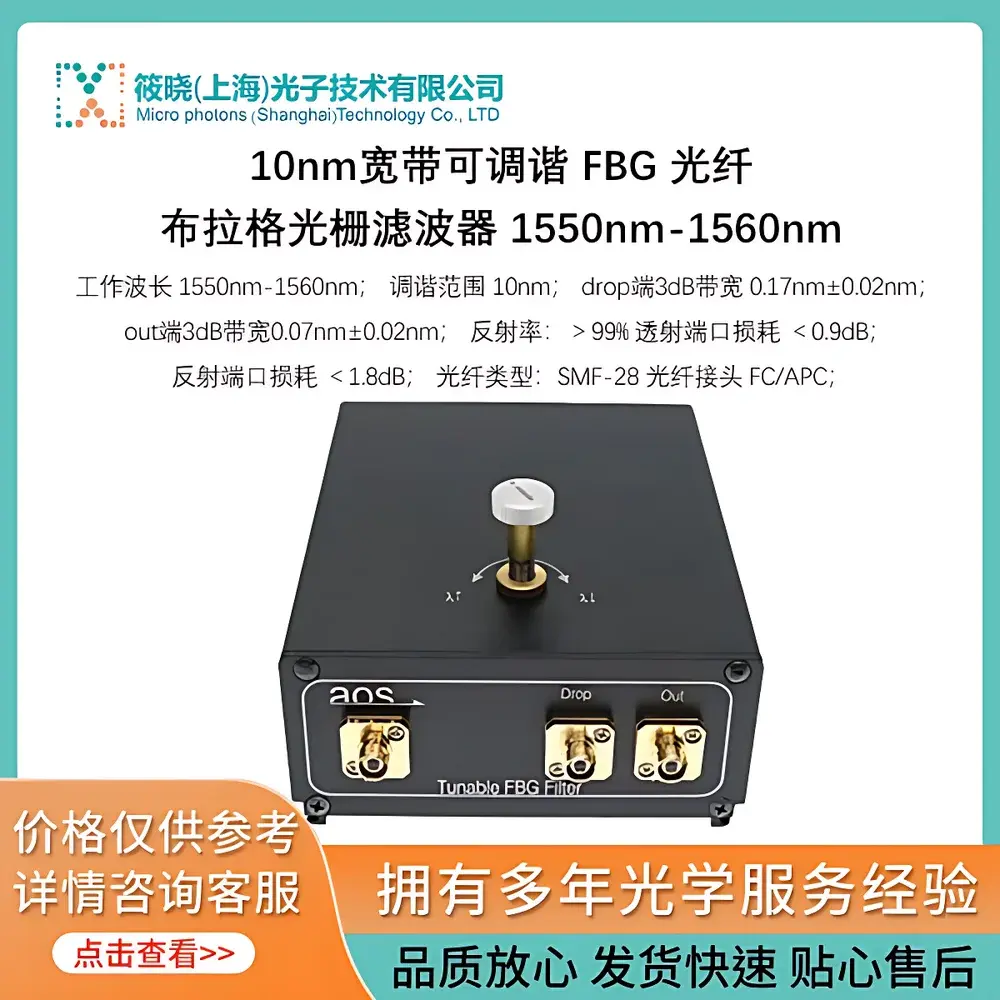
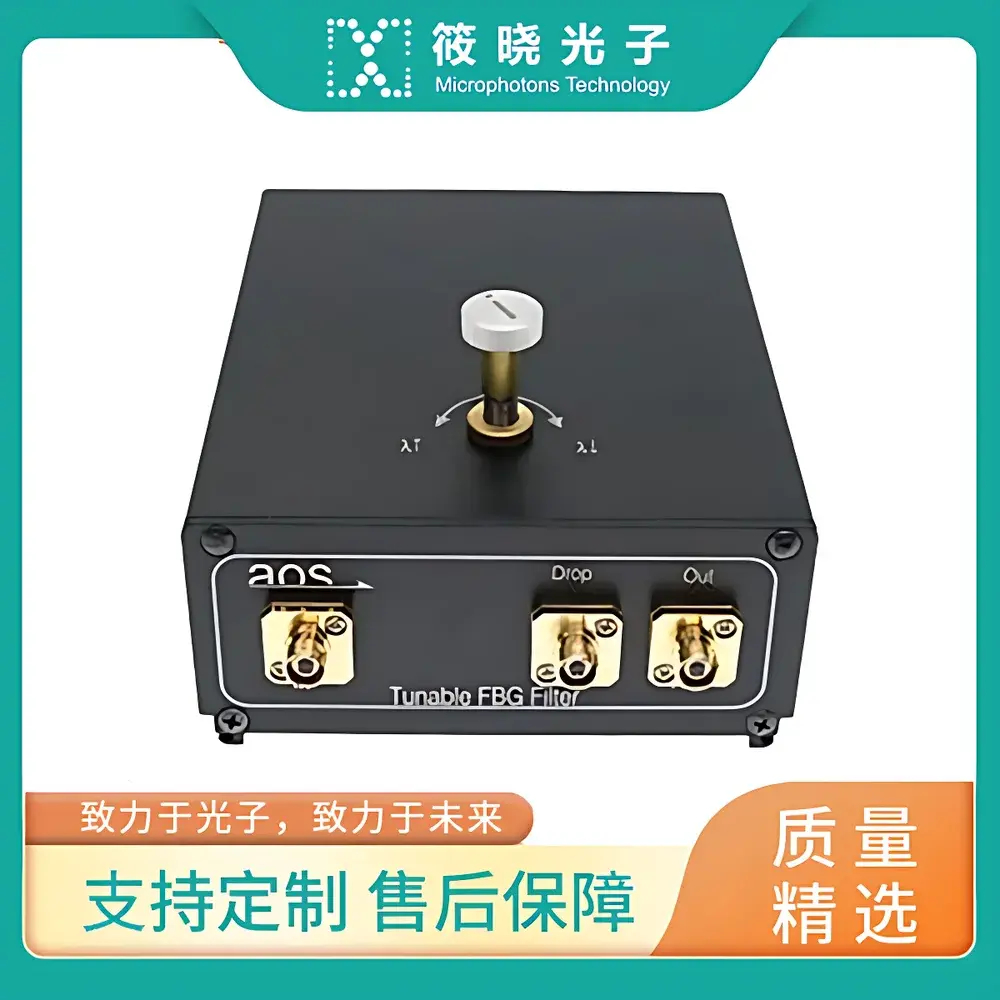
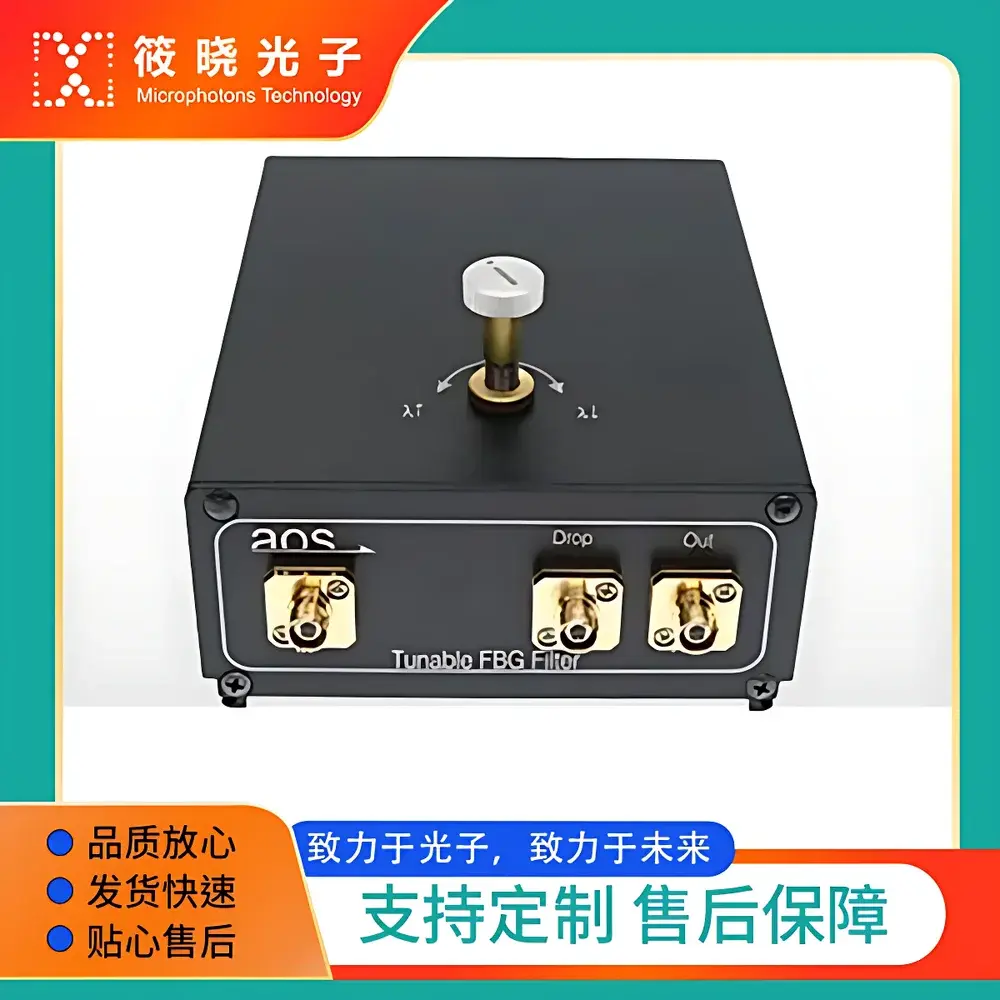
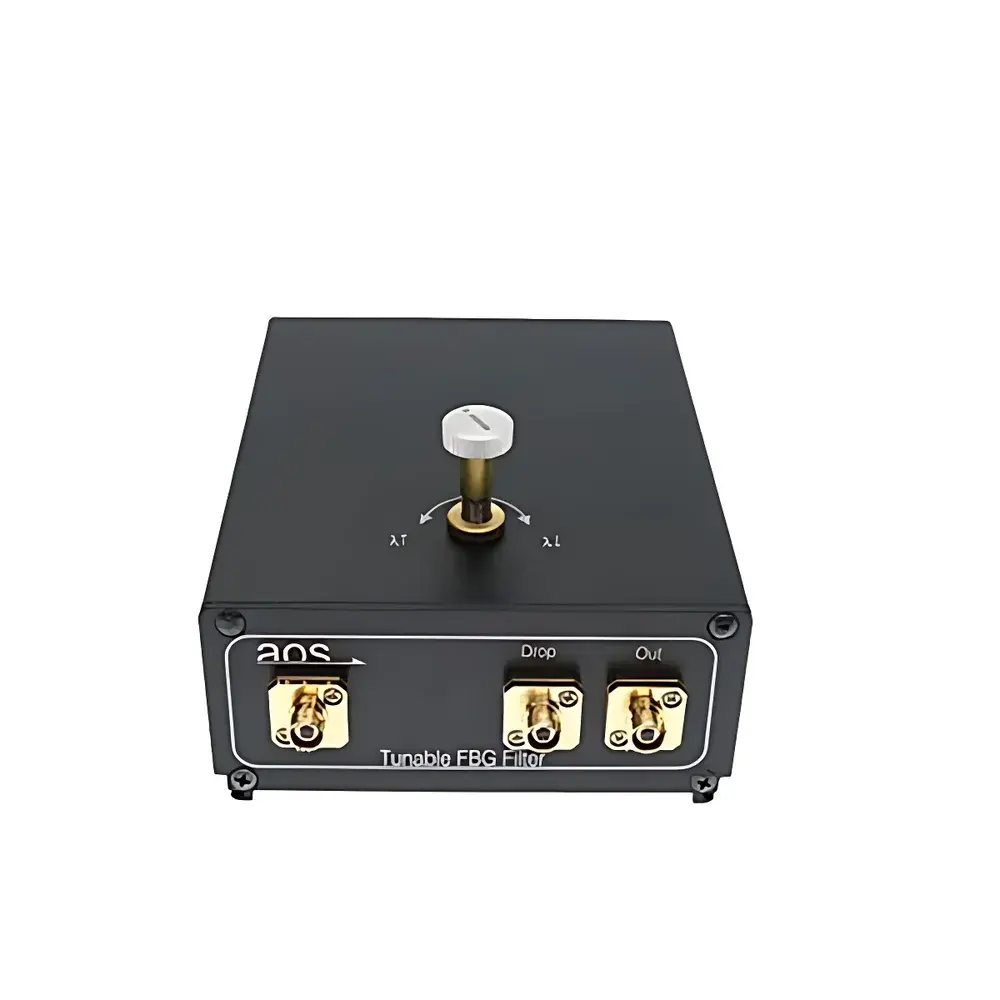
Microphotons MP-TFF-5-FA 10 nm Tunable Bandwidth FBG Fiber Bragg Grating Filter (1550–1560 nm)
| Brand | Microphotons |
|---|---|
| Origin | Germany |
| Manufacturer Type | Manufacturer |
| Origin Category | Imported |
| Model | MP-TFF-5-FA |
| Price | Upon Request |
Overview
The Microphotons MP-TFF-5-FA is a precision-engineered, mechanically tunable Fiber Bragg Grating (FBG) filter operating in the C-band telecom window. It leverages the fundamental principle of Bragg resonance in photosensitive optical fiber: when a periodic modulation of the core’s effective refractive index is inscribed via UV exposure, incident light at the Bragg wavelength λB = 2neffΛ is reflected, while all other wavelengths propagate with minimal perturbation. Tuning is achieved through controlled axial strain applied to the grating region—typically via a micrometer-driven translation stage—altering both the grating period Λ and the effective index neff. This enables continuous, repeatable wavelength adjustment across a 10 nm range (1550–1560 nm), with sub-picometer mechanical stability and hysteresis < ±0.01 nm over repeated cycles. Designed for integration into dense wavelength-division multiplexing (DWDM) test benches, laser cavity feedback control, and optical coherence domain reflectometry (OCDR), the device delivers deterministic spectral selectivity without active electronics or thermal tuning elements.
Key Features
- Continuous 10 nm mechanical tuning range (1550–1560 nm) with < ±0.01 nm repeatability
- Narrowband spectral response: Drop port 3 dB bandwidth = 0.17 nm ± 0.02 nm; Through port 3 dB bandwidth = 0.07 nm ± 0.02 nm
- Low insertion loss: < 0.9 dB at transmission port; < 1.8 dB at reflection port
- High extinction ratio: >100 dB side-mode suppression in reflection spectrum
- Robust mechanical architecture with stainless-steel housing and kinematic strain transfer mechanism
- FC/APC connectorized interface for polarization-maintaining compatibility and low back-reflection performance
- Operating temperature range: 0–45 °C (no active thermal stabilization required)
Sample Compatibility & Compliance
The MP-TFF-5-FA is compatible with standard single-mode fiber (SMF-28e+) and polarization-maintaining (PM1550) fiber configurations upon customization. Its passive, all-fiber construction ensures immunity to electromagnetic interference (EMI) and compliance with IEC 61300-2-4 (fiber optic connector durability) and Telcordia GR-1209-CORE (reliability of passive components). While not certified to ISO/IEC 17025 for metrological traceability, the device supports GLP/GMP-aligned validation protocols when integrated into calibrated optical test systems. Its mechanical tuning mechanism avoids thermally induced drift, making it suitable for applications requiring long-term spectral stability under ambient lab conditions—consistent with ASTM F2753-09 (standard practice for characterization of tunable optical filters).
Software & Data Management
As a purely passive, manually tuned component, the MP-TFF-5-FA does not include embedded firmware or digital interfaces. However, it is fully interoperable with industry-standard optical test platforms including Keysight N77xx series optical power meters, EXFO FTB-500 optical spectrum analyzers, and Thorlabs TSP01 temperature controllers (for environmental correlation studies). Users may log tuning position vs. measured Bragg wavelength using external interferometric references (e.g., scanning Fabry–Pérot etalons traceable to NIST SRM 2034). For automated test systems, the micrometer actuator can be retrofitted with OEM-compatible stepper motor stages (e.g., Newport ESP300 controller), enabling programmable wavelength sweeps under LabVIEW or Python-based instrument control frameworks compliant with IVI-COM and SCPI standards.
Applications
- Wavelength-selective signal routing and channel isolation in DWDM system verification
- Background noise rejection in high-sensitivity optical time-domain reflectometry (OTDR) and distributed acoustic sensing (DAS)
- External cavity stabilization for tunable diode lasers and fiber lasers
- Spectral calibration reference for broadband sources in spectroscopic instrumentation
- Dynamic filtering in reconfigurable optical add-drop multiplexer (ROADM) prototyping
- Coherence-gated filtering in swept-source optical coherence tomography (SS-OCT) development
FAQ
Is the tuning range truly continuous and reversible?
Yes—mechanical strain tuning provides monotonic, hysteresis-corrected wavelength displacement with full reversibility over ≥10⁵ tuning cycles.
What is the typical polarization-dependent loss (PDL) of this filter?
Measured PDL is < 0.05 dB across the entire 10 nm tuning range when used with SMF-28e+ fiber.
Can the device be customized for PM fiber pigtails or different connector types?
Yes—customization options include PM1550 pigtails, FC/PC, SC/APC, or bare-fiber input/output configurations; lead time extends by 2–3 weeks.
Does the filter support operation outside the specified temperature range?
Extended operation down to –5 °C or up to 55 °C is possible but may reduce tuning linearity and increase thermal drift beyond ±0.03 nm/°C.
How is wavelength calibration performed during manufacturing?
Each unit undergoes spectral characterization using a calibrated OSA referenced to a stabilized HeNe laser (632.8 nm) and an Er-doped fiber comb source traceable to NIST.