
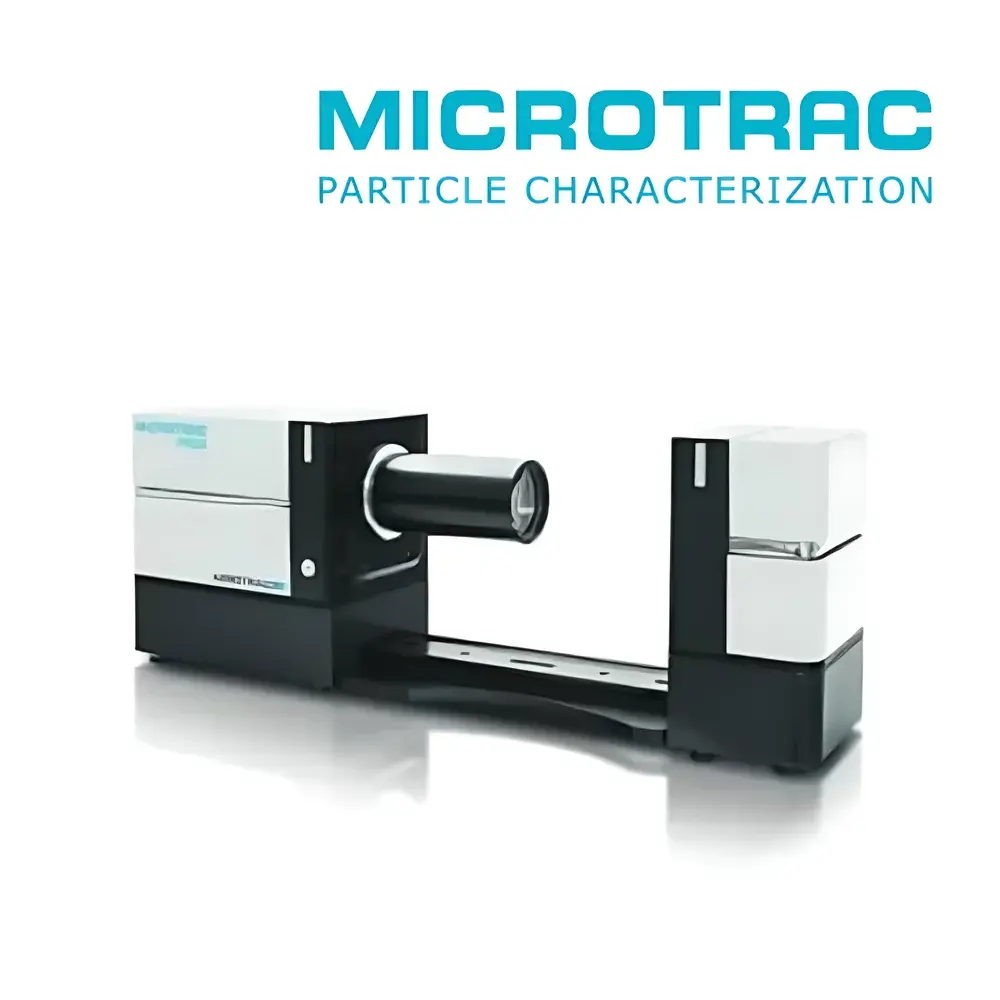
Microtrac AEROTRAC II Laser Spray Particle Size Analyzer
| Brand | Microtrac |
|---|---|
| Origin | Germany |
| Model | AEROTRAC II |
| Dispersion Method | Dry Dispersion |
| Instrument Type | Laboratory Laser Diffraction Particle Size Analyzer |
| Measurement Range | 0.5–2,000 µm |
| Repeatability | ≤1% |
| Measurement Time | 10–15 seconds |
| Optical Principle | Static Laser Diffraction with Full-Range Mie Theory Processing |
| Laser Source | Semiconductor Laser |
| Auto-Focusing | Yes |
| Trigger Mode | Automatic Pulse Detection |
| Software Platform | Windows-Compatible Analysis Suite |
| Optional Accessories | PD-10S Dry Spray Module, SC-13 Wet Dispersion Unit, MB-600 Motorized Translation Stage |
| Compliance | Designed for ASTM E799, ISO 13320, and USP <429> alignment |
Overview
The Microtrac AEROTRAC II is a purpose-engineered laser diffraction spray particle size analyzer optimized for real-time, non-invasive characterization of aerosolized droplets and dry powder sprays in laboratory environments. Unlike conventional wet-suspension laser diffraction systems, the AEROTRAC II employs static laser diffraction in free-fall or jet-stream configurations—enabling direct measurement of particles in motion without dilution, solvent interaction, or sedimentation bias. Its optical architecture integrates a high-stability semiconductor laser source, a wide-field detection array (0.02°–175° scattering angle), and real-time auto-focusing optics to maintain optimal beam-sample interaction across dynamic spray plumes. The system applies full-range Mie theory for rigorous optical modeling—accounting for particle refractive index, absorption coefficient, and shape anisotropy—ensuring traceable, physics-based size distribution calculations from 0.5 µm to 2,000 µm. Designed for industrial R&D and QC laboratories, it delivers statistically robust data under transient spray conditions—critical for validating nozzle performance, atomizer efficiency, inhaler dose uniformity, and powder coating consistency.
Key Features
- Real-time pulse-triggered acquisition synchronized with spray events—eliminates timing drift and captures representative transient distributions
- Modular optical platform with interchangeable measurement zones: standard spray chamber, extended-path configuration for low-velocity plumes, and coaxial alignment ports for inline process integration
- Dual-mode operation: dry dispersion via PD-10S pneumatic spray module (for powders and agglomerate-limited aerosols) and optional wet dispersion using SC-13 flow cell with Tempax® quartz cuvette (for slurries and viscous suspensions)
- Compact, rigid optical bench with vibration-damped base and temperature-stabilized laser diode—engineered for long-term measurement stability in shared lab environments
- Automated focus calibration and beam profiling prior to each measurement cycle—ensures consistent spatial resolution and minimizes operator-dependent setup variance
- Multi-scattering correction algorithm embedded in standard firmware—validates single-scattering assumptions and applies iterative deconvolution where multiple scattering exceeds 15% intensity threshold
Sample Compatibility & Compliance
The AEROTRAC II accommodates a broad spectrum of spray and powder morphologies: pressurized liquid droplets (e.g., metered-dose inhalers, agricultural nozzles), ultrasonic mists (humidifiers, cosmetic mists), electrostatic powder coatings, fluidized bed sprays, and centrifugal atomizer outputs. Its universal mounting interface accepts spray sources ranging from 2 mm capillary tips to 50 mm rotary atomizers via configurable kinematic fixtures (MB-600 motorized stage enables repeatable XYZ positioning within ±5 µm). All wet-path components comply with ISO 8573-1 Class 2 compressed air purity standards when used with PD-10S; Tempax® cuvettes meet USP optical clarity and thermal shock resistance requirements. System design aligns with ISO 13320:2020 for laser diffraction methodology and supports audit-ready documentation per FDA 21 CFR Part 11 when paired with validated software modules.
Software & Data Management
The AEROTRAC II operates on a Windows-based analysis suite featuring intuitive workflow navigation, customizable report templates (PDF/CSV/XLSX export), and batch processing for multi-run comparative analysis. Raw scattering patterns are stored in HDF5 format with embedded metadata (timestamp, trigger latency, environmental humidity/temperature logs). Statistical evaluation includes D10/D50/D90, span, relative width, and modal distribution overlays. Advanced users may access raw angular intensity arrays for third-party Mie inversion or custom kernel development. The software supports LIMS integration via ASTM E1482-compliant XML schema and offers optional electronic signature, change control, and audit trail modules compliant with GLP and GMP documentation frameworks.
Applications
- Aerosol pharmaceutical development: DPI and pMDI spray characterization per Ph. Eur. 2.9.18 and USP
- Agrochemical formulation optimization: pesticide droplet size mapping for drift mitigation and foliar coverage modeling
- Automotive paint and coil coating QC: dry powder spray uniformity assessment prior to electrostatic deposition
- Food ingredient atomization: milk powder, coffee extract, and flavor encapsulate spray drying validation
- Industrial humidifier and misting system certification: compliance verification against ISO 21501-4 for airborne particle concentration
- Academic combustion research: fuel injector spray breakup dynamics and Sauter mean diameter correlation with injection pressure
FAQ
What particle refractive indices are supported in the Mie calculation engine?
The software includes a built-in database of >120 materials (e.g., polystyrene latex, titanium dioxide, lactose, water) and allows user-defined complex refractive index inputs (n + ik) for custom formulations.
Can the AEROTRAC II measure polydisperse sprays with bimodal or trimodal distributions?
Yes—the full angular detection range and high-resolution CCD array enable resolution of distinct modes separated by ≥2.5× in geometric diameter, validated per ISO 13320 Annex B.
Is external environmental control (e.g., humidity chamber) required for stable measurements?
Not mandatory, but recommended for hygroscopic powders; the system reports ambient RH/T during acquisition and allows post-hoc correction using empirical sorption models.
How is instrument calibration verified between runs?
NIST-traceable PSL and glass microsphere reference standards (e.g., NIST SRM 1963, 2800) are measured daily; calibration status is logged automatically and flagged if D50 deviation exceeds ±0.8% of certified value.
Does the system support automated pass/fail criteria against predefined specification limits?
Yes—custom acceptance rules (e.g., “D90 ≤ 45 µm AND Span ≤ 1.8”) can be embedded in method files and enforced during acquisition with audible/visual alerts on failure.



