
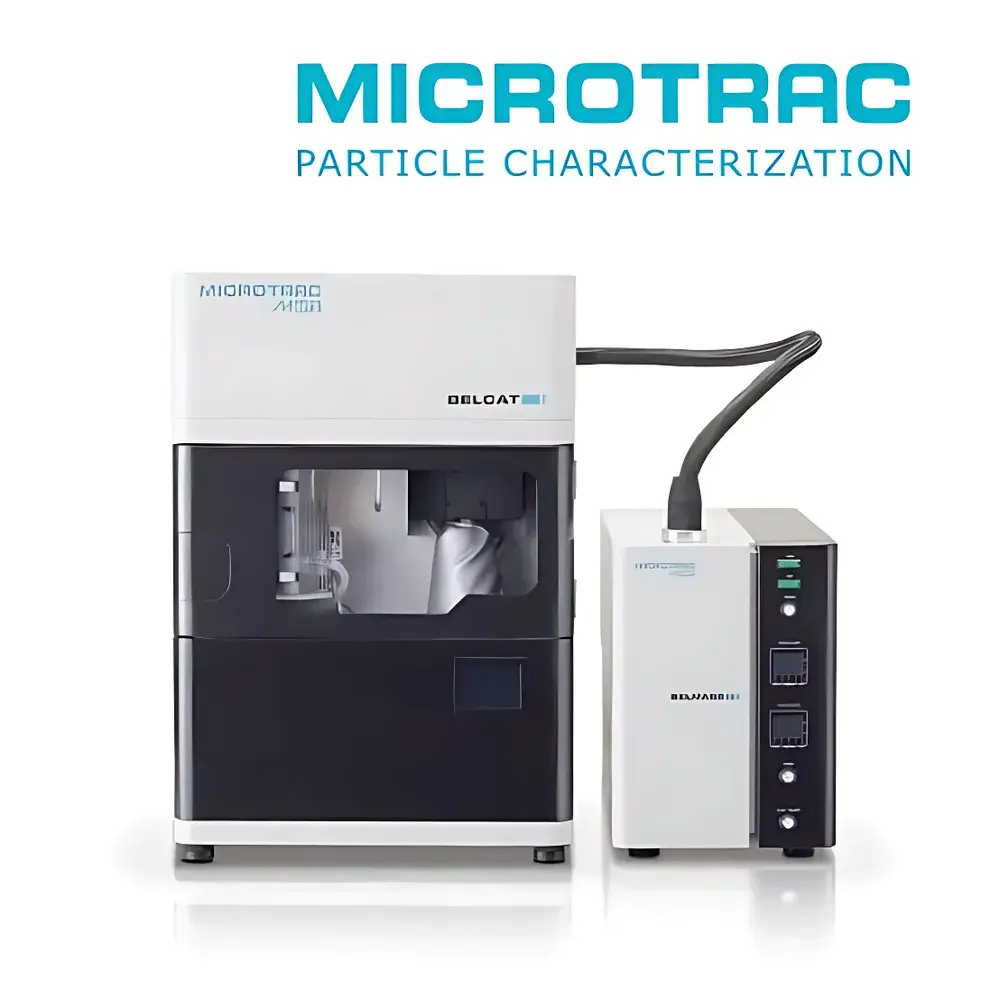
Microtrac BELCAT II Automated Chemisorption Analyzer
| Brand | Microtrac |
|---|---|
| Origin | Japan |
| Model | BELCAT II |
| Instrument Type | Chemisorption Analyzer |
| Measurement Principle | Dynamic Flow Method |
| Number of Gas Inlets | 8 (Pre-treatment), 3 (Carrier), 8 (Pulse), 8 (Mixing) |
| Temperature Range | Ambient to 1200 °C |
| Isothermal Stability | ±1 °C |
| Heating Rates | 50–500 °C at 70 °C/min |
| Pressure Range | Atmospheric |
| Key Functions | TPD, TPR, TPO, TPRx, Pulse Chemisorption, Single-point BET, Breakthrough Curve Analysis |
| Gas Compatibility | He, Kr, N2, Ar, O2, H2, CO, CO2, NH3, H2O, NO, SO2, H2S, CH3OH, C2H5OH, Toluene, Benzene, and other reactive/volatile species |
| Thermal Conductivity Detector (TCD) | Quad-wire configuration with W–Re or gold-plated tungsten filaments |
| resolution | 1 μV |
| Mass Flow Controllers (MFCs) | 3–4 units |
| Sample Volume Capacity | 0–1 cm³ |
| Pulse Loop Volumes | 0.3 cm³, 1 cm³, or custom |
Overview
The Microtrac BELCAT II Automated Chemisorption Analyzer is an advanced, fully integrated surface characterization platform engineered for quantitative analysis of catalytic materials under dynamic flow conditions. It operates on the well-established dynamic flow principle—where gaseous or vapor-phase probes are introduced over a temperature-programmed catalyst bed while monitoring effluent composition via high-sensitivity thermal conductivity detection. This method enables precise determination of active site density, acid/base strength distribution, redox behavior, and surface reactivity kinetics. Designed for rigorous R&D environments—including university catalysis laboratories, industrial catalyst development centers, and regulatory-compliant QC facilities—the BELCAT II supports both fundamental mechanistic studies and process-relevant screening. Its architecture complies with essential engineering requirements for reproducible surface science: stable thermal gradients, trace-level gas detection, programmable multi-step pretreatment sequences, and full auditability of instrument parameters and data acquisition events.
Key Features
- Fully automated gas handling system with 8 independent pre-treatment, 8 pulse, 8 mixing, and 3 carrier gas inlets—enabling complex multi-gas protocols without manual intervention.
- High-precision quartz furnace with programmable heating rates up to 70 °C/min (50–500 °C) and 30 °C/min (500–1100 °C), coupled with ±1 °C isothermal stability across the full operating range (ambient to 1200 °C).
- Dual-mode quad-wire TCD featuring switchable high/low sensitivity (1 μV resolution), compatible with both inert carrier gases (He, Ar) and reactive species (H2, NH3, SO2, H2S), ensuring robust signal-to-noise performance across diverse chemisorption chemistries.
- Integrated Peltier-based vapor generation module for accurate, contamination-free delivery of volatile organics (e.g., methanol, toluene, benzene) and aqueous steam—eliminating reliance on external saturators or syringe pumps.
- Software-controlled cryo-trap actuation and forced-air furnace cooling (1100 °C → 100 °C in under 60 minutes), enabling rapid turnaround between experiments and minimizing thermal history effects.
- Modular sample tube design accommodating up to 1 cm³ of solid catalyst material, supporting higher loading for low-surface-area samples or extended kinetic profiling.
Sample Compatibility & Compliance
The BELCAT II accommodates heterogeneous catalysts in powder, pellet, extrudate, or monolithic forms—compatible with standard ASTM D3907 (TPD of acidic sites), ISO 18325 (catalyst acidity measurement), and USP <1251> (surface area and porosity testing). Its corrosion-resistant gas pathways and chemically inert internal surfaces permit safe operation with aggressive analytes including H2S, SO2, and halogenated compounds—critical for desulfurization, SCR, and environmental catalysis research. All hardware and firmware components meet CE marking requirements for electromagnetic compatibility (EMC Directive 2014/30/EU) and low-voltage safety (LVD Directive 2014/35/EU). Data acquisition and instrument control logs support GLP/GMP compliance when configured with optional electronic signature and 21 CFR Part 11–compliant audit trail modules.
Software & Data Management
Control and analysis are performed via BELSoft™ v5.x—a Windows-based application offering synchronized temperature ramping, gas switching, pulse injection timing, TCD signal acquisition, and real-time derivative calculation (e.g., dF/dt for peak deconvolution). Raw chromatographic traces are stored in vendor-neutral ASCII format with embedded metadata (timestamp, setpoints, calibration IDs, operator ID). Batch processing tools enable automated integration of TPD/TPR peaks using baseline subtraction, Gaussian fitting, and quantification against calibrated standards. Export options include CSV, Excel, and PDF reports compliant with internal SOP templates. Optional cloud synchronization allows secure remote monitoring and centralized instrument fleet management across multi-site laboratories.
Applications
- Acid–base property mapping of zeolites, aluminas, and mixed oxides via NH3-TPD and pyridine-TPD, including Brønsted/Lewis site discrimination using FTIR coupling.
- Redox characterization of transition metal oxides (e.g., Co3O4, CeO2) and supported noble metals (Pt, Pd, Rh) via H2-TPR and CO-TPR under controlled stoichiometry.
- Surface oxygen mobility assessment in perovskite-type catalysts using O2-TPO and CO-TPO protocols.
- Breakthrough curve analysis for transient adsorption capacity evaluation—particularly relevant for VOC abatement and CO2 capture sorbents.
- In situ pretreatment optimization: identifying optimal calcination, reduction, or sulfidation conditions prior to catalytic testing.
- Single-point BET surface area estimation using Kr or N2 at 77 K or 87 K, respectively—integrated within the same instrument platform without sample transfer.
FAQ
What types of catalysts can be analyzed on the BELCAT II?
The system is optimized for solid heterogeneous catalysts—including supported metals, metal oxides, zeolites, carbons, MOFs, and sulfided phases—regardless of morphology (powder, pellet, extrudate) or thermal stability (up to 1200 °C).
Does the BELCAT II support quantitative active site counting?
Yes. When combined with calibrated pulse injection volumes and stoichiometric adsorption models (e.g., 1 H2 molecule per surface metal atom), it delivers quantitative active metal dispersion and turnover frequency (TOF) estimates.
Can liquid-phase reactants be introduced without external vaporizers?
Yes. The integrated Peltier-controlled vapor delivery system enables direct, temperature-stabilized introduction of volatile organics and water vapor—eliminating cold spots, condensation artifacts, and flow-rate drift.
Is the instrument suitable for routine QC testing in regulated environments?
With optional 21 CFR Part 11 compliance packages—including user access controls, electronic signatures, and immutable audit trails—the BELCAT II meets pharmaceutical, petrochemical, and fine chemical QA/QC documentation standards.
How is data integrity ensured during long-duration TPD experiments?
All acquisition parameters (temperature, flow, valve states, TCD gain) are timestamped and logged at ≥1 Hz. Hardware watchdog timers prevent runaway conditions, and automatic shutdown triggers activate upon out-of-range sensor readings or power anomalies.



