
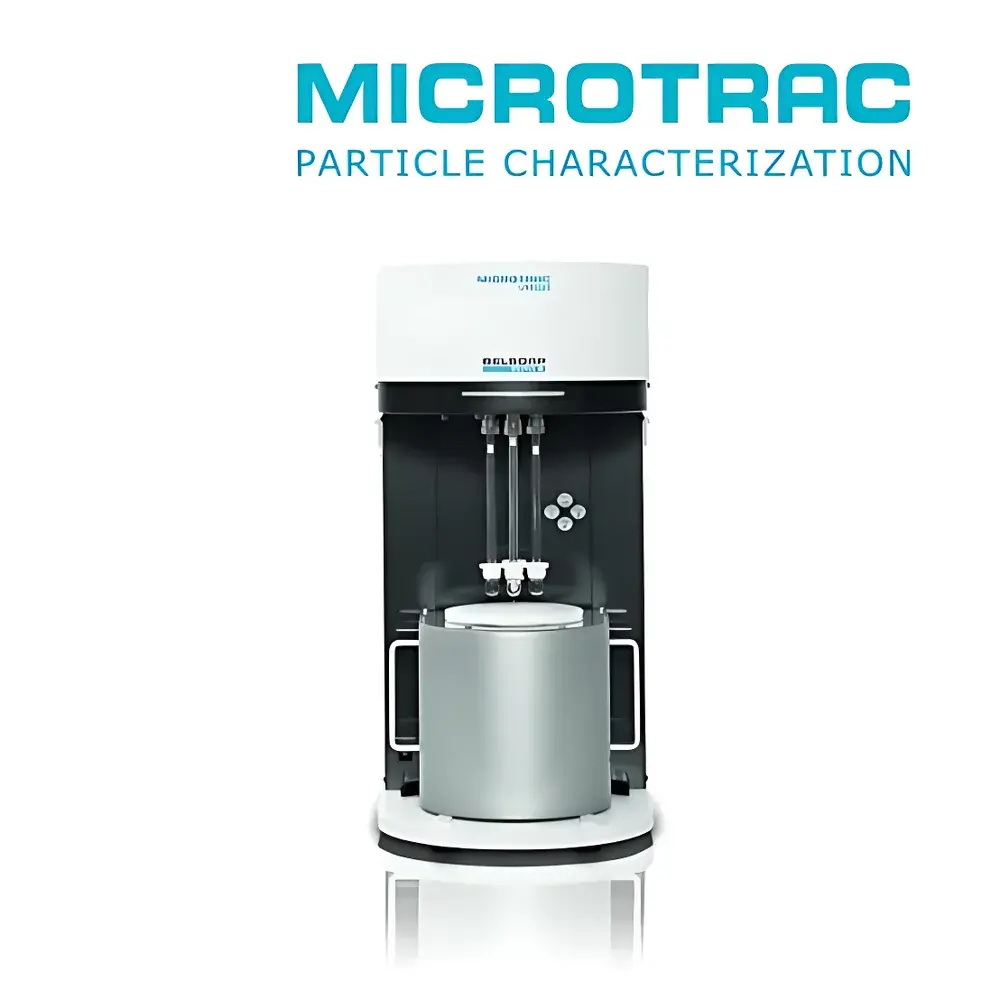
Microtrac BELSORP MINI X Automated Specific Surface Area and Micropore Analyzer
| Brand | Microtrac |
|---|---|
| Origin | Japan |
| Model | BELSORP MINI X |
| Instrument Type | Specific Surface Area and Pore Size Analyzer |
| Principle | Static Volumetric Gas Adsorption (Combined with Dynamic Pre-evacuation) |
| Analysis Stations | 4 |
| Surface Area Range | ≥0.01 m²/g (no upper limit) |
| Pore Size Range | 0.35–500 nm |
| Pressure Range | 0–133.3 kPa |
| Measurement Theory | Static Volumetric Method + Advanced Free Space Monitoring (AFSM™) |
| Compliance Options | FDA 21 CFR Part 11, IQ/OQ Documentation Package Available |
Overview
The Microtrac BELSORP MINI X is an automated, high-precision specific surface area and micropore analyzer engineered for rigorous physical characterization of solid materials using static volumetric gas adsorption. It operates on the fundamental principles of physisorption—primarily nitrogen (N₂) at 77 K—to quantify monolayer coverage, total surface area (via BET theory), pore volume distribution (via DFT, NLDFT, or QSDFT models), and micropore-specific parameters (e.g., t-plot, αs-plot, HK, DA). Building upon the proven architecture of the BELSORP MINI II, the MINI X integrates enhanced hardware control, real-time free-space calibration (AFSM™), and intelligent gas dosing algorithms to deliver improved reproducibility (<1.5% RSD for repeated BET measurements on standard silica gel) and reduced analysis cycle time—particularly critical for high-throughput QC labs and R&D environments requiring statistical confidence across multiple samples.
Key Features
- Four independent analysis stations, each equipped with a dedicated high-stability pressure transducer (0.01% FS accuracy) and thermally isolated manifold, enabling true parallel measurement without cross-talk or shared vacuum resource contention.
- Advanced Free Space Monitoring (AFSM™) technology: dynamically recalibrates void volume before and during adsorption steps using helium expansion, eliminating systematic errors from sample displacement uncertainty and thermal drift.
- Gas Dosing Optimization (GDO): leverages historical isotherm data to predict optimal incremental gas doses—minimizing over-pressurization, reducing equilibration wait times, and improving low-pressure (<0.01 P/P₀) micropore resolution.
- Integrated maintenance diagnostics: firmware-level monitoring of valve actuation cycles, pump performance decay, cold trap efficiency, and sensor drift—generating actionable alerts prior to calibration deviation.
- Automated reporting with timestamped audit trails: all measurement parameters, raw pressure/temperature logs, isotherm points, and post-processing selections are embedded in exportable .csv and .pdf reports compliant with GLP/GMP documentation requirements.
Sample Compatibility & Compliance
The BELSORP MINI X accommodates powders, granules, monoliths, fibers, and thin films (up to 2 g per station) across diverse material classes—including metal-organic frameworks (MOFs), activated carbons, zeolites, battery cathode/anode composites, pharmaceutical excipients, and ceramic precursors. Its modular Dewar system supports liquid nitrogen (77 K), liquid argon (87 K), and isopropanol/dry ice (195 K) cooling configurations. For regulated environments, optional 21 CFR Part 11-compliant software provides electronic signatures, role-based access control, immutable audit logs, and full traceability of method changes—validated with IQ/OQ documentation packages aligned with ASTM D3663, ISO 9277, and USP . All hardware meets IEC 61000-6-3 EMC standards and carries CE marking for laboratory use in EEA jurisdictions.
Software & Data Management
BELSOFT v5.2—native Windows-based application—offers intuitive workflow navigation, real-time isotherm visualization, and one-click application of standardized models (BET, Langmuir, BJH, DFT kernels). Raw data files (.bel) retain full metadata (instrument ID, operator, calibration history, ambient conditions), enabling retrospective reprocessing without loss of context. Batch processing supports up to 16 samples across multiple instruments; results synchronize automatically to network drives or cloud storage via configurable SMTP email notifications (including pass/fail flags against user-defined specification limits). Export formats include ASTM E2936-compliant .txt, ISO-standardized .cif for crystallographic correlation, and machine-readable JSON for LIMS integration.
Applications
This instrument serves as a primary characterization tool in catalyst development (surface acidity quantification via CO₂/NH₃ chemisorption add-ons), lithium-ion battery electrode optimization (pore tortuosity vs. ionic conductivity modeling), pharmaceutical solid-state stability assessment (hydration-induced surface area reduction), and quality control of filtration media (pore throat distribution vs. bubble point correlation). Academic users apply it to validate synthetic protocols for hierarchical porous polymers; industrial labs deploy it for batch release testing of pigment dispersibility, cement hydration kinetics, and semiconductor dielectric film porosity mapping.
FAQ
What gases can be used besides nitrogen?
Nitrogen (77 K) is standard; argon (87 K), krypton (77 K), and carbon dioxide (273 K) are supported for specialized micropore analysis or low-surface-area materials.
Is helium pycnometry integrated?
No—helium density measurement requires external pycnometer; however, AFSM™ uses helium for free-space calibration only.
Can the system perform temperature-programmed desorption (TPD)?
Not natively—the MINI X is optimized for isothermal adsorption; TPD capability requires separate thermal desorption module (e.g., BELCAT series).
How is data integrity ensured during power interruption?
All active measurements write to non-volatile memory every 5 seconds; resume-from-interrupt functionality restores exact state upon reboot without data loss.
What maintenance intervals are recommended?
Valve lubrication every 12 months; cold trap regeneration every 6 months; full system calibration annually or after 500 measurement cycles—tracked automatically by onboard diagnostics.



