
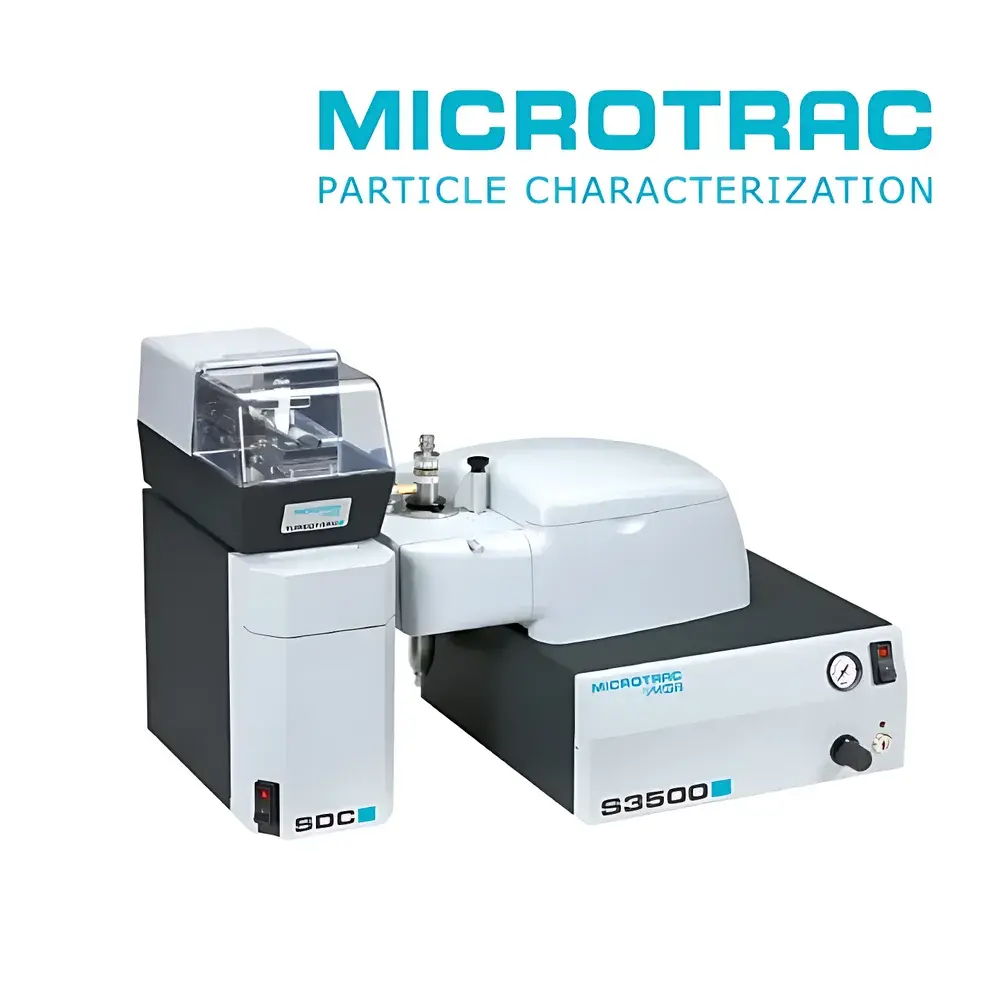
Microtrac S3500 Series Laser Diffraction and Dynamic Image Analysis Particle Size and Shape Analyzer
| Brand | Microtrac |
|---|---|
| Origin | Germany |
| Model | S3500 Series |
| Dispersion Method | Dry & Wet |
| Instrument Type | Laboratory Laser Particle Size Analyzer |
| Measurement Range (Laser Diffraction) | 0.01–2,800 µm |
| Image Analysis Range | 0.75–2,000 µm |
| Repeatability | <1% |
| Measurement Time (Laser Diffraction) | 10–30 s |
| Measurement Time (Dynamic Image Analysis) | ~60 s |
| Light Source | Patented Triple-Solid-State Laser (Laser Diffraction) / High-Intensity Stroboscopic LED (Image Analysis) |
| Detection Angle Range | 0.02°–163° |
| Detector Array | 151 logarithmically spaced silicon photodiodes |
| Image Sensor | 5 MP, 2456 × 2058 resolution, 15 fps (optional high-speed camera available) |
| Software Compliance | Fully compliant with FDA 21 CFR Part 11 (audit trail, electronic signatures, data integrity controls) |
Overview
The Microtrac S3500 Series is a dual-technology laboratory particle characterization system engineered for simultaneous, orthogonal measurement of particle size distribution (PSD) and morphological parameters. It integrates two ISO- and ASTM-aligned principles: static laser diffraction (ISO 13320) for statistically robust volumetric size distribution across an ultra-broad dynamic range (0.01–2,800 µm), and real-time dynamic image analysis (ISO 13322-2) for quantitative shape assessment—including aspect ratio, circularity, convexity, solidity, and over 30 additional morphometric descriptors. Unlike single-technique analyzers, the S3500 enables correlation between diffraction-derived equivalent spherical diameters and image-derived projected-area equivalents—critical for understanding processing behavior in pharmaceuticals, battery cathode slurries, catalysts, and advanced ceramics. Its modular optical architecture features a patented triple-laser source for enhanced signal-to-noise ratio and angular scattering fidelity, coupled with a tilted flow cell design that minimizes particle sedimentation and facilitates rapid cleaning between wet measurements.
Key Features
- Dual-mode operation: seamless switching between laser diffraction and dynamic image analysis without hardware reconfiguration
- Tilted quartz flow cell with optimized hydrodynamics—reduces particle settling, improves dispersion stability, and simplifies maintenance
- Real-time image acquisition at 15 frames per second (standard), with optional high-speed imaging module for transient dispersion events
- Full-angle detection system (0.02°–163°) with 151 logarithmically arranged silicon photodiodes—ensures high-resolution backscatter capture and eliminates scanning artifacts
- Integrated dry dispersion unit (optional) compatible with jet mill-based deagglomeration for cohesive powders
- Comprehensive shape library with automated classification algorithms for irregular particles, fibers, and agglomerates
Sample Compatibility & Compliance
The S3500 accommodates diverse sample types—including aqueous and organic suspensions, emulsions, dry powders, and nanoparticle colloids—via interchangeable dispersion modules. Wet measurements support refractive index matching for transparent or high-absorption materials. All data acquisition, processing, and reporting workflows comply with regulatory requirements for quality-controlled environments: full traceability under FDA 21 CFR Part 11 (including role-based access control, electronic signatures, and immutable audit trails), alignment with ISO/IEC 17025 documentation standards, and compatibility with GLP/GMP laboratory information management systems (LIMS). The instrument meets CE marking requirements and conforms to IEC 61000-6-3 (EMC) and IEC 61010-1 (safety) standards.
Software & Data Management
The proprietary Tri-Scan™ software provides unified control, real-time visualization, and post-acquisition analysis across both measurement modes. It supports customizable report templates (PDF, Excel, CSV), batch processing of multi-sample datasets, and statistical comparison tools (e.g., t-tests, ANOVA overlays). Raw scattering patterns and individual particle images are stored with metadata (timestamp, operator ID, instrument configuration), enabling retrospective reprocessing without data loss. The software includes built-in validation protocols for IQ/OQ/PQ execution and generates compliance-ready documentation packages for internal audits or regulatory inspections. Language localization is available in English, German, French, Spanish, Japanese, and Simplified Chinese.
Applications
- Pharmaceutical development: monitoring API crystallization kinetics, excipient blend uniformity, and inhaler aerosol performance
- Battery materials: characterizing NMC, LFP, and silicon anode powders for slurry rheology prediction and electrode coating consistency
- Coatings & pigments: correlating particle shape (e.g., aspect ratio, surface roughness) with gloss, opacity, and film formation
- Food & agriculture: assessing starch granule integrity, protein aggregate morphology, and pesticide suspension stability
- Environmental science: quantifying microplastic shape indices and weathering-induced surface degradation
- Quality control labs: supporting release testing per USP , ISO 13320, and ASTM D4294 specifications
FAQ
What regulatory standards does the S3500 software support for data integrity?
Tri-Scan™ implements full 21 CFR Part 11 compliance—including electronic signature workflows, user authentication, audit trail logging, and data encryption—enabling use in FDA-regulated pharmaceutical and medical device manufacturing.
Can the S3500 measure nanoparticles below 100 nm with high confidence?
Yes—the 0.01 µm lower limit is validated using NIST-traceable polystyrene latex standards and supported by Mie theory modeling with adjustable complex refractive index inputs.
Is dynamic image analysis limited to dilute suspensions?
The system employs advanced particle tracking and depth-of-field compensation algorithms, permitting reliable imaging at concentrations up to 0.5 vol%, depending on particle transparency and contrast.
How does the tilted flow cell improve measurement reproducibility?
The 15° tilt angle promotes laminar flow, reduces gravitational settling near the optical window, and prevents localized clogging—resulting in consistent signal baseline and <1% RSD across replicate runs.
Does the instrument support method transfer between labs?
Yes—Tri-Scan™ includes method export/import functionality with embedded calibration history and detector sensitivity profiles, facilitating cross-site harmonization per ICH Q5E guidelines.



