
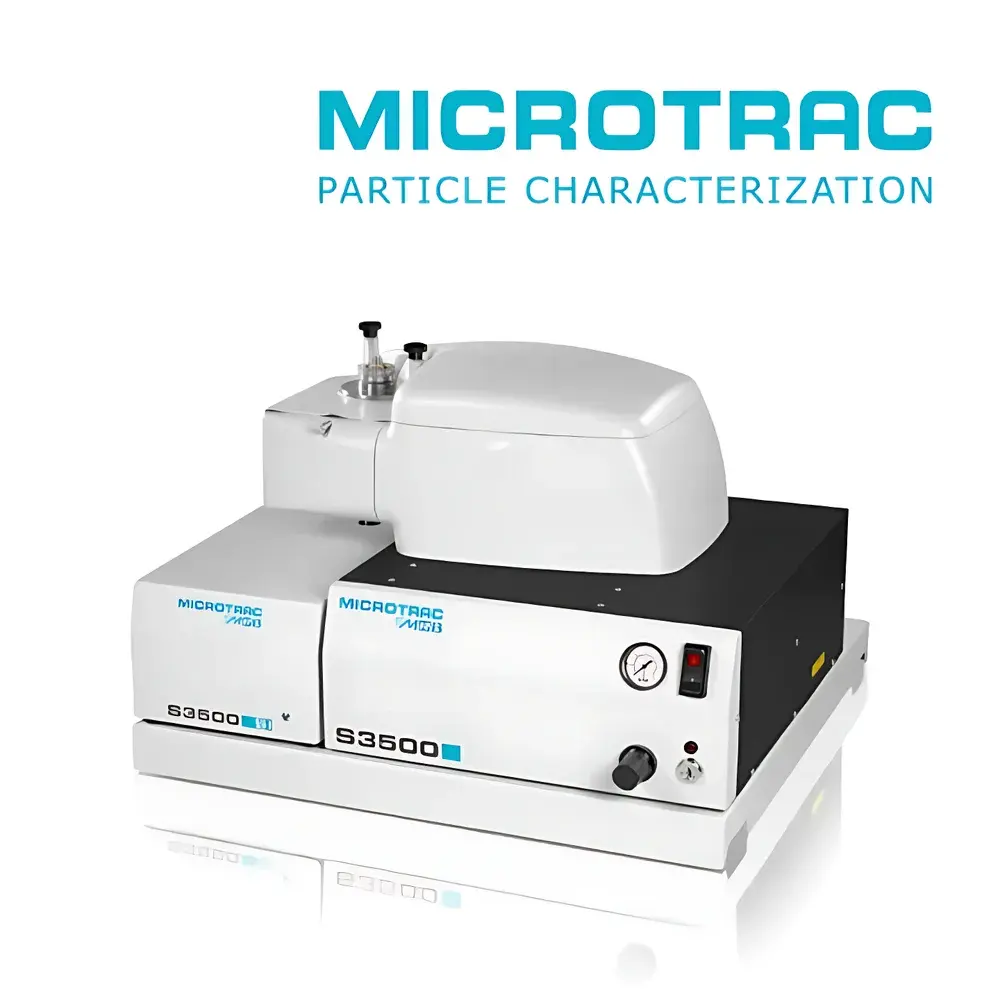
Microtrac S3500SI Laser Diffraction and Dynamic Image Analysis Particle Size and Shape Analyzer
| Brand | Microtrac |
|---|---|
| Origin | Germany |
| Model | S3500SI |
| Measurement Principle | Laser Diffraction & Dynamic Image Analysis |
| Size Range (Laser Diffraction) | 0.01–2800 µm |
| Size Range (Dynamic Imaging) | 0.75–2000 µm |
| Repeatability | ±0.1% |
| Light Source | Triple Solid-State Red Lasers (635 nm) + High-Intensity Stroboscopic LED |
| Detector Array | 151 Logarithmically Spaced Silicon Photodiodes, Acceptance Angle: 0.02°–163° |
| Imaging Sensor | 5 MP CMOS, Resolution: 2456 × 2058 |
| Analysis Time (LD) | 10–999 s |
| Analysis Time (Imaging) | 60 s per field |
| Software Compliance | FDA 21 CFR Part 11, Audit Trail, Electronic Signatures, Data Integrity Controls |
Overview
The Microtrac S3500SI is a dual-technology benchtop particle characterization system engineered for simultaneous, correlative measurement of particle size distribution (PSD) and morphological parameters in liquid dispersions. It integrates two physically distinct but complementary analytical principles: static laser diffraction (LD) based on Mie and Fraunhofer scattering theory, and real-time dynamic image analysis (DIA) using high-resolution stroboscopic illumination and frame-grabbed imaging. Unlike single-technique instruments, the S3500SI enables direct cross-validation between ensemble-average LD data and individual-particle statistics derived from DIA—critical for method development, QC troubleshooting, and regulatory submissions where both population-level metrics and outlier detection (e.g., agglomerates, fibers, or irregular contaminants) are required. Its patented triple-laser optical architecture eliminates angular blind zones and enhances signal-to-noise ratio across the full 0.01–2800 µm range, while the inclined flow cell design minimizes sedimentation and ensures representative sampling of heterogeneous suspensions.
Key Features
- Triple solid-state red laser system (635 nm) with precisely aligned beam paths for extended angular coverage (0.02°–163°) and robust scattering signal capture
- Integrated dynamic imaging module featuring a 5-megapixel CMOS sensor (2456 × 2058 px), stroboscopic LED illumination, and real-time particle tracking at up to 60 fps
- Inclined quartz flow cell with optimized hydrodynamics—reduces particle settling, facilitates rapid cleaning, and maintains consistent dispersion integrity during sequential measurements
- Real-time visualization interface showing live particle images overlaid with size/shape annotations, enabling immediate assessment of dispersion stability and contamination events
- Simultaneous acquisition mode: LD and DIA data collected in parallel on the same sample aliquot under identical dispersion conditions
- FDA 21 CFR Part 11-compliant software platform with role-based access control, electronic signatures, immutable audit trails, and secure data export protocols
Sample Compatibility & Compliance
The S3500SI is validated for aqueous and organic liquid-phase suspensions, including pharmaceutical nanosuspensions, battery cathode slurries, pigment dispersions, and food emulsions. It supports ISO 13320 (laser diffraction), ISO 13322-2 (dynamic image analysis), and ASTM E2457 (particle shape characterization). All firmware and software modules comply with GLP/GMP documentation requirements, supporting traceable calibration logs, instrument qualification reports (IQ/OQ/PQ), and raw data archiving in vendor-neutral formats (e.g., CSV, TIFF, HDF5). The system meets IEC 61000-4 electromagnetic compatibility standards and operates within Class II laser safety limits (IEC 60825-1).
Software & Data Management
The TriTrack™ software suite provides synchronized processing of LD and DIA datasets within a unified workspace. Users can apply multi-parameter filters (e.g., circularity < 0.4 AND aspect ratio > 5) to isolate fibrous or elongated impurities, generate bivariate histograms (e.g., length vs. width), and export statistically weighted shape distributions. Over 30 morphological descriptors—including convexity, solidity, Feret diameter, and Hu moments—are computed per particle. Batch reporting templates support automated PDF generation with embedded metadata (operator ID, timestamp, instrument serial number, calibration status). All data modifications are logged with user ID, timestamp, and pre/post values—ensuring full compliance with 21 CFR Part 11 Subpart C requirements for electronic records and signatures.
Applications
- Pharmaceutical development: Monitoring nanoparticle aggregation kinetics in injectables and assessing crystallinity impact on dissolution profiles
- Battery materials QC: Quantifying secondary particle breakage in NMC slurries and detecting metallic debris in anode coatings
- Coatings & inks: Correlating pigment aspect ratio distribution with rheological behavior and film gloss uniformity
- Food & beverage: Characterizing fat globule deformation during homogenization and identifying starch granule swelling anomalies
- Environmental analysis: Differentiating biogenic vs. anthropogenic particulates in wastewater effluents via combined size-shape fingerprinting
FAQ
What distinguishes the S3500SI from conventional laser diffraction analyzers?
It uniquely combines laser diffraction with real-time dynamic imaging on a single platform, enabling concurrent ensemble and individual-particle analysis without sample transfer or method revalidation.
Can the system measure non-spherical particles accurately?
Yes—the triple-laser configuration improves angular resolution for non-ideal scatterers, and the DIA module provides direct morphological quantification independent of optical model assumptions.
Is method transfer possible between S3500SI and other Microtrac platforms?
TriTrack™ uses standardized data structures and export protocols; validated methods can be ported to S3500, S3600, or Sync™ systems with minimal recalibration.
How is data integrity ensured during long-term deployment?
The software enforces automatic backup scheduling, checksum validation on all exported files, and time-stamped, tamper-evident audit logs compliant with ALCOA+ principles.
Does the system support automated dispersion optimization?
Yes—integrated ultrasonic probe control and programmable pump speed ramping allow closed-loop optimization of sonication energy and flow rate based on real-time DIA feedback.



