
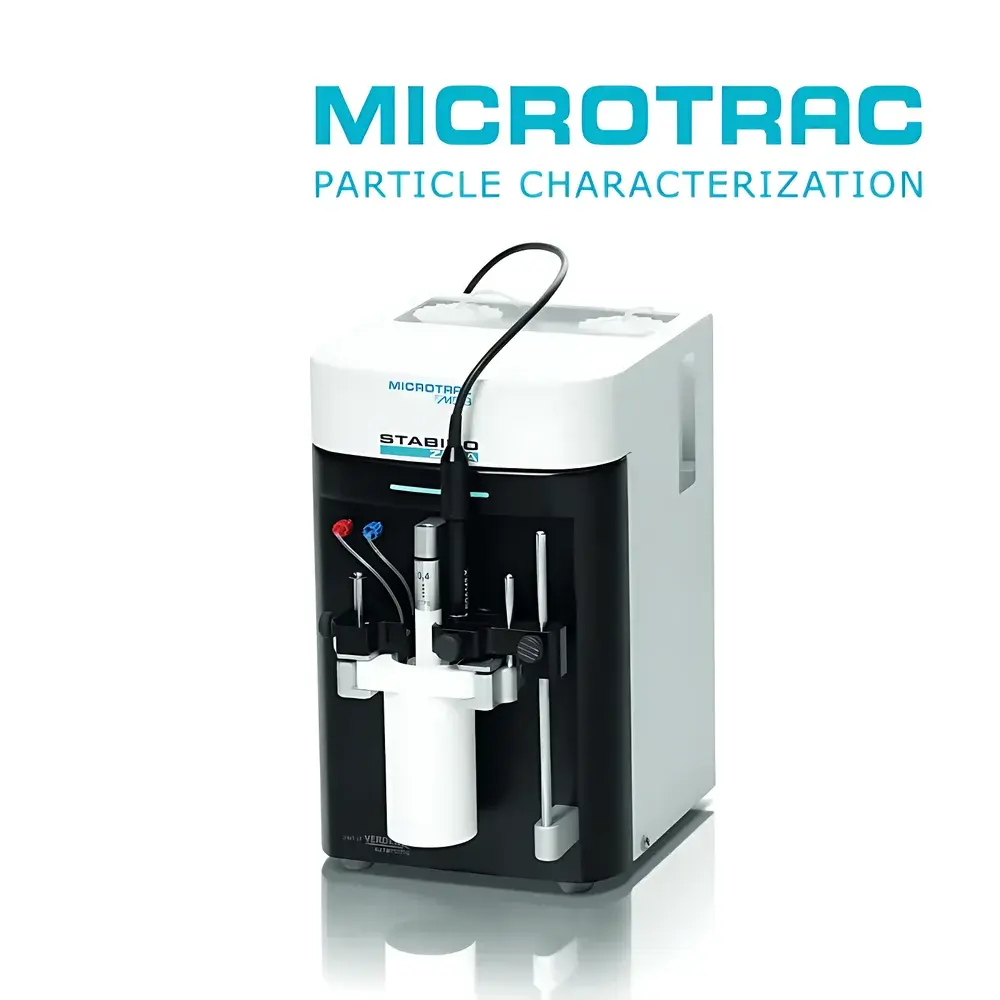
Microtrac STABINO ZETA Zeta Potential and Nanoparticle Size Analyzer
| Brand | Microtrac |
|---|---|
| Origin | Germany |
| Model | STABINO ZETA |
| Zeta Potential Range | ±3000 mV |
| pH Range | 1–14 |
| Operating Temperature Range | 0–90 °C |
| pH Resolution | ±0.1 |
| Temperature Resolution | ±0.1 |
| Measurement Principle | 180° Dynamic Light Scattering and Heterodyne Doppler Electrophoresis |
| Repeatability | ≤1% error |
Overview
The Microtrac STABINO ZETA is a high-precision, benchtop zeta potential and nanoparticle size analyzer engineered for rigorous colloidal stability assessment in research, quality control, and process development laboratories. Unlike conventional electrophoretic light scattering (ELS) instruments that rely solely on laser Doppler velocimetry under applied electric fields, the STABINO ZETA employs a robust flow potential (streaming potential) measurement principle—complemented by optional dynamic light scattering (DLS) capability—making it uniquely suited for highly concentrated, opaque, or conductive dispersions where traditional ELS fails. Flow potential measurement is based on the generation of an electrical signal when pressure-driven liquid flow induces shear at a stationary particle–solid interface (e.g., particles adsorbed onto the inner wall of a cylindrical cell). This method directly probes the interfacial potential at the shear plane—the physicochemically relevant parameter governing colloidal stability—and avoids assumptions about particle mobility or dielectric boundary conditions inherent in electrophoretic models. The instrument operates across an exceptionally wide conductivity range (0–50 mS/cm), accommodates samples from 0.01 to >10 vol%, and supports viscosity up to 300 mPa·s—enabling direct analysis of industrial slurries, pigment pastes, polymer emulsions, and biological suspensions without dilution.
Key Features
- Integrated flow potential + optional DLS module for simultaneous zeta potential and hydrodynamic size determination
- Automated titration platform with programmable dosing, mixing, and real-time signal acquisition (typical cycle: 5–15 min)
- Wide operational pH range (1–14) with ±0.1 pH resolution and temperature control (0–90 °C, ±0.1 °C resolution)
- No requirement for optical transparency or low ionic strength—valid for turbid, colored, or high-conductivity samples
- Shear-plane-sensitive measurement eliminates model-dependent corrections required in classical electrophoresis
- Calibration-free operation for charge titration; no need for particle size, refractive index, or solvent viscosity input
- Rugged stainless-steel flow cell with replaceable piston and precision-machined cylinder geometry for long-term reproducibility
Sample Compatibility & Compliance
The STABINO ZETA is validated for use with nanoparticles (≥0.3 nm), macromolecules, submicron pigments, ceramic slurries, pharmaceutical suspensions, and food-grade emulsions. Its flow potential architecture complies with ISO 13099-2:2012 (Colloidal systems — Methods for zeta-potential determination — Part 2: Optical methods) for comparative zeta potential reporting, and supports GLP/GMP workflows via audit-trail-enabled software logging. While absolute zeta potential values derived from flow potential require empirical scaling factors (e.g., via calibration against reference latex standards), the instrument delivers fully traceable, quantitative charge titration curves essential for ISO/IEC 17025-compliant method validation. It meets key regulatory expectations for stability-indicating assays in FDA-regulated environments—including documentation of system suitability, reagent lot tracking, and electronic signature support per 21 CFR Part 11 when configured with compliant software modules.
Software & Data Management
STABINO Control Software provides intuitive, wizard-guided experiment setup—including automated acid/base, surfactant, or polyelectrolyte titrations—with real-time plotting of streaming current vs. titrant volume, pH, and temperature. All raw signals, metadata, and processing parameters are stored in a structured SQLite database with timestamped versioning. Export formats include CSV, PDF reports (with embedded graphs and statistical summaries), and XML for LIMS integration. Advanced analysis tools enable derivative-based inflection point detection for pI (isoelectric point) identification, buffering capacity mapping, and charge reversal quantification. Data integrity safeguards include user-level access controls, electronic signatures, and immutable audit trails meeting ALCOA+ principles (Attributable, Legible, Contemporaneous, Original, Accurate, Complete, Consistent, Enduring, Available).
Applications
- Determining optimal pH and ionic strength windows for colloidal stability in pigment dispersions and ink formulations
- Quantifying critical coagulant dosage in water treatment slurry optimization
- Characterizing surface charge evolution during polymerization or nanoparticle synthesis
- Evaluating binding affinity and charge neutralization in drug–polymer complexation studies
- Mapping electrostatic interactions in protein–nanocarrier systems under physiological ion conditions
- Validating surfactant efficiency and micelle formation thresholds in personal care emulsions
FAQ
How does flow potential differ from electrophoretic zeta potential?
Flow potential measures the voltage generated by pressure-driven fluid motion across a fixed charged interface, whereas electrophoretic zeta potential infers interfacial potential from particle velocity under an applied electric field. Flow potential avoids electrophoretic mobility assumptions and works in non-transparent, high-conductivity media.
Can the STABINO ZETA measure true zeta potential values?
It reports streaming potential, which correlates linearly with zeta potential at the shear plane. For quantitative zeta conversion, users apply empirically determined scaling factors—often established using NIST-traceable standards or cross-validation with ELS on dilute analogues.
Is sample dilution required?
No. The flow potential method is inherently compatible with undiluted, concentrated dispersions (up to 10 vol%) and high-viscosity systems (≤300 mPa·s), eliminating dilution-induced artifacts.
What maintenance is required for long-term accuracy?
Routine cleaning of the flow cell with appropriate solvents, periodic piston seal inspection, and annual verification using certified conductivity and pH standards ensure metrological continuity per ISO/IEC 17025 guidelines.
Does the system support Good Manufacturing Practice (GMP) compliance?
Yes—when deployed with validated software configuration, electronic signature modules, and documented IQ/OQ/PQ protocols, it fulfills core data integrity and traceability requirements of GMP Annex 11 and FDA 21 CFR Part 11.
Related Products



