
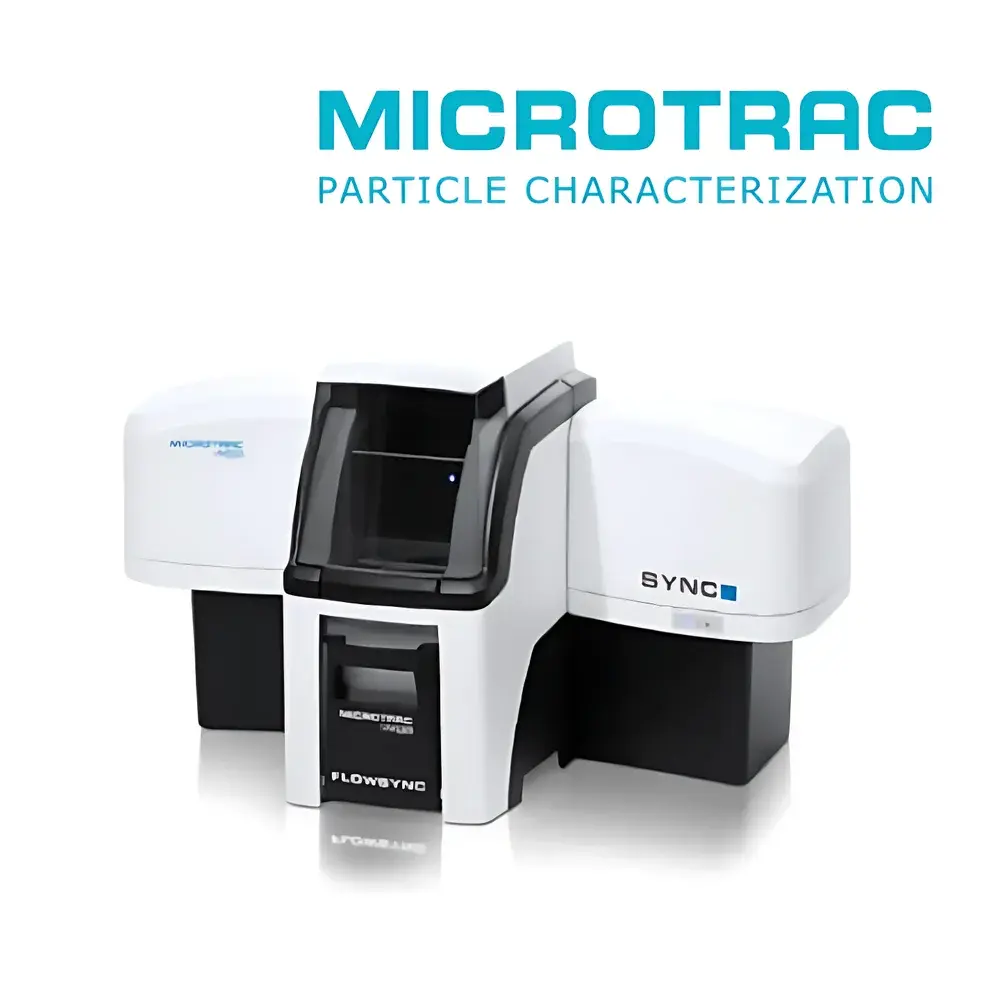
Microtrac SYNC Laser Particle Size and Shape Analyzer
| Brand | Microtrac |
|---|---|
| Origin | Germany |
| Model | SYNC |
| Dispersion Method | Dry & Wet |
| Instrument Type | Laboratory Laser Diffraction + Dynamic Image Analysis Hybrid System |
| Measurement Range | 0.01–4000 µm |
| Repeatability | <1% |
| Measurement Time | 10–30 s |
Overview
The Microtrac SYNC is a dual-technology laboratory particle characterization system engineered for simultaneous, co-located laser diffraction (LD) and dynamic image analysis (DIA). Unlike sequential or hybrid systems requiring sample reprocessing, the SYNC employs patented synchronous measurement architecture: both optical modalities interrogate the *exact same particle population*, in the *same sample cell*, at the *same time*. This eliminates inter-method variability and enables true correlation between size distribution (via Mie-based LD) and morphological descriptors (via high-resolution DIA). The system integrates a blue laser (405 nm) optimized for sub-micron resolution—particularly effective for narrow or multi-modal distributions below 1 µm—while maintaining full-range coverage up to 4000 µm. Its core design principle is metrological traceability: all measurements adhere to ISO 13320 (laser diffraction) and ISO 13322-2 (static/dynamic image analysis) standards, with optical paths calibrated using NIST-traceable reference materials.
Key Features
- Synchronous dual-mode operation: Real-time concurrent acquisition of laser diffraction spectra and high-frame-rate particle images from identical hydrodynamic or aerodynamic conditions.
- Blue-laser-enhanced sub-micron sensitivity: 405 nm wavelength improves scattering signal-to-noise ratio for particles <1 µm, enabling robust detection of fine fractions and outliers in bimodal or skewed distributions.
- Tool-free dry/wet module interchange: Push-pull mechanical interface with pre-routed fluidic and electrical connections; wet module (FLOWSYNC-WET) features automated liquid dosing, priming, recirculation, and drain cycles; dry module (FLOWSYNC-DRY) delivers controlled dispersion via venturi-assisted aerosolization and laminar flow transport.
- Comprehensive morphology suite: Quantifies >30 shape descriptors per particle—including aspect ratio, circularity, convexity, solidity, elongation, and Feret diameters—calculated directly from binary edge-detection masks.
- FDA 21 CFR Part 11-compliant software architecture: Audit trail with user authentication, electronic signatures, immutable data logs, and role-based access control for regulated environments (e.g., pharmaceutical QC, battery material release testing).
Sample Compatibility & Compliance
The SYNC accommodates suspensions (aqueous/organic), emulsions, dry powders, and agglomerated nanomaterials without method revalidation. Wet dispersion supports refractive index matching for transparent particles (e.g., silica, polymers); dry dispersion handles cohesive, friable, or heat-sensitive materials (e.g., API crystals, metal powders for additive manufacturing). All hardware and firmware comply with IEC 61000-6-3 (EMC) and IEC 61010-1 (safety). Data integrity protocols meet GLP/GMP requirements for pharmaceutical applications (USP , EP 2.9.31) and ISO/IEC 17025 accreditation for contract testing laboratories.
Software & Data Management
TRUSize™ v5.2 software provides integrated workflow management—from method setup and instrument calibration to statistical reporting and batch comparison. Raw diffraction patterns and image stacks are stored in vendor-neutral HDF5 format. Morphology data exports as CSV with metadata headers compliant with ASTM E2865 (standard guide for particle shape analysis). Batch processing supports ISO 9276-2-compliant distribution fitting (Rosin-Rammler, Log-Normal, Gaussian) and outlier identification via Tukey’s fences applied to individual particle metrics. Cloud-synced backup and local RAID-1 storage ensure data redundancy.
Applications
The SYNC serves cross-industry R&D and quality control needs where particle size *and* shape govern performance: electrode slurry homogeneity in lithium-ion battery cathodes; sintering behavior prediction for ceramic green bodies; flowability and packing density assessment of 3D-printing metal powders; dissolution rate modeling of milled APIs; pigment dispersion stability in automotive coatings; fracture toughness correlation in tungsten carbide composites; and droplet size/shape evolution in food emulsions under shear. Its ability to detect <0.1% oversized particles (<10 µm in a 100 µm median distribution) makes it critical for contamination screening in semiconductor slurries and medical device lubricants.
FAQ
How does synchronous measurement differ from sequential dual-mode systems?
Synchronous measurement captures LD and DIA data from identical particle ensembles under identical fluidic/aerodynamic conditions—eliminating temporal drift, sampling bias, and dispersion state inconsistency inherent in sequential methods.
Can the SYNC quantify shape changes during in-situ dispersion?
Yes—when coupled with optional real-time dispersion monitoring modules (e.g., inline ultrasonication feedback), the system tracks morphological evolution across dispersion energy gradients.
Is method transfer possible between SYNC and legacy Microtrac instruments?
TRUSize™ supports backward-compatible method import from S3500 and ROD series; however, LD/DIA correlation parameters require recalibration due to optical path differences.
What validation documentation is provided for regulated use?
Includes IQ/OQ/PQ protocols, calibration certificates (NIST-traceable PSL standards), and 21 CFR Part 11 implementation reports—all delivered with instrument commissioning.
Does the system support automated pass/fail decision logic for release testing?
Yes—customizable acceptance criteria can be defined per parameter (e.g., D90 ≤ 15.2 µm ± 0.3 µm, circularity ≥ 0.82), triggering automatic flagging and report generation.



