
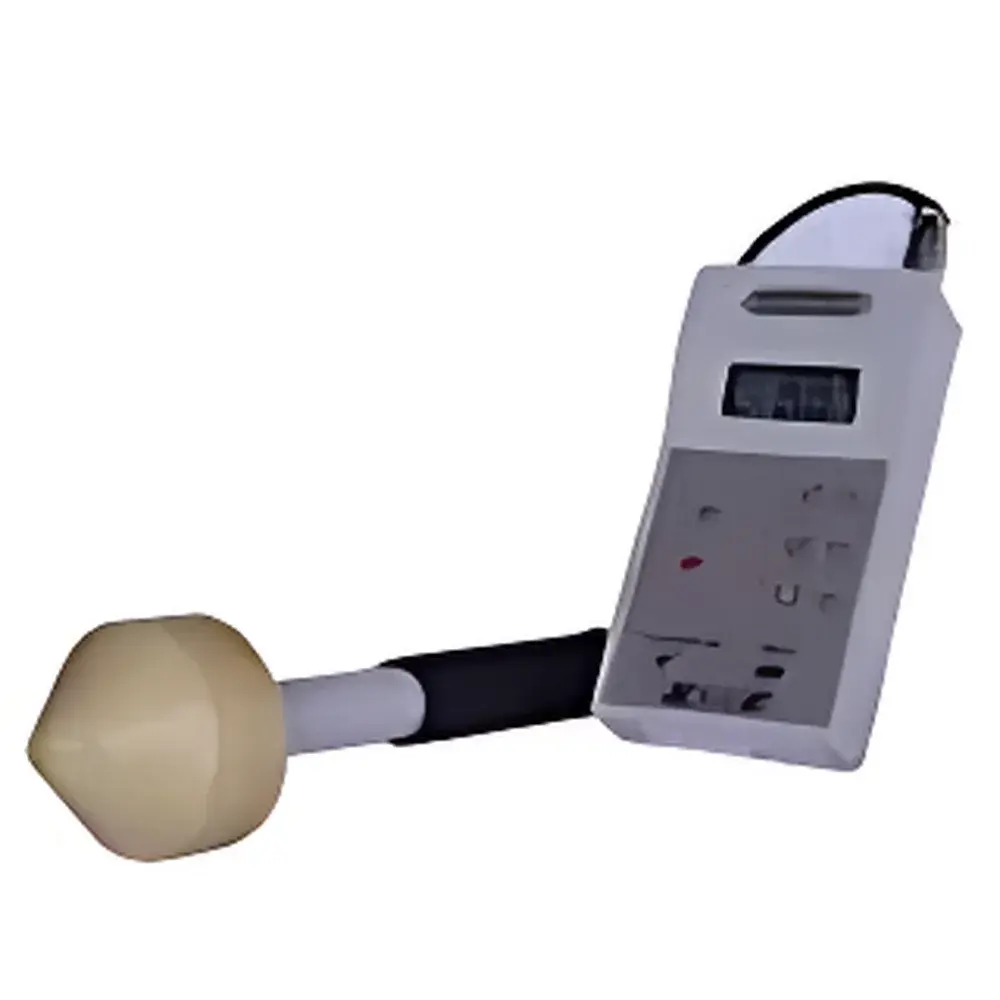
Microwave Leakage Detector ML-91
| Origin | Jiangsu, China |
|---|---|
| Manufacturer Type | Authorized Distributor |
| Origin Category | Domestic (PRC) |
| Model | ML-91 |
| Price | USD 950 (FOB Jiangsu) |
| Operating Temperature | −10 °C to +40 °C |
| Relative Humidity | 66 % ±15 % RH |
| Atmospheric Pressure | 750 mmHg ±30 mmHg |
| Frequency Band | 3–33 cm (i.e., 0.9–10 GHz) |
| Power Density Range | 0.2 µW/cm² to 20 mW/cm² |
| Display | 3-digit LED, auto-ranging across 200 µW/cm² / 2 mW/cm² / 20 mW/cm² scales with LED range indicators |
| Alarm Threshold | Adjustable, default ≥5 mW/cm² |
| Calibration Field Accuracy | ±0.75 dB |
| Full-Scale Indication Error (at rated voltage) | ≤±1.5 % |
| Indicator Dimensions | 82 mm × 40 mm × 172 mm |
| Net Weight | 0.8 kg |
Overview
The ML-91 Microwave Leakage Detector is a portable, field-deployable instrument engineered for quantitative assessment of electromagnetic radiation leakage from microwave ovens, industrial microwave heating systems, radar enclosures, and RF-shielded facilities. It operates on the principle of broadband isotropic detection using a calibrated thermocouple-based or diode-loaded sensor probe—optimized for the 0.9–10 GHz frequency band (corresponding to free-space wavelengths of 3–33 cm). Unlike narrowband spectrum analyzers, the ML-91 delivers rapid, real-time power density readings in µW/cm² and mW/cm² units, enabling immediate compliance verification against occupational exposure limits defined in ICNIRP 2020, IEEE C95.1-2019, and national standards such as GB 4706.21–2008 (China) and EN 50664:2017 (EU). Its compact form factor and battery-powered operation support routine safety audits, preventive maintenance checks, and post-repair validation in commercial kitchens, food processing lines, medical sterilization units, and R&D laboratories.
Key Features
- Triple-range auto-scaling digital display (200 µW/cm² / 2 mW/cm² / 20 mW/cm²) with dedicated LED range indicators for unambiguous scale identification
- User-adjustable audible/visual alarm threshold (factory-default set at 5 mW/cm²), configurable to match site-specific safety protocols or regulatory action levels
- Calibration traceability to national metrology institutes via documented ±0.75 dB uncertainty in standardized TEM cell or waveguide calibration fields
- Robust mechanical design with IP54-rated enclosure (dust-protected, splash-resistant) suitable for workshop and industrial floor environments
- Low-drift analog front-end and temperature-compensated signal conditioning ensuring ≤±1.5 % full-scale error across rated operating conditions (−10 °C to +40 °C, 51–81 % RH)
- Integrated rechargeable Ni-MH battery pack (optional AC adapter included), supporting >8 hours continuous measurement per charge
Sample Compatibility & Compliance
The ML-91 is validated for use with common microwave-generating equipment including domestic and commercial cavity ovens (2.45 GHz), industrial conveyorized dryers (915 MHz and 2.45 GHz), magnetron-based plasma sources, and RF sealing apparatus. Its isotropic response minimizes angular dependence, meeting the directional uniformity requirements specified in IEC 62233:2005 for household appliance leakage testing. The instrument conforms to electromagnetic compatibility (EMC) Class B per CISPR 11 and carries CE marking under the EU Radio Equipment Directive (2014/53/EU). While not certified for GLP/GMP-regulated data acquisition, its analog output port (0–2 V DC proportional to displayed value) permits integration into validated environmental monitoring networks when paired with compliant data loggers.
Software & Data Management
The ML-91 operates as a standalone hardware meter without embedded firmware or wireless connectivity. All measurements are displayed locally on the 3-digit LED screen; no onboard storage or USB interface is provided. For audit-trail compliance, users may manually record readings in paper-based or electronic logbooks aligned with ISO/IEC 17025 documentation practices. Optional third-party data acquisition modules (e.g., National Instruments USB-6009 with custom LabVIEW VI) can digitize the analog output for time-stamped trend analysis, provided calibration certificates and uncertainty budgets are maintained per ISO/IEC 17025 Clause 6.5. Traceability documentation—including factory calibration report (certified to JJG 977–2019), probe sensitivity curve, and temperature coefficient data—is supplied with each unit.
Applications
- Routine leakage verification of microwave oven door seals and interlock systems prior to daily operation (per FDA 21 CFR Part 1030.10 and Health Canada Safety Code 6)
- Post-maintenance validation after magnetron replacement, waveguide repair, or shielding refurbishment
- Occupational hygiene surveys in food service, pharmaceutical lyophilization, and rubber vulcanization facilities
- Educational laboratory demonstrations of near-field EM propagation and shielding effectiveness
- Pre-compliance screening for FCC Part 18 and EN 61000-3-2 emissions pretesting
FAQ
Is the ML-91 suitable for measuring 5G base station emissions?
No. Its 0.9–10 GHz bandwidth does not cover licensed 5G bands (e.g., 24.25–29.5 GHz, 37–40 GHz), and its isotropic probe lacks the frequency selectivity required for cellular infrastructure assessment.
Does the instrument require annual recalibration?
Yes. Per ISO/IEC 17025 and manufacturer recommendations, recalibration is advised every 12 months or after any physical shock, exposure to excessive RF fields (>50 mW/cm²), or battery replacement affecting reference voltage stability.
Can the alarm threshold be locked to prevent unauthorized adjustment?
No. The threshold potentiometer is externally accessible; physical security (e.g., tamper-evident seal) or procedural controls must be implemented by the end user to maintain integrity.
What is the probe’s effective isotropic radius?
The active sensing element has a spherical equivalent radius of ≤8 mm, satisfying the spatial averaging requirement for localized exposure assessment per ICNIRP guidelines.
Is NIST-traceable calibration available?
Yes—upon request, accredited third-party calibration services (e.g., A2LA-accredited labs) provide NIST-traceable certificates with expanded uncertainty (k=2) reported for each range and frequency point.







