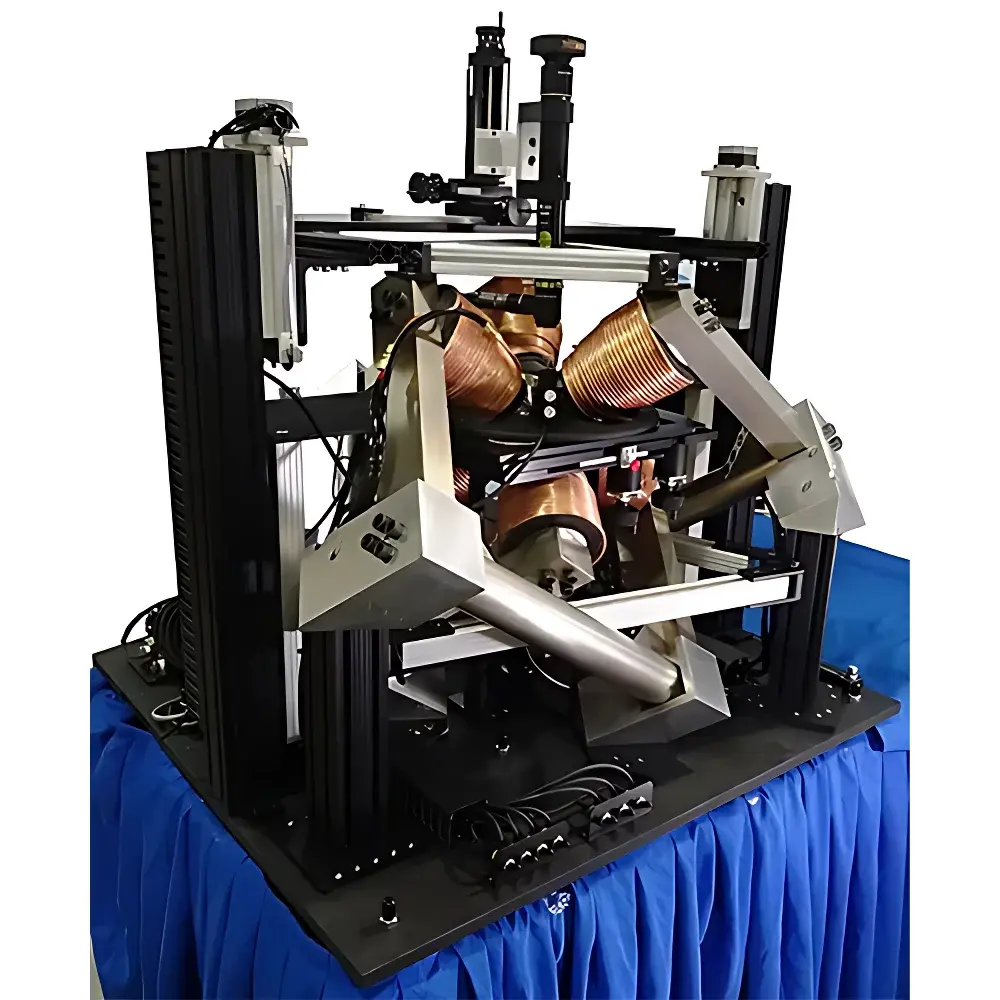
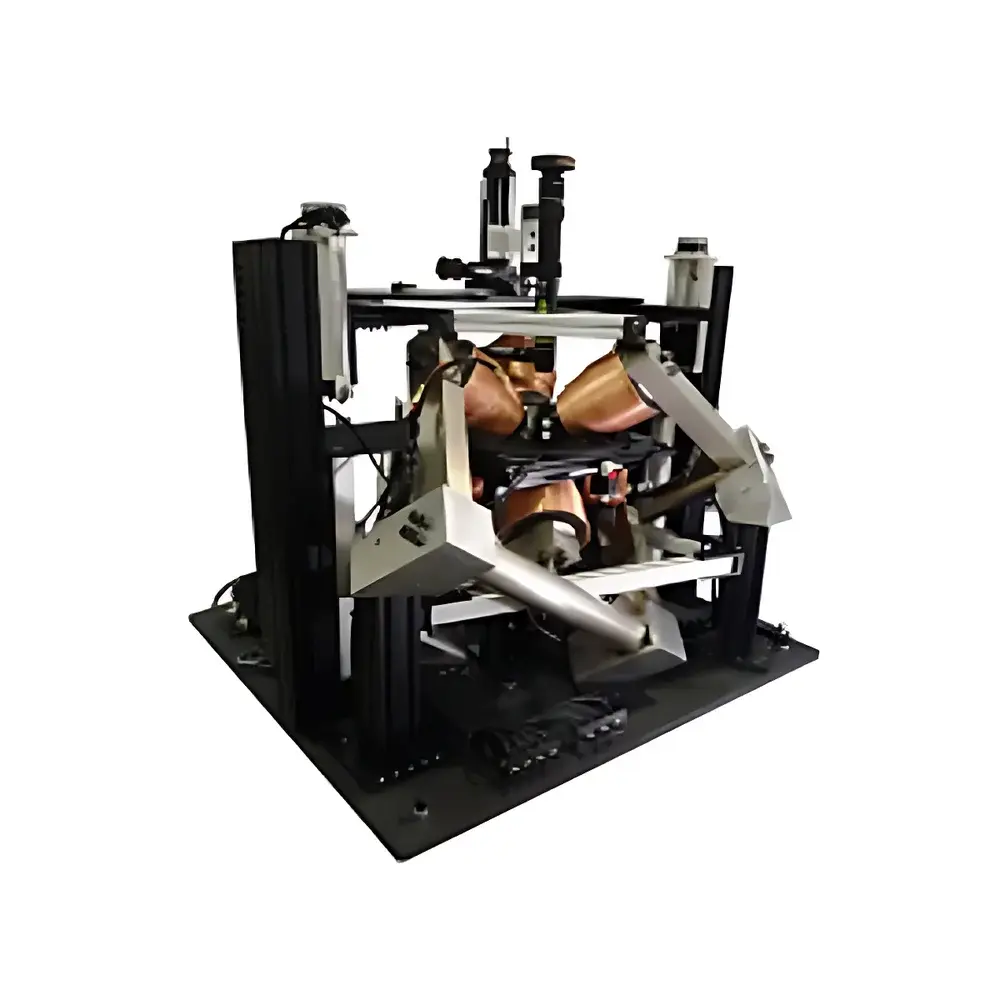
MicroXact MPS-C-300 3D Vector Magnet Probe Station
| Brand | MicroXact |
|---|---|
| Model | MPS-C-300 |
| Category | RF Probe Station |
| Wafer Size Capacity | Up to 200 mm (standard 10–150 mm) |
| Magnetic Field Range | ±6 kOe (±0.6 T) in 3D vector configuration |
| Field Directional Accuracy | ±1.0° |
| Field Uniformity | ±2% over 10 mm diameter |
| Field Stability | <0.1% over 24 h |
| Minimum Field Resolution | 200 mG |
| Frequency Bandwidth | DC to ~67 GHz |
| Motion Range (X-Y) | 100 mm × 100 mm |
| Chuck Type | Isolated / Grounded / Coaxial configurable |
| Control Software | LabVIEW-based, open-source, modular API |
Overview
The MicroXact MPS-C-300 3D Vector Magnet Probe Station is an engineered platform for wafer-level electrical and magnetic characterization under precisely controlled, fully programmable three-dimensional magnetic fields. Unlike conventional fixed-axis or dual-axis electromagnet probe stations, the MPS-C-300 employs a triaxial orthogonal Helmholtz-coil architecture with closed-loop field sensing and real-time feedback control—enabling arbitrary vector field orientation (θ, φ, |B|) at any point within its uniform volume. This architecture is grounded in classical electromagnetic field superposition and calibrated using NIST-traceable Hall sensor arrays, ensuring metrological integrity across all operational modes: static field application, linear field sweeps, and user-defined time-varying waveforms (including step, ramp, and arbitrary waveform generation via integrated DACs). Designed specifically for spintronics R&D, magnetic memory development (STT-MRAM, SOT-MRAM), and magneto-transport physics, the system supports cryogenic-ready configurations (down to 4 K with optional insert) and RF/microwave probing up to 67 GHz—making it suitable for both fundamental research and high-reliability process qualification in semiconductor fabs.
Key Features
- True 3D vector magnetic field generation (±6 kOe / ±0.6 T) with independent X/Y/Z coil control and real-time Hall-probe feedback
- Sub-degree directional accuracy (±1.0°) and <0.1% long-term field stability—validated per ASTM E1447 and ISO/IEC 17025 calibration protocols
- Wafer handling support from 10 mm die to full 200 mm wafers; vacuum-compatible chuck options (isolated, grounded, coaxial) with thermal anchoring ports
- High-precision manual micropositioning stage with 100 mm × 100 mm travel and optional 40–200 TPI fine-thread actuators for sub-micron probe placement repeatability
- LabVIEW-based open-control architecture with documented APIs, enabling seamless integration with Keysight B1500A, Keithley 4200-SCS, Zurich Instruments HF2LI, and other industry-standard SMUs, VNAs, and lock-in amplifiers
- Onboard data logging with timestamped field vectors, probe position coordinates, and synchronized instrument triggers—exportable to HDF5, CSV, and MATLAB .mat formats
Sample Compatibility & Compliance
The MPS-C-300 accommodates bare dies, packaged devices, and full wafers—including compound semiconductor substrates (GaAs, InP), SOI, SiC, and magnetic heterostructures (CoFeB/MgO/Ta stacks). Its chuck interface complies with SEMI Standard E10 for equipment automation readiness and supports Class 100 cleanroom operation when fitted with laminar flow enclosures. All magnetic field specifications adhere to IEC 61000-4-8 (power frequency magnetic field immunity) and are validated against traceable standards maintained by NIST and PTB. The system meets GLP/GMP documentation requirements for field calibration logs, software versioning, and audit trails—fully compatible with FDA 21 CFR Part 11-compliant electronic signature workflows when deployed with validated LabVIEW runtime environments.
Software & Data Management
The native MPS Control Suite provides intuitive graphical configuration of field trajectories (constant, sweep, or arbitrary waveform), automated raster scanning of magnetic hysteresis loops, and synchronized acquisition of multi-channel electrical responses (Rxx, Rxy, dR/dH, harmonic mixing signals). All software modules are developed under IEEE Std 1012-2016 (System Verification and Validation) guidelines. Raw field and measurement data are stored with embedded metadata (timestamp, coordinate frame, temperature, bias conditions), supporting FAIR (Findable, Accessible, Interoperable, Reusable) data principles. Export interfaces include Python bindings (via PyVISA), SCPI command layer, and RESTful API endpoints for CI/CD pipeline integration in automated test environments.
Applications
- Spin-transfer torque (STT) and spin-orbit torque (SOT) switching dynamics in MTJ and SOT-MRAM devices
- Anisotropic magnetoresistance (AMR), giant magnetoresistance (GMR), and tunneling magnetoresistance (TMR) mapping across wafer lots
- Field-dependent carrier mobility extraction in 2D magnetic semiconductors (CrI3, Fe3GeTe2)
- Resonant spin torque oscillators (STOs) and magnonic bandgap characterization
- Calibration and validation of on-chip Hall sensors and magnetoresistive read heads
- DC and RF magnetotransport studies under vector-field bias—supporting IEEE Std 1620.1-2015 (magnetic device test methodology)
FAQ
What is the maximum uniform field volume achievable at ±6 kOe?
At full field strength, the ±2% uniformity volume is defined over a 10 mm diameter sphere centered in the coil intersection; uniformity improves to ±0.5% within a 5 mm sphere.
Can the system be upgraded for low-temperature operation?
Yes—MPS-C-300 is mechanically and electrically compatible with commercial cryostats (e.g., Janis ST-500, BlueFors LD series); optional cold-finger-mounted probes and radiation-shielded cabling kits are available.
Is remote operation supported for multi-user lab environments?
All software components support concurrent TCP/IP connections with role-based access control (RBAC); session logging and command history are retained for compliance review.
How is field calibration traceability maintained?
Each system ships with a factory calibration certificate referencing NIST SRM 2580 (Hall probe standard), with annual recalibration intervals recommended per ISO/IEC 17025 Clause 6.5.
Does the platform support pulsed field operation?
Yes—the power supply architecture supports programmable current slew rates up to 10 A/ms per axis, enabling microsecond-scale field transients synchronized to external triggers.