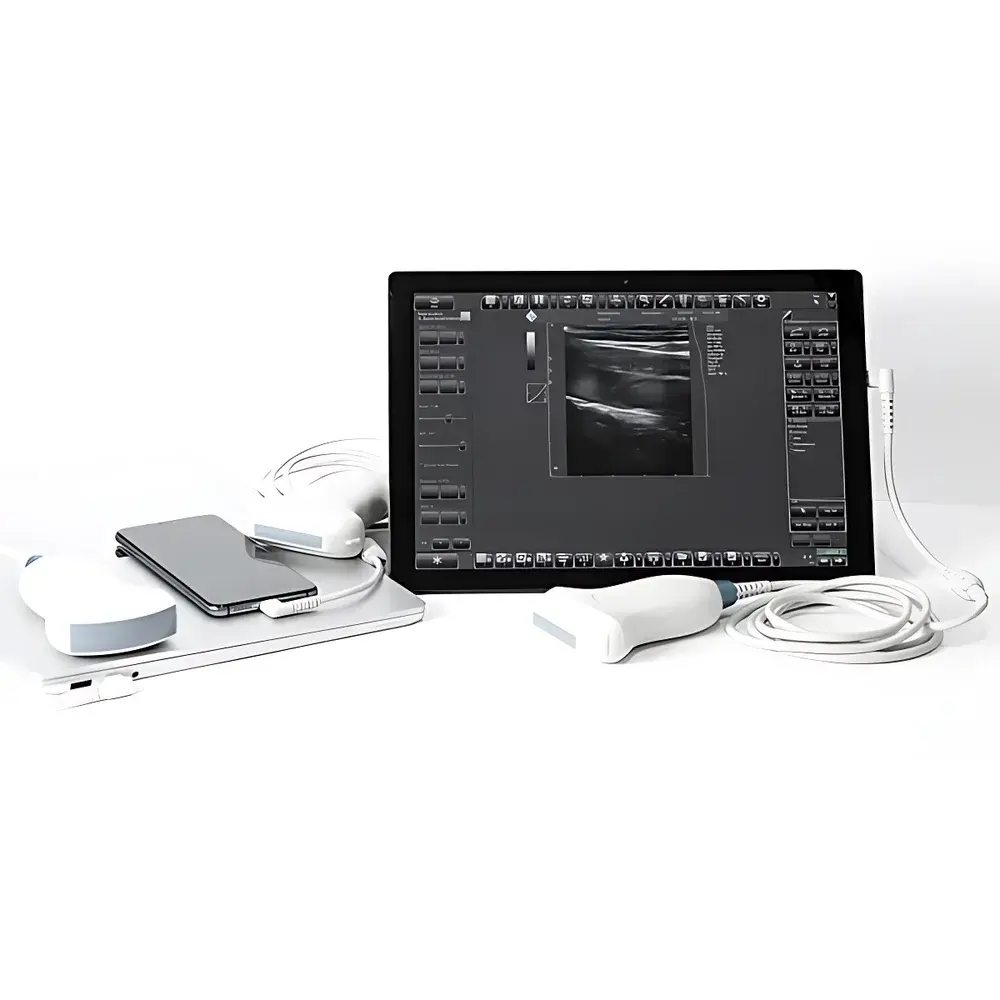
MicrUs Pro OEM Ultrasound Imaging Platform by TELEMED
| Origin | Imported |
|---|---|
| Manufacturer Type | OEM Supplier |
| Country of Origin | Lithuania |
| Model | MicrUs Pro |
| Spatial Resolution | 30 µm |
| Temporal Resolution | 7.5 ns |
| Gray Scale Levels | 16–256 |
| Time Gain Compensation (TGC) | Adjustable |
| Measurement Capabilities | Distance, Area, Perimeter, Angle, Volume, Stenosis Ratio, Time, Velocity, Heart Rate |
| Dynamic Range | 12 dB to 54 dB |
| Display Modes | B, B+B, 4B, B+M, M |
| Maximum Penetration Depth | 50 mm |
Overview
The MicrUs Pro OEM Ultrasound Imaging Platform is a high-performance, open-architecture, PC-based ultrasound engine developed by UAB TELEMED — a Lithuanian medical technology company founded in 1992 and operating in the global OEM market since 1995. Engineered for integration into third-party diagnostic systems, research platforms, and point-of-care devices, the MicrUs Pro delivers clinical-grade B-mode, M-mode, and compound imaging capabilities with hardware-agnostic software control. Its architecture migrates all signal acquisition, beamforming, and image processing functions from proprietary ASICs to real-time CPU/GPU-based software — enabling rapid deployment of advanced imaging modes including parallel beamforming, spatial compound imaging, virtual convex expansion, tissue harmonic imaging (THI), iTHI pulse inversion, digital Doppler multi-beam processing, adaptive speckle reduction, raw RF data access, and dynamic receive focusing. Designed for regulatory scalability, the platform supports FDA 510(k) and CE IVD pathway integration through documented design history files, traceable requirements, and ISO 13485-aligned development processes.
Key Features
- Open, USB-C–based architecture compatible with Windows PCs, Android tablets, and smartphones (via USB OTG)
- Real-time software-defined beamforming with sub-microsecond timing precision and 7.5 ns temporal resolution
- 30 µm axial spatial resolution optimized for high-frequency small-animal, dermatological, ophthalmic, and intravascular applications
- Configurable display modes: B, B+B, 4B, B+M, and M, with zoom and dual-view support
- Adjustable time-gain compensation (TGC) with up to 128 depth-dependent gain steps
- Comprehensive on-board measurement suite compliant with ASTM E178 and ISO 11979-5 for quantitative ultrasound analysis
- Dynamic range of 12–54 dB with automatic gain optimization and user-selectable presets
- Embedded SDK for Windows and Android (API documentation, sample code, and NDA-protected firmware interfaces included)
Sample Compatibility & Compliance
The MicrUs Pro supports a broad spectrum of clinical and preclinical use cases, including abdominal, obstetric/gynecologic, urologic, endocrine, vascular, and musculoskeletal (MSK) imaging. Its 50 mm maximum penetration depth and adjustable frequency response make it suitable for both superficial high-resolution scanning and moderate-depth soft-tissue assessment. The platform complies with IEC 62304 (software lifecycle), IEC 62366-1 (usability engineering), and EN 60601-1-2 (EMC). All OEM integrations are supported with full technical documentation packages required for regulatory submissions under FDA 21 CFR Part 820, EU MDR Annex II, and Health Canada SOR/98-282. Traceable calibration procedures and DICOM SR export ensure interoperability with PACS and LIS environments.
Software & Data Management
The MicrUs Pro runs TELEMED’s EchoWave A software stack — a modular, extensible framework supporting DICOM 3.0 (storage, query/retrieve, worklist), HL7 v2.x messaging, and configurable report templates. Raw RF data capture enables post-acquisition reconstruction, spectral analysis, and AI model training. All measurements include audit trails with timestamps, operator ID, and device metadata — satisfying FDA 21 CFR Part 11 electronic record/electronic signature requirements when deployed in GxP environments. Software updates are delivered via secure OTA channels with version-controlled release notes and backward-compatible API contracts. SDK access includes C/C++ and Java bindings, Android NDK support, and comprehensive documentation for integration with MATLAB, Python (NumPy/SciPy), and Qt-based GUI frameworks.
Applications
- Preclinical research: Small-animal phenotyping, tumor angiogenesis monitoring, embryonic development studies
- Point-of-care diagnostics: Portable vascular screening, MSK injury assessment, thyroid nodule characterization
- OEM system integration: Embedded ultrasound modules for surgical navigation, robotic guidance, and tele-ultrasound endpoints
- Academic imaging labs: Development of novel reconstruction algorithms, deep learning segmentation models, and elastography pipelines
- Remote diagnostics: Cloud-connected deployments with encrypted streaming, remote probe control, and collaborative annotation tools
FAQ
Is the MicrUs Pro certified for clinical use?
The MicrUs Pro is supplied as an OEM component without standalone regulatory clearance; final system-level certification (e.g., FDA 510(k), CE IVD) is the responsibility of the integrating manufacturer.
What level of technical support is provided to OEM partners?
TELEMED offers dedicated engineering support, including hardware reference designs, firmware validation reports, SDK troubleshooting, and regulatory documentation assistance under signed NDA and OEM agreement terms.
Can raw RF data be exported for offline analysis?
Yes — the platform supports lossless export of demodulated RF data in IEEE 754-compliant binary format with precise timestamping and channel metadata.
Does the SDK support real-time custom image processing?
Yes — the SDK exposes low-latency APIs for frame-level access, GPU-accelerated filtering, and user-defined reconstruction kernels via OpenCL and CUDA interfaces.
What are the minimum host system requirements for Android deployment?
Android 9.0 (Pie) or later, 6-inch OLED display (1080×2340), USB-C OTG support, ≥4 GB RAM with ≥1.5 GB/s memory bandwidth, and ARMv8 64-bit octa-core CPU.