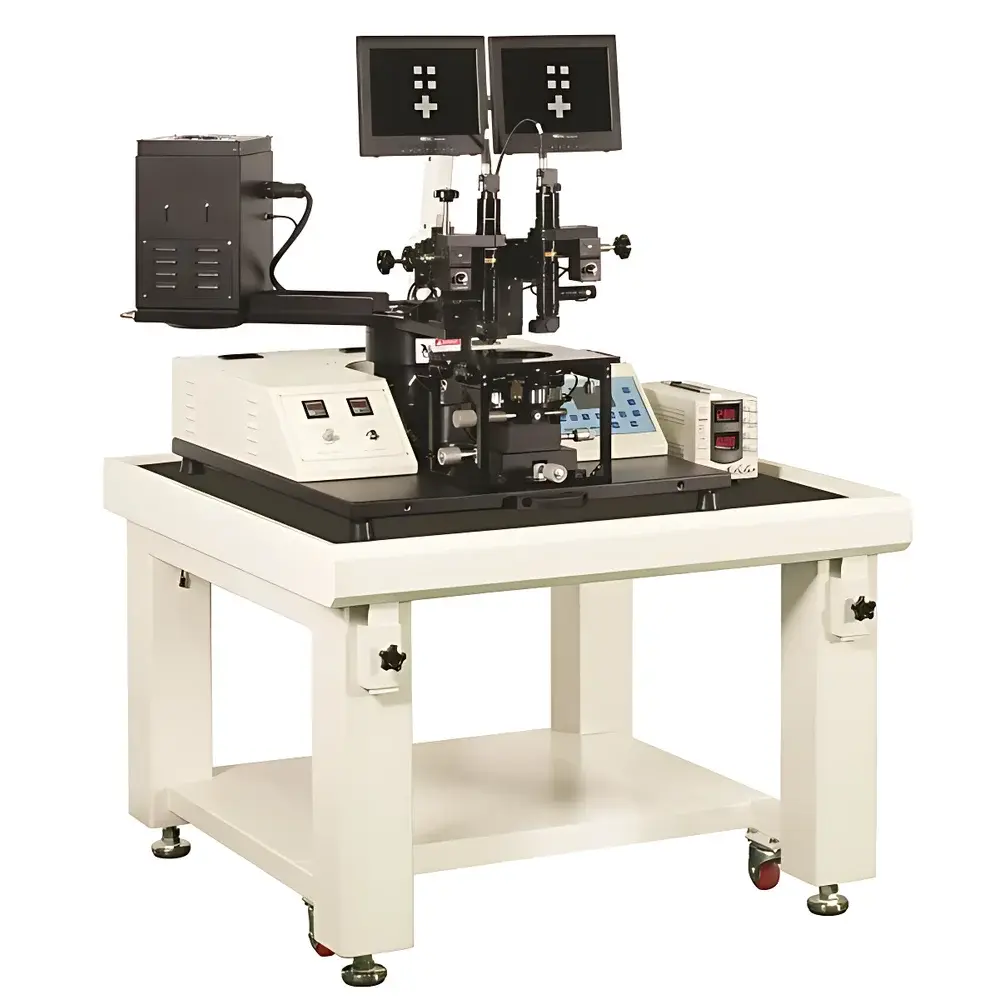
Midas MDA-400LJ Manual Mask Aligner with 365 nm UV LED Source
| Brand | Midas |
|---|---|
| Origin | South Korea |
| Manufacturer Status | Authorized Distributor |
| Origin Category | Imported |
| Model | MDA-400LJ |
| Pricing | Upon Request |
| Mask Size Max | 5-inch |
| Substrate Size Max | 4-inch circular wafers |
| Beam Shape | Circular |
| Beam Diameter | 125 mm |
| Light Source | UV LED |
| Wavelength | 365 nm |
| Beam Uniformity | < ±3 % |
| Peak Irradiance at 365 nm | 25 mW/cm² |
| Alignment Method | Manual |
| Alignment Accuracy | ±1 µm |
| Exposure Modes | Soft Contact, Hard Contact, Proximity (Vacuum-assisted) |
| Resolution | 1 µm (with 1 µm photoresist thickness under vacuum contact) |
| Weight | 150 kg |
| Dimensions (W×D×H) | 995 × 800 × 850 mm |
Overview
The Midas MDA-400LJ is a precision-engineered manual mask aligner designed for low-to-medium volume photolithography processes in academic research labs, prototyping facilities, and microfabrication cleanrooms. It employs a high-stability 365 nm UV LED light source—offering superior spectral stability, extended lifetime (>10,000 hours), and negligible thermal drift compared to traditional mercury arc lamps. The system operates on the principle of contact or proximity photolithography: ultraviolet radiation passes through a photomask and exposes a UV-sensitive photoresist coated on a substrate, enabling pattern transfer via subsequent development. Its fixed-wavelength output at 365 nm (i-line) ensures compatibility with standard g-line/i-line resists (e.g., AZ® series, SU-8, and PMMA), while the uniform 125 mm circular illumination field supports consistent exposure across substrates up to 4-inch diameter. Engineered for repeatability and ease of operation, the MDA-400LJ delivers sub-micron alignment accuracy and resolution performance validated under controlled vacuum-contact conditions.
Key Features
- Stable 365 nm UV LED source with <±3% spatial irradiance uniformity across the full 125 mm exposure field
- Manual XYZθ alignment stage with micrometer-driven fine adjustment (1 µm resolution) and real-time optical viewing via integrated dual-magnification microscope (10×/20×)
- Vacuum-assisted contact mode ensuring minimal gap (<1 µm) between mask and resist surface—critical for achieving 1 µm lithographic resolution
- Three exposure modes: soft contact (light pressure), hard contact (mechanical clamping), and proximity (controlled 10–50 µm gap), each selectable via mechanical interlock
- Robust cast-aluminum frame and vibration-damped optical base plate minimizing misalignment during exposure
- No ozone generation or mercury disposal concerns—fully compliant with ISO 14001 environmental management practices
Sample Compatibility & Compliance
The MDA-400LJ accommodates substrates up to 4-inch (100 mm) circular wafers—including silicon, glass, quartz, sapphire, and flexible polymer foils—provided they meet flatness tolerances ≤10 µm over the exposure area. It accepts standard 5-inch (127 mm) photomasks with chrome-on-quartz or Cr-on-glass patterns. All mechanical and optical components conform to ISO 9001-certified manufacturing protocols. While the system itself does not require regulatory certification as a standalone tool, its operational parameters align with ASTM F2239 (Standard Practice for Photolithography Process Control) and support GLP-compliant documentation when integrated into validated lab workflows. Vacuum and exposure timing functions are manually actuated—no electronic audit trail is generated, thus it is not FDA 21 CFR Part 11 compliant out-of-the-box; however, external logging systems may be interfaced via analog I/O terminals.
Software & Data Management
The MDA-400LJ is a fully manual, non-computerized instrument: no embedded firmware, touchscreen interface, or data logging capability is included. Exposure time is controlled via a calibrated mechanical timer (0.1–999.9 s range, ±0.1 s accuracy), and all alignment decisions are operator-mediated using optical feedback. This architecture eliminates software validation requirements and simplifies qualification under ISO/IEC 17025 or internal QA procedures. For labs requiring traceability, integration with external programmable logic controllers (PLCs) or USB-connected timers with CSV export is feasible via auxiliary trigger ports. No proprietary drivers or operating system dependencies are involved—ensuring long-term maintainability without vendor lock-in.
Applications
- R&D-scale microelectromechanical systems (MEMS) fabrication, including cantilevers, accelerometers, and microfluidic channel patterning
- Prototyping of organic electronics: OLED pixel definition, conductive polymer electrode arrays, and perovskite solar cell interconnects
- Micro-optics fabrication: diffractive optical elements (DOEs), microlens arrays, and waveguide couplers on fused silica substrates
- Academic teaching platforms for semiconductor processing courses—enabling hands-on instruction in mask alignment, exposure dose calibration, and resist contrast curve analysis
- Low-cost fabrication of biosensor electrodes, electrochemical microarrays, and paper-based diagnostic devices using silver nanoparticle or carbon ink resists
FAQ
What is the maximum usable mask size supported by the MDA-400LJ?
The system accepts standard 5-inch (127 mm) square photomasks with thicknesses between 3 mm and 6 mm.
Does the UV LED source require warm-up time before stable output?
No—LED emission reaches >99% of nominal irradiance within 100 ms of activation, eliminating thermal stabilization delays common with arc lamps.
Can the system be upgraded to motorized alignment or automated exposure control?
No—the MDA-400LJ is a fixed-configuration manual platform; Midas offers the MDA-600 series for motorized variants.
Is the 1 µm resolution specification guaranteed for all resist types and thicknesses?
Resolution of 1 µm is demonstrated under vacuum contact mode using standard i-line resist (e.g., AZ 1518) at 1 µm thickness; performance varies with resist contrast, developer chemistry, and post-exposure bake parameters.
What maintenance is required for long-term operational stability?
Annual inspection of LED collimation optics, recalibration of the mechanical timer, and verification of vacuum seal integrity constitute the recommended preventive maintenance protocol.