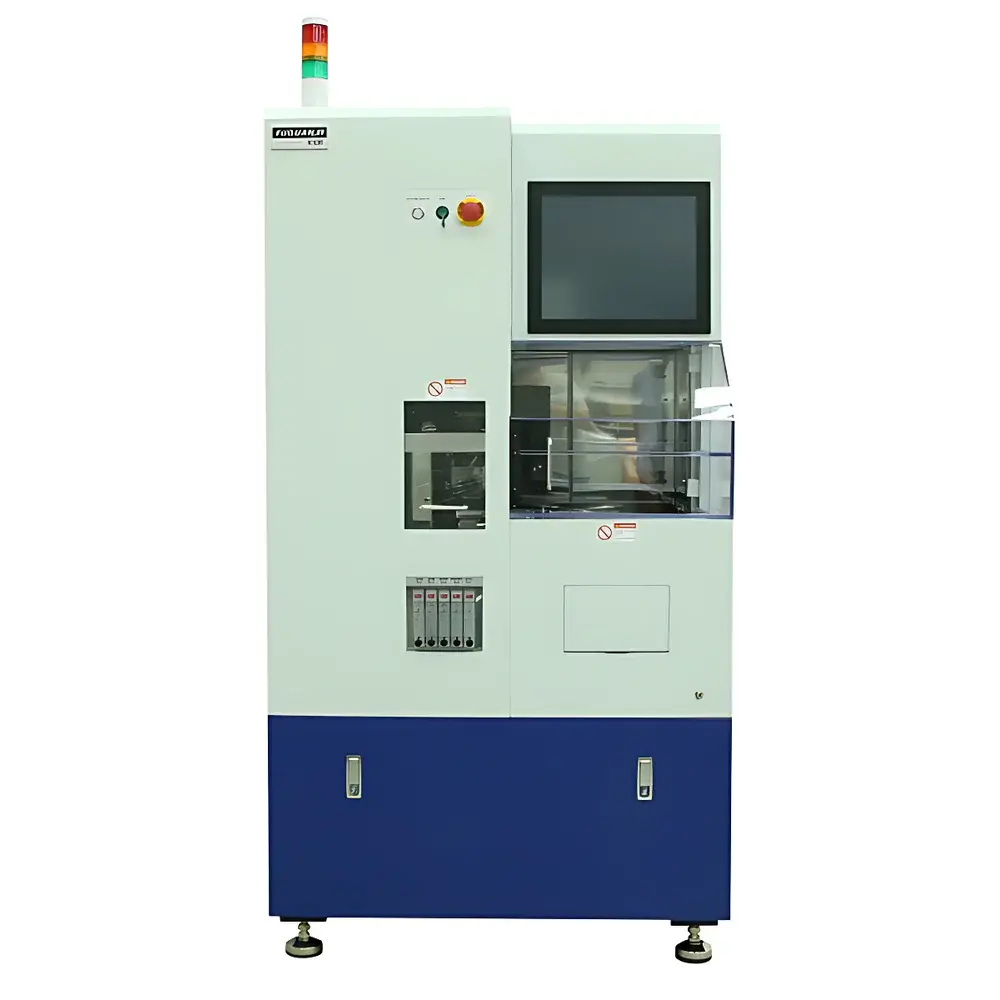

Midas SD220 / SD240 Semi-Automatic Dicing Saw for 8″ and 12″ Wafers
| Brand | Midas |
|---|---|
| Origin | South Korea |
| Model | SD220, SD240 |
| Maximum Cutting Speed | 0.05–650 mm/sec |
| Workpiece Compatibility | Silicon wafers, PCBs, QFN, PBGA, ceramics, quartz, LEDs, mobile blue glass filters, silicon carbide |
| Y-axis Repeatability | 0.001 mm |
| Spindle Power | 1.2 kW / 1.8 kW / 2.4 kW air-cooled |
| Max Spindle Speed | 60,000 rpm |
| Blade Diameter Support | 2" (58 mm), optional 3" |
| Theta Axis | DD servo motor, continuous 380° rotation |
| X/Y Travel Range | 220 mm / 330 mm (SD220/SD240) |
| Z-axis Stroke | 60 mm |
| Positioning Accuracy | ±0.002 mm over full travel |
| Index Step Resolution | 0.0001 mm |
| Vacuum Chuck Capacity | 6–12 inch |
| Air Pressure | 0.55–0.7 MPa |
| Cooling Water Flow | 2.0 LPM @ 0.3–0.5 MPa |
| Dimensions (W×D×H) | 980×840×1835 mm (SD220), 1030×880×1835 mm (SD240) |
| Weight | 875 kg / 895 kg |
Overview
The Midas SD220 and SD240 semi-automatic dicing saws are precision-engineered semiconductor packaging tools designed for high-fidelity singulation of brittle and composite substrates in advanced microelectronic manufacturing. Operating on the principle of diamond-blade mechanical dicing under controlled coolant flow and vacuum-assisted workholding, these systems deliver deterministic material removal with minimal chipping, microcracking, or thermal distortion. Engineered for Class 100–1000 cleanroom environments, they support both front-side and back-side dicing protocols for silicon, SiC, quartz, ceramic, and heterogeneous hybrid substrates—including LED sapphire wafers and ultra-thin mobile filter glass. The dual-model architecture enables scalable deployment: the SD220 accommodates up to 8-inch (200 mm) wafers with 220 mm × 220 mm cutting envelope, while the SD240 extends capability to full 12-inch (300 mm) wafers within a 330 mm × 330 mm XY travel range—both compliant with SEMI S2/S8 safety and environmental standards.
Key Features
- High-stiffness granite base and linear motor-driven axes ensure sub-micron motion stability and long-term geometric fidelity across thermal cycles.
- Three-tier air-spindle configuration (1.2 kW / 1.8 kW / 2.4 kW) delivers consistent torque and vibration damping at speeds up to 60,000 rpm, optimized for diamond blade longevity and surface finish control.
- Y-axis repeatability of ±0.001 mm and positioning accuracy of ±0.002 mm over full stroke meet stringent requirements for fine-pitch die separation in fan-out wafer-level packaging (FOWLP) and 2.5D/3D IC integration.
- Integrated theta axis with direct-drive (DD) servo motor enables continuous 380° rotational indexing—critical for multi-angle dicing, stepped cuts, and non-orthogonal street geometry alignment.
- Modular sensor suite includes optional Non-Contact Sensor (NCS) for real-time blade-to-surface gap monitoring and Blade Breakage Detection (BBD) system with acoustic emission analysis for predictive tool health management.
- Vacuum chuck supports 6–12 inch wafers with uniform clamping force distribution; compatible with standard FOUP, SMIF, and open cassette loading interfaces.
Sample Compatibility & Compliance
The SD220/SD240 platforms process a broad spectrum of rigid and laminated materials used in power electronics, MEMS, optoelectronics, and advanced packaging. Validated substrates include monocrystalline silicon (50–775 µm thick), silicon carbide (SiC) wafers (100–200 µm), alumina and aluminum nitride ceramics, fused quartz, FR-4 and polyimide-based PCBs, QFN/PBGA leadframes, sapphire LED wafers, and chemically strengthened blue glass filters. All configurations comply with ISO 14644-1 (cleanroom classification), IEC 61000-6-2/6-4 (EMC immunity/emission), and UL 61010-1 safety certification. Optional traceability modules support audit-ready GLP/GMP workflows per FDA 21 CFR Part 11 when integrated with validated MES or SAP QM systems.
Software & Data Management
Control is executed via Midas’ proprietary DICE-OS v4.2, a real-time Windows-based platform with deterministic motion scheduling and synchronized I/O handling. The interface supports G-code import, parametric recipe templates, and hierarchical job queuing with user-level access control (admin/operator/maintenance tiers). Process logs—including spindle load, coolant pressure, vacuum level, axis position error, and blade wear index—are timestamped and exportable in CSV/Excel format. Optional Ethernet/IP and SECS/GEM connectivity enable seamless integration into factory automation networks, supporting data acquisition for SPC analysis and predictive maintenance models. Audit trails record all parameter changes, operator logins, and emergency stops—fully compliant with electronic record retention requirements under ISO 9001:2015 Clause 7.5.3.
Applications
- Singulation of silicon and SiC power device wafers prior to pick-and-place in discrete packaging lines.
- Edge trimming and street isolation for MEMS inertial sensors and RF front-end modules.
- Partial-depth dicing for through-silicon via (TSV) wafer stacking and temporary bonding/debonding processes.
- Low-damage scribing of brittle optical substrates such as AR-coated blue glass filters for smartphone camera modules.
- Multi-layer ceramic substrate segmentation for high-frequency RF modules and automotive radar assemblies.
- Back-grind alignment dicing for ultra-thin die (<100 µm) handling in chip-on-film (COF) and panel-level packaging (PLP) flows.
FAQ
What wafer sizes does the SD220/SD240 support?
The SD220 is rated for up to 8-inch (200 mm) wafers; the SD240 supports 12-inch (300 mm) wafers with extended XY travel and reinforced chuck design.
Is the system compatible with automated material handling?
Yes—optional EFEM integration kits support SMIF pod loading, robotic arm handoff via SECS/GEM, and FOUP alignment verification using integrated vision-guided positioning.
Can the dicing saw perform partial-depth cuts?
Yes—Z-axis resolution of 0.0001 mm and programmable depth profiling allow precise control of cut depth from 1 µm to full-through, including step-cut and ramp-cut profiles.
What coolant delivery options are available?
Standard configuration includes dual-channel cooling: high-flow (6.0 LPM) for blade lubrication and low-flow (0.6 LPM) for localized nozzle targeting; optional deionized water filtration and temperature stabilization modules are available.
Does Midas provide validation documentation for GMP environments?
Yes—IQ/OQ documentation packages, including calibration certificates traceable to NIST standards, are supplied with each unit; PQ support is available upon request for site-specific qualification protocols.