
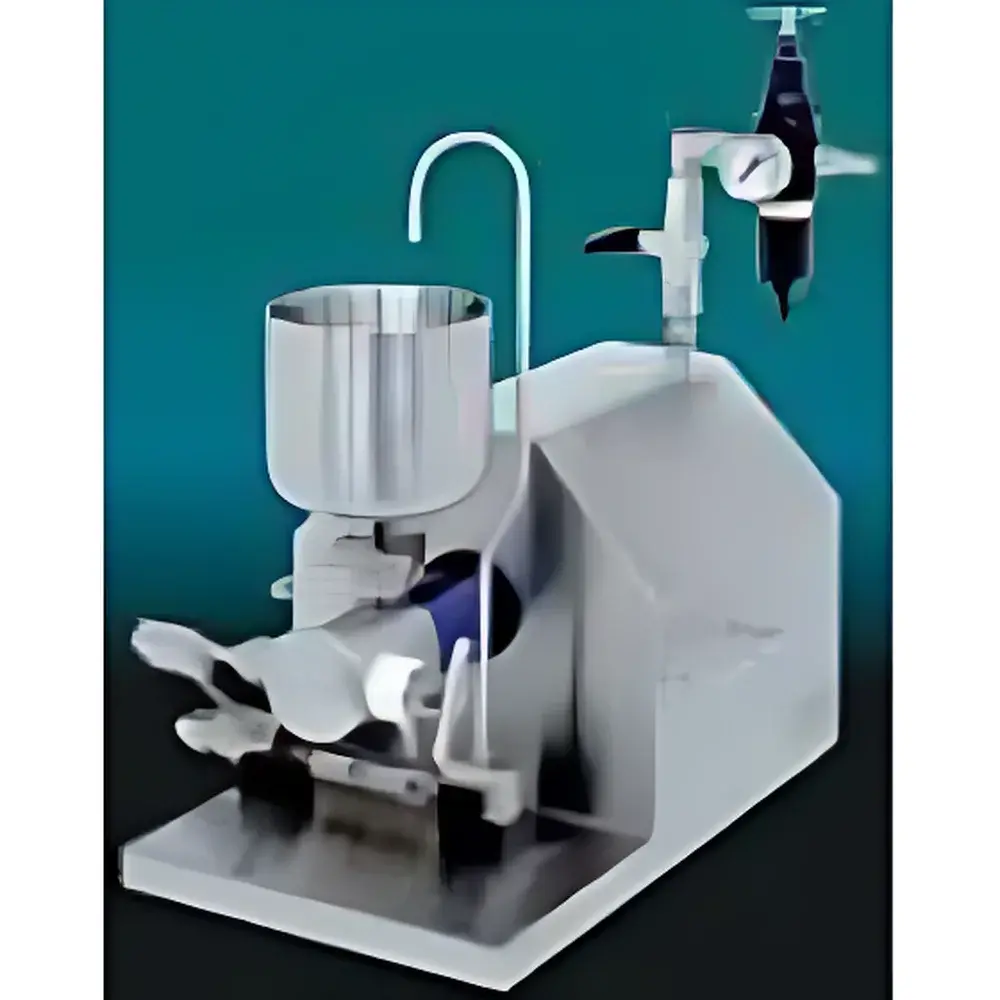
MIFC HC-8000 High-Pressure Homogenizer
| Origin | USA |
|---|---|
| Manufacturer Type | Authorized Distributor |
| Origin Category | Imported |
| Model | HC-8000 |
| Price Range | USD $14,000–$70,000 |
| Instrument Type | High-Pressure Cell Disruptor |
| Max Operating Pressure | 1,000–8,000 psi |
| Max Flow Rate | 1,000 mL/min |
| Feed Temperature Limit | 75 °C |
| Compressed Air Requirement | 57 SCFM at 50 psi, dew point −17.7 to 1.6 °C, 15 hp (11 kW) |
| Minimum Sample Volume | 250 mL |
| Dimensions | 58 × 38 × 58 cm |
| Weight | 26.7 kg |
| Construction Material | Electropolished 316 Stainless Steel |
| Cleaning | CIP-capable high-pressure fluid path |
| Drive Mechanism | Pneumatic, explosion-proof |
| Sterilization Compliance | Autoclavable and SIP-compatible components |
Overview
The MIFC HC-8000 High-Pressure Homogenizer is a precision-engineered, pneumatically driven cell disruption system designed for reproducible, scalable lysis of microbial, mammalian, and plant cells under strictly controlled shear and cavitation conditions. Unlike conventional valve-based homogenizers, the HC-8000 employs a patented fixed-geometry interaction chamber—comprising two precisely aligned, wear-resistant stainless steel surfaces—that generates intense, consistent hydrodynamic shear without moving parts or adjustable valves. This architecture ensures exceptional pressure stability, minimal thermal drift, and long-term calibration integrity across repeated cycles. The system operates using standard laboratory compressed air (50 psi supply), eliminating dependency on hydraulic oil or electric high-pressure pumps—thereby reducing maintenance complexity, operational risk, and total cost of ownership. Its compact footprint (58 × 38 × 58 cm), lightweight design (26.7 kg), and integrated CIP (Clean-in-Place) capability make it suitable for biosafety level 2 (BSL-2) laboratories, GMP-compliant pilot-scale bioprocessing suites, and academic core facilities requiring rapid turnaround between sterile batches.
Key Features
- Patented fixed-geometry interaction chamber: No moving parts, no valve wear, and zero recalibration required over extended service life.
- Operating pressure range of 1,000–8,000 psi: Enables optimization for diverse cell types—from Gram-negative bacteria (e.g., E. coli) to tough yeast and filamentous fungi—without hardware modification.
- Electropolished 316 stainless steel wetted path: Fully compliant with ASME BPE-2022 surface finish standards (Ra ≤ 0.4 µm), validated for steam-in-place (SIP) and autoclave sterilization (121 °C, 30 min).
- Pneumatic drive with intrinsic explosion-proof operation: Certified for use in Class I, Division 2 hazardous environments per UL 60079-0 and ATEX directives.
- CIP-enabled high-pressure fluid circuit: Integrated flush ports and full-bore tubing permit automated cleaning with NaOH, ethanol, or peracetic acid solutions without disassembly.
- Thermal management: Feed temperature tolerance up to 75 °C supports thermolabile formulations (e.g., liposomal mRNA carriers) and inline process integration with heated feed tanks.
- Scalable throughput: Minimum sample volume of 250 mL supports R&D screening; continuous flow rate up to 1,000 mL/min enables pilot-scale processing (~120 L/h).
Sample Compatibility & Compliance
The HC-8000 is routinely deployed in applications demanding regulatory traceability and material compatibility assurance. Its all-metal fluid path exhibits full resistance to organic solvents, surfactants (e.g., Triton X-100, Tween 80), and low-pH buffers commonly used in viral vector purification and lipid nanoparticle (LNP) formulation. The device meets ISO 13485:2016 design control requirements for medical device manufacturing and supports FDA 21 CFR Part 11-compliant electronic records when paired with validated third-party data acquisition software. It is widely referenced in ASTM E2875-22 (Standard Guide for Validation of High-Pressure Homogenization Processes) and aligns with USP guidelines for characterization of nanoscale drug delivery systems. All elastomeric seals (including piston rod seals) are USP Class VI-certified fluorocarbon compounds, ensuring extractables/leachables profiles suitable for parenteral product development.
Software & Data Management
While the HC-8000 operates as a stand-alone analog-controlled instrument, its pneumatic pressure regulation interface is compatible with industrial PLCs (e.g., Siemens S7-1200, Allen-Bradley CompactLogix) via 4–20 mA or 0–10 V analog input/output modules. For audit-ready operation, users integrate optional digital pressure transducers (e.g., Honeywell PX3X series) and temperature sensors (PT100 class A) into custom LabVIEW or Python-based SCADA systems. These configurations support full-cycle logging—including pressure ramp profiles, dwell times, cumulative run hours, and thermal history—with timestamped, encrypted CSV export. Such implementations satisfy GLP/GMP requirements for raw data archiving, electronic signature workflows, and retrospective deviation investigation.
Applications
- Cell lysis for recombinant protein extraction (e.g., inclusion body solubilization from E. coli).
- Preparation of sub-100 nm liposomes and lipid nanoparticles for nucleic acid delivery.
- Homogenization of vaccine adjuvants (e.g., squalene-in-water emulsions per MF59 protocol).
- Disruption of microalgae for bioactive compound recovery (e.g., astaxanthin, phycocyanin).
- Particle size reduction and stabilization of nanoemulsions in topical dermatological formulations.
- Consistency testing of monoclonal antibody aggregates under accelerated shear stress conditions.
FAQ
What validation documentation is provided with the HC-8000?
Factory-issued IQ/OQ protocols, material certifications (EN 10204 3.1), and pressure sensor calibration certificates (traceable to NIST) are included. PQ support packages are available upon request.
Can the HC-8000 be integrated into a closed-system bioprocess train?
Yes—the inlet/outlet ports accept ISO-KF 25 or SMS 19 sanitary fittings; optional sterile diaphragm isolation valves and pre-sterilized disposable chambers are available.
Is operator training included with purchase?
Comprehensive on-site or virtual commissioning and SOP development support is provided during installation, including hands-on operation, CIP cycle validation, and safety interlock verification.
What maintenance intervals are recommended?
Piston seal replacement every 500 operating hours; interaction chamber inspection every 2,000 hours; full pneumatic system desiccant replacement quarterly under continuous use.
Does the HC-8000 meet cGMP requirements for clinical-stage manufacturing?
When operated within documented parameter ranges and supported by user-defined change control and preventive maintenance procedures, the HC-8000 satisfies ICH Q5A(R2) and Annex 1 (2022) expectations for viral clearance process robustness and equipment qualification.



