
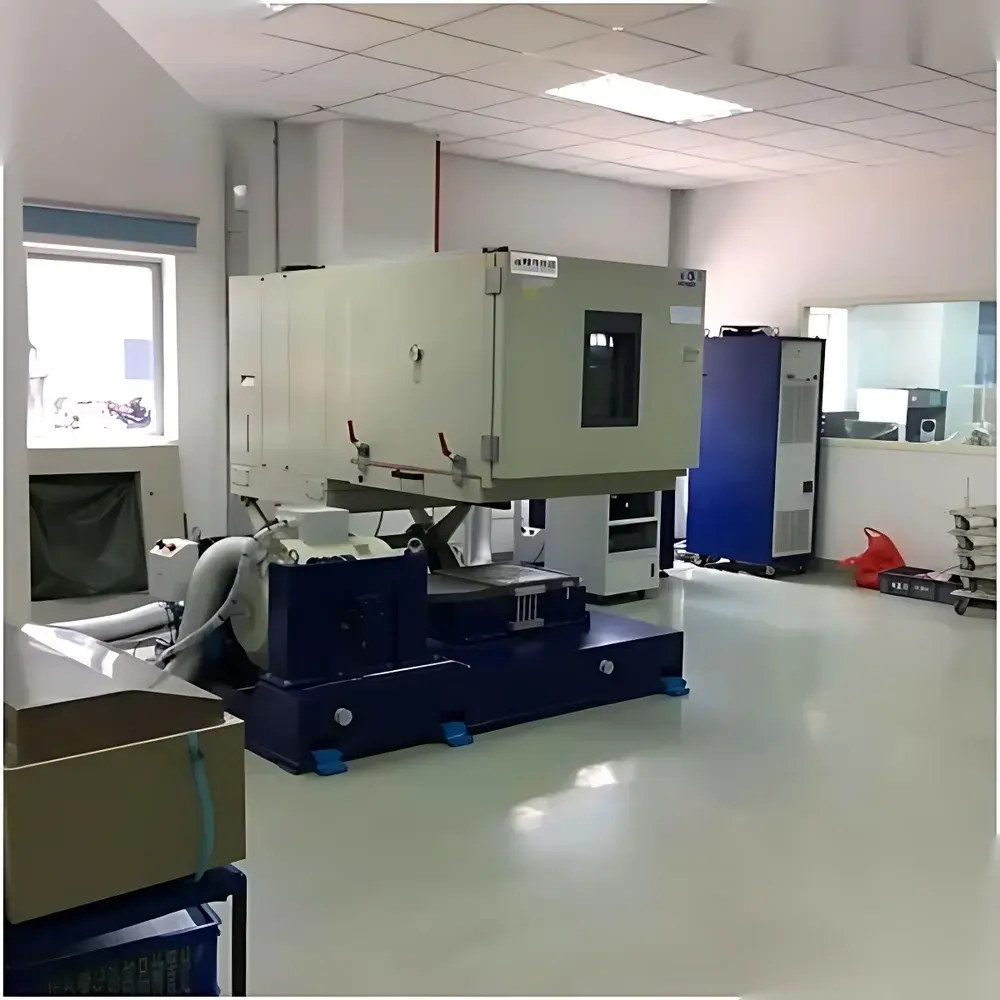
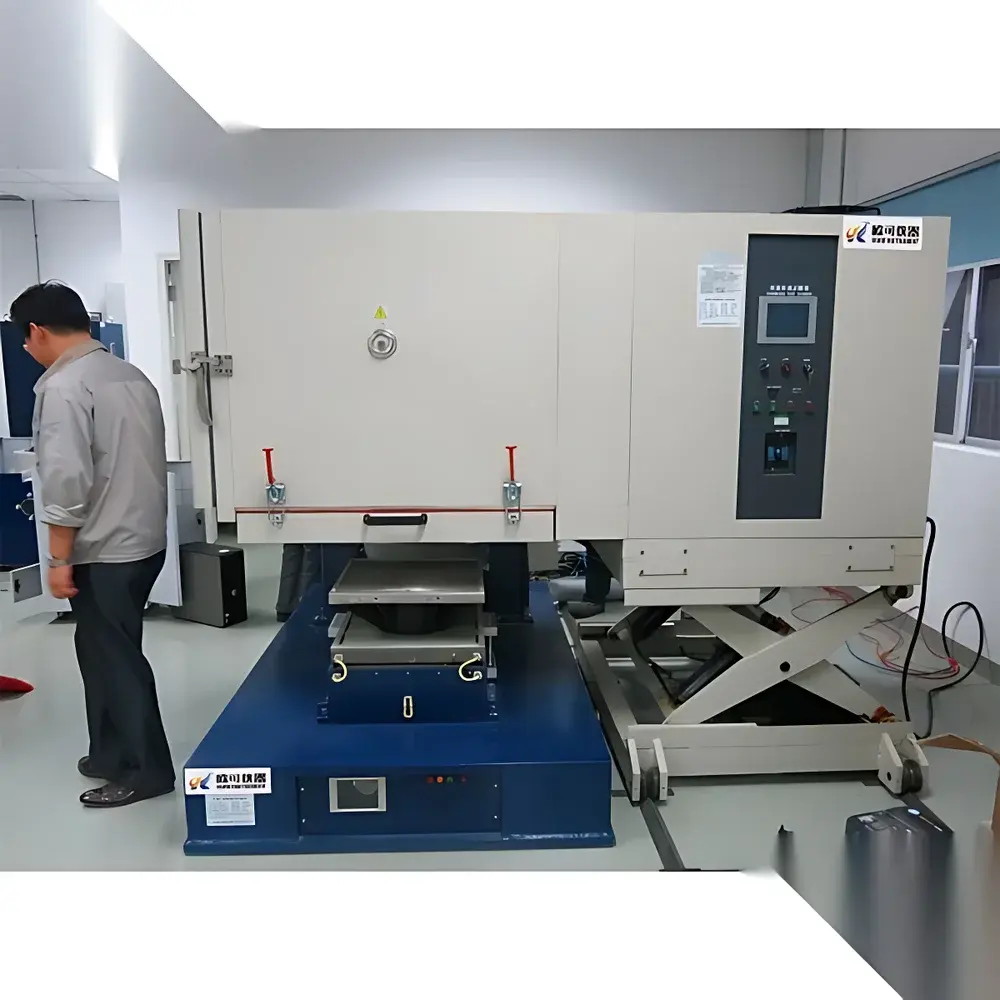
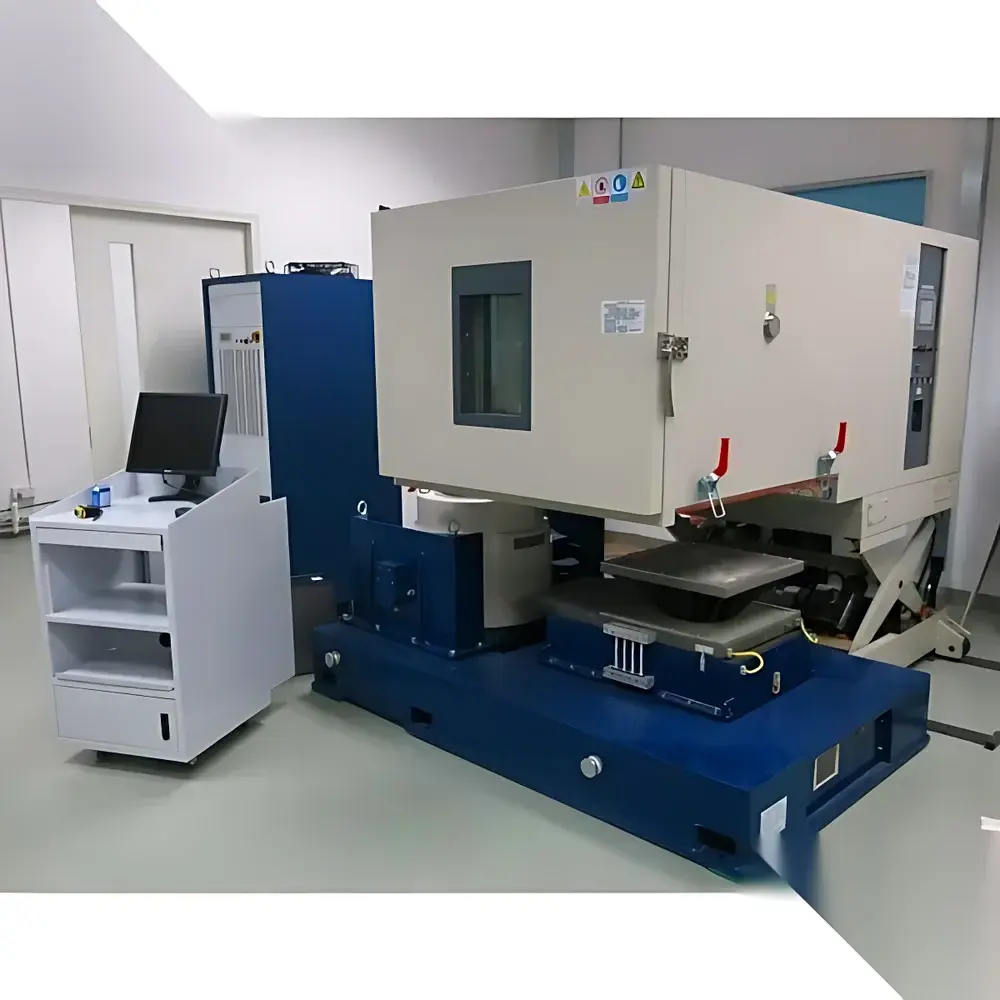
Military-Grade Combined Environmental Test System (Temperature, Humidity, Vibration)
| Brand | Other Brands |
|---|---|
| Origin | Imported |
| Manufacturer Type | Authorized Distributor |
| Price | USD 14,000 (FOB) |
| Chamber Interior | SUS304 Stainless Steel |
| Exterior | Cold-Rolled Steel with Electrostatic Powder Coating |
| Insulation | Rigid Polyurethane Foam or Ultra-Fine Glass Wool |
| Sealing | High-Temperature Silicone Gasket |
| Control Method | BTHC (Balanced Temperature & Humidity Control) |
| Controller | Korean-Made Touchscreen PID Controller, 0.1°C/0.1%RH Accuracy, Independent Heating/Humidification/Cooling/Dehumidification Channels |
| Display | LCD with Real-Time Graphical Interface |
| Communication | RS-485/RS-232 & Ethernet (Modbus TCP/RTU Compatible) |
| Programmable Memory | ≥1,000 Segments, ≥999 Cycles |
| Heating | Stainless Steel Finned Air Heater |
| Humidification | Shallow-Water Pan Steam Generator |
| Refrigeration | Hermetic Compressor, Single-Stage or Cascade Cryogenic Circuit |
| Water Purification | Integrated Deionized Water Filter |
| Auto-Fill | Power-On Water Intake Function |
| Air Circulation | Custom Aluminum Impeller Fan with HVAC-Optimized Blade Profile |
| Timer | Programmable Operational Scheduler |
| Viewing Window | Reinforced Double-Layer Tempered Glass with LED Illumination |
| Safety System | Dual-Redundant Over-Temp/Over-Humidity/Vibration-Amplitude Cut-Off, Emergency Stop, Ground Fault Detection |
| Vibration Interface | Motorized Height-Adjustable Mounting Platform for Seamless Integration with Electrodynamic or Hydraulic Shakers |
Overview
The Military-Grade Combined Environmental Test System is an integrated triaxial environmental simulation platform engineered to replicate the simultaneous stresses of temperature, humidity, and mechanical vibration encountered during defense system deployment, transportation, and operational life cycles. Designed in strict accordance with MIL-STD-810H, DO-160G Section 24 (Environmental Conditions and Test Procedures for Airborne Equipment), and IEC 60068-2 series standards, this system enables rigorous qualification testing of avionics, weapon guidance units, vehicle electronics, and ruggedized communication modules. Its core architecture employs a BTHC (Balanced Temperature and Humidity Control) methodology—where thermal and moisture energy flows are dynamically decoupled yet coordinated via high-bandwidth PID algorithms—to ensure stable, low-drift chamber conditions even under rapid transition profiles. Unlike conventional sequential test chambers, this system maintains true concurrent control across all three domains, eliminating thermal lag-induced condensation artifacts and enabling accurate assessment of synergistic failure modes such as solder joint fatigue under thermal cycling + random vibration, or insulation breakdown under high-humidity + shock loading.
Key Features
- Triple-domain synchronization: Simultaneous real-time control of temperature (−70°C to +180°C), relative humidity (10–98% RH), and broadband vibration (5–2000 Hz, up to 100 gpk, compatible with external shakers up to 22 kN force capacity)
- Dual-redundant safety architecture: Independent hardware watchdogs monitor chamber temperature, humidity saturation, refrigerant pressure, vibration amplitude, and power integrity—triggering immediate shutdown upon deviation beyond Class II safety thresholds per IEC 61508 SIL2 requirements
- High-fidelity environmental replication: SUS304 interior surfaces prevent outgassing and corrosion; rigid polyurethane insulation achieves ≤0.8 W/m²·K thermal transmittance; double-glazed observation window minimizes thermal bridging while maintaining optical clarity at −55°C
- Intelligent water management: Integrated deionized water purification module (resistivity ≥1 MΩ·cm) eliminates mineral scaling in steam generators; auto-fill logic synchronizes with chamber power-up sequence to avoid dry-heating risks
- Programmable test orchestration: Controller supports nested profile structures—including ramp-soak-sweep sequences, conditional branching based on sensor feedback, and time-synchronized trigger outputs for external data acquisition systems
- Vibration interface compatibility: Motorized height-adjustment stage (±150 mm travel, ±0.1 mm repeatability) ensures precise coaxial alignment between chamber baseplate and shaker armature, critical for maintaining force transmission fidelity per ISO 10816-3
Sample Compatibility & Compliance
This system accommodates test specimens up to 1200 mm × 1000 mm × 1000 mm (W×D×H), with configurable internal mounting rails and grounding provisions compliant with MIL-STD-461G CS114 and RS103. All internal electrical interfaces meet EN 61000-4-2/4/5/6 immunity requirements. Calibration traceability follows ISO/IEC 17025:2017 through NIST-traceable reference sensors (PT100 Class A for temperature, capacitive polymer hygrometers for humidity, laser interferometer-verified vibration transducers). Documentation packages include full FAT/SAT reports, uncertainty budgets per GUM (JCGM 100:2008), and compliance matrices mapping test capabilities to MIL-STD-810H Methods 502.7 (Temp), 507.6 (Humidity), and 514.7 (Vibration).
Software & Data Management
The embedded controller firmware supports export of raw time-series data in IEEE C37.118-compliant CSV format, with timestamp resolution ≤10 ms. Optional PC-based software (Windows/Linux) provides GLP/GMP-compliant audit trails, electronic signatures per 21 CFR Part 11, and automated report generation in PDF/A-2b format. Data archiving includes checksum validation, version-controlled profile libraries, and role-based access control (RBAC) for multi-user laboratories. Remote monitoring via HTTPS-enabled web interface allows secure real-time visualization of chamber status, alarm logs, and trend charts without exposing internal network segments.
Applications
- Qualification of airborne radar processors under combined thermal shock + random vibration per DO-160G Section 24, Category D
- Reliability screening of missile seeker assemblies subjected to humidity soak followed by sinusoidal sweep vibration
- Accelerated life testing of naval-grade power converters exposed to salt fog preconditioning + wide-temperature cycling + mechanical shock
- Validation of UAV battery management systems under low-pressure (simulated altitude) + high-humidity + harmonic vibration profiles
- Development testing of C4ISR subsystems requiring electromagnetic compatibility verification within thermally stabilized enclosures
FAQ
What standards does this system comply with for military qualification testing?
It meets MIL-STD-810H (Methods 502.7, 507.6, 514.7, 516.7), DO-160G Section 24, and IEC 60068-2-1/2/14/30/64, with full documentation traceable to national metrology institutes.
Can the system operate vibration and climate profiles independently?
Yes—the controller supports standalone mode for each domain, but its primary design intent is synchronized multi-stress execution with cross-domain interlocks enabled by default.
Is remote calibration verification supported?
Yes—via built-in self-test routines and optional NIST-traceable portable reference probes that connect through the RS-485 service port.
What is the maximum allowable specimen mass for vibration coupling?
When integrated with a 22 kN electrodynamic shaker, the system supports specimens up to 150 kg with center-of-gravity offset ≤±25 mm from mounting plane, verified per ISO 10816-3 modal analysis protocols.
Does the system support automated test reporting for regulatory submissions?
Yes—software modules generate FDA 21 CFR Part 11-compliant electronic records, including operator identity, parameter deviations, calibration history, and digital signatures.



