
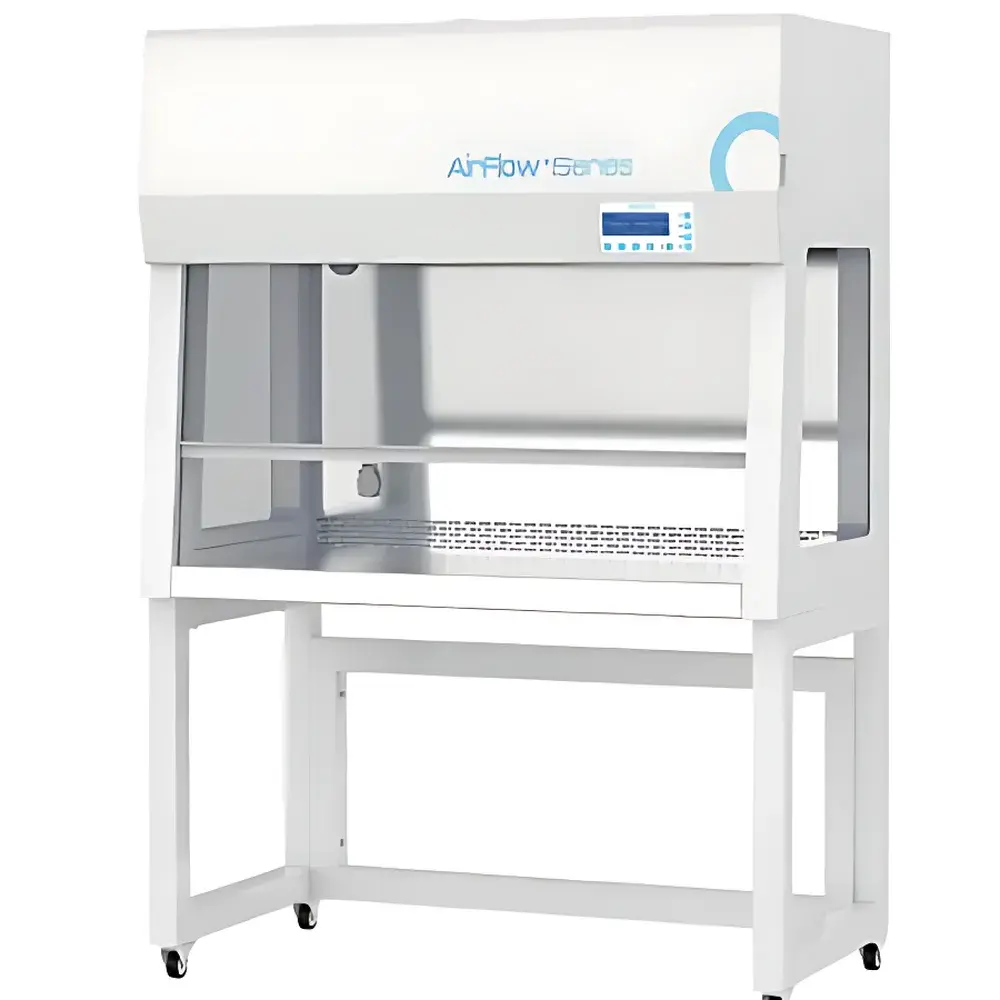
MILLET MLT-BCV Series Vertical Laminar Flow Clean Bench
| Brand | MILLET |
|---|---|
| Origin | Jiangsu, China |
| Manufacturer Type | Authorized Distributor |
| Product Category | Domestic |
| Model | MLT-BCV Series |
| Price Range | USD 1,400 – 7,000 |
| Instrument Type | Vertical Laminar Flow Clean Bench |
| Cleanliness Class | ISO 5 (Class 100) |
| Noise Level | ≤ 62 dB(A) |
| User Capacity | Single-Operator Single-Face or Dual-Operator Dual-Face Configurations |
| Airflow Pattern | Vertical Downflow |
| Filtration Efficiency | ≥ 99.99% @ 0.3 µm (HEPA H14 per EN 1822) |
| Average Air Velocity | 0.30–0.50 m/s (adjustable in 0.01 m/s increments) |
| Illumination | ≥ 900 lx |
| Vibration Amplitude | ≤ 3–4 µm (depending on model) |
| Power Supply | 220 V AC / 50 Hz |
| Max Power Consumption | 250–750 VA |
| Working Area Dimensions (W×D×H) | 920×620×645 mm to 1820×620×645 mm |
| Overall Dimensions (W×D×H) | 1060×720×1745 mm to 1960×720×1745 mm |
| Microbial Contamination | ≤ 0.5 CFU/plate/hour (90 mm Petri dish) |
Overview
The MILLET MLT-BCV Series Vertical Laminar Flow Clean Bench is an ISO 5 (Class 100) certified local air purification system engineered for applications requiring a particle-controlled, microbiologically low-burden workspace. It operates on the principle of vertical unidirectional laminar airflow—filtered air is drawn through a pre-filter and then a high-efficiency particulate air (HEPA) filter (H14 grade per EN 1822), delivering uniform, low-turbulence downflow across the work surface at precisely regulated velocities between 0.30 and 0.50 m/s. This airflow pattern creates a protective barrier that sweeps airborne contaminants—including viable microorganisms, dust, and submicron particles—away from the operator and sample zone, minimizing cross-contamination risks during sensitive procedures. Designed for integration into R&D laboratories, QC environments, and pilot-scale production areas, the MLT-BCV series supports critical workflows in electronics assembly, aerospace component handling, precision instrumentation calibration, fine chemical synthesis, and food safety testing where ambient particulate levels must be actively suppressed.
Key Features
- Human-centered ergonomics: 5° forward-tilted sash and anti-fatigue backlighting reduce operator strain during extended use.
- Dynamic airflow control: Constant-velocity regulation with 0.01 m/s resolution ensures stable laminar conditions despite filter loading or ambient pressure fluctuations.
- Intelligent monitoring interface: LCD display shows real-time face velocity, HEPA operational hours, UV lamp status, and system alarms.
- Dual-safety interlock system: UV irradiation is automatically disabled when the sash is raised above safe threshold; lighting remains active only when UV is off.
- Acoustic optimization: Low-noise, high-static-pressure centrifugal blower maintains ≤ 62 dB(A) sound pressure level at 1 m distance—compliant with ISO 7779 and ANSI S12.55 laboratory noise guidelines.
- Robust construction: Stainless steel work surface (304 grade) resists corrosion and facilitates decontamination; tempered glass side panels enhance visibility and structural integrity.
- Extended filter service life: Integrated pre-filter captures coarse particulates, reducing HEPA loading rate and extending replacement intervals by up to 40% under typical lab conditions.
- Configurable power infrastructure: Built-in 1 kVA grounded outlet supports auxiliary equipment without external power strips.
Sample Compatibility & Compliance
The MLT-BCV series accommodates a broad range of non-hazardous samples—from semiconductor wafers and optical lenses to sterile culture media and pharmaceutical intermediates—within its vertically ventilated workspace. Its ISO 5 classification is validated per ISO 14644-1:2015 using discrete particle counters (e.g., TSI 3330) and microbial sampling per ISO 14698-1. While not intended for containment of biohazards (i.e., it lacks negative pressure or exhaust ducting), the unit meets core requirements for cleanroom-adjacent operations under GMP Annex 1 (2022), USP <797>, and EU GMP Chapter 5 for aseptic processing support environments. All electrical components comply with IEC 61010-1 for laboratory equipment safety, and UV lamp output conforms to IEC 62471 photobiological safety standards.
Software & Data Management
The MLT-BCV operates via embedded firmware with no external PC dependency. All operational parameters—including cumulative HEPA runtime, UV exposure cycles, and alarm event logs—are stored locally with timestamped records accessible via the front-panel interface. Audit-trail functionality supports GLP-compliant documentation: each alarm (e.g., filter degradation warning, sash mispositioning) triggers simultaneous audible alert, visual LED indicator, and persistent log entry. While the system does not integrate natively with LIMS or SCADA platforms, data export is supported via optional RS-485 or USB-to-serial adapter (sold separately), enabling periodic extraction of maintenance history for internal quality review or regulatory inspection readiness.
Applications
- Electronics: Handling of MEMS devices, PCB soldering stations, and photomask alignment under particle-free conditions.
- Aerospace: Assembly and inspection of inertial navigation sensors and optical guidance components.
- Precision engineering: Calibration of coordinate measuring machines (CMMs) and interferometric metrology tools.
- Food science: Preparation of microbiological test samples, sensory evaluation panels, and shelf-life study inoculations.
- Chemical R&D: Weighing of hygroscopic reagents, solvent-sensitive crystallization trials, and catalyst handling.
- Academic research: Teaching labs requiring reproducible laminar flow environments for cell culture setup or molecular biology workflows.
FAQ
Is the MLT-BCV suitable for biosafety level 2 (BSL-2) work?
No. It provides personnel and product protection only—not environmental protection—and must not be used for handling infectious agents or toxins requiring containment.
What HEPA filter standard does the MLT-BCV meet?
It uses EN 1822-1:2019 H14-class filters, certified for ≥ 99.995% particle capture efficiency at the most penetrating particle size (MPPS) of 0.3 µm.
Can the unit be installed in a non-ventilated room?
Yes—vertical flow clean benches recirculate filtered air internally and require no external ductwork or make-up air supply.
How often should the pre-filter be replaced?
Under typical laboratory conditions (ISO 8 ambient), replace every 3–6 months; frequency increases in high-dust environments and should be verified by differential pressure monitoring.
Does the system support FDA 21 CFR Part 11 compliance?
The base configuration provides audit-ready event logging but lacks electronic signature capability; full Part 11 compliance requires supplemental validation and third-party software integration.



