
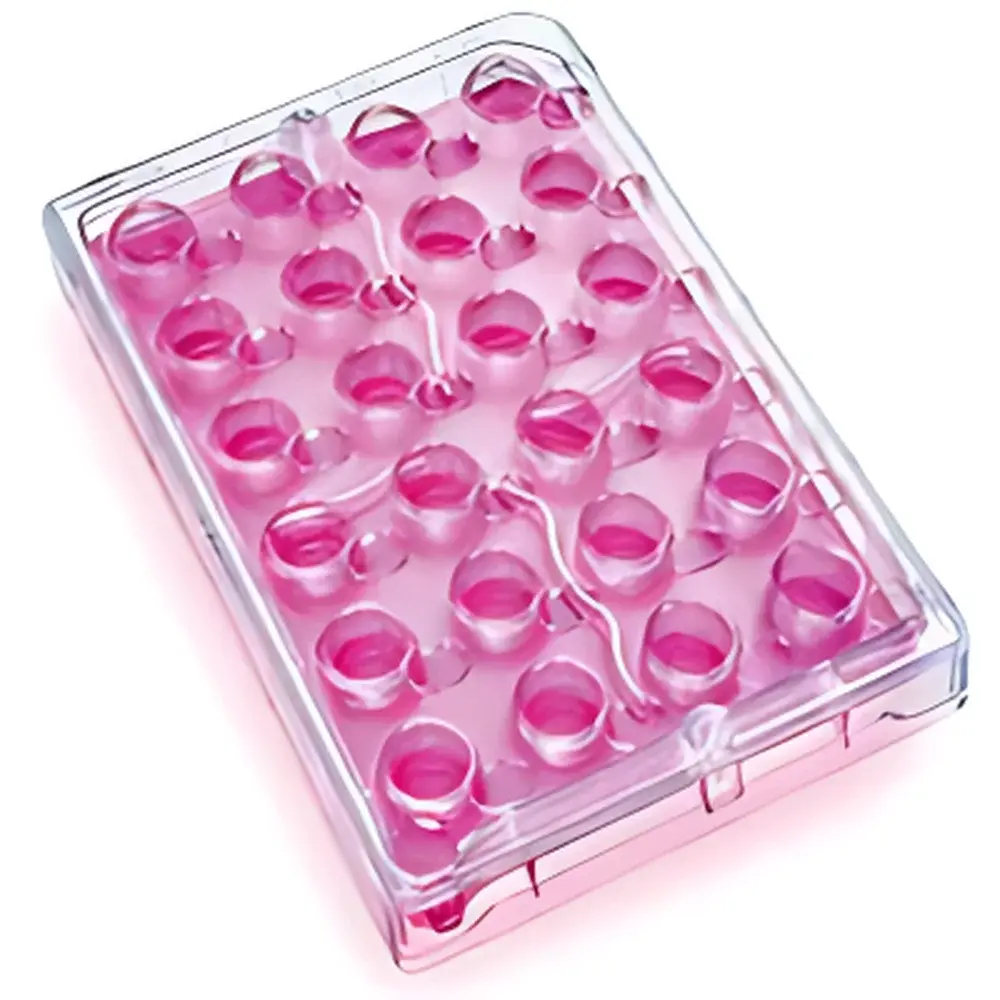
Millicell 24-Well Cell Culture Plate Assembly (PCF or PET Membrane, 0.4 µm or 1.0 µm Pore Size)
| Brand | Millipore |
|---|---|
| Origin | USA |
| Configuration | Sterile, Pre-assembled Transwell-Compatible Insert System |
| Membrane Material | Polycarbonate (PCF) or Polyester (PET) |
| Pore Size | 0.4 µm (PCF) or 1.0 µm (PET) |
| Well Count | 24 |
| Format | Integrated Insert + Receiver Plate + Lid |
| Sterility | Certified Sterile, Non-Pyrogenic, DNase/RNase-Free |
| Packaging | Individual Blister Pack or Multi-Pack |
| Compliance | ISO 13485–Certified Manufacturing |
| Intended Use | In vitro cell culture, co-culture, permeability assays, differentiation studies, and barrier function analysis |
Overview
The Millicell 24-Well Cell Culture Plate Assembly is a precision-engineered, pre-sterilized transwell-compatible system designed for reproducible in vitro cell culture under controlled physiological conditions. Unlike conventional multi-well plates requiring separate inserts and receiver trays, this integrated assembly combines a 24-well insert plate, matching receiver base, and vented lid into a single, alignment-secured unit. It operates on the principle of porous membrane-supported cell monolayer formation—enabling apical-basolateral compartmentalization essential for transport studies, barrier integrity assessment (e.g., TEER), and polarized secretion analysis. The system supports both static and dynamic culture protocols and is validated for use in regulatory-compliant environments including GLP and GMP-aligned laboratories.
Key Features
- Integrated architecture eliminates misalignment risk: Insert wells are mechanically keyed to the receiver plate, ensuring consistent 0.5 mm vertical spacing between membrane and bottom surface—critical for uniform fluid shear and nutrient diffusion.
- Patented “tear-drop” shaped well openings in the lid reduce air entrapment during medium addition, minimizing sub-membrane bubble formation that can compromise monolayer confluence and assay reproducibility.
- Widened well rims (±0.3 mm tolerance) facilitate precise pipette tip placement and reduce cross-contamination during manual feeding or automated liquid handling.
- Expanded label area (12 × 8 mm per well) accommodates barcode adhesion and handwritten annotations without obstructing optical clarity or lid sealing integrity.
- Standalone stability: When detached from the receiver plate, the insert plate stands upright on its reinforced perimeter—protecting fragile confluent monolayers during washing or immunostaining steps.
- Leak-resistant design: Optional solid-bottom receiver plates with internal partition walls prevent inter-well cross-flow during centrifugation or tilt-based media exchange protocols.
Sample Compatibility & Compliance
The Millicell 24-well assembly is compatible with primary human and rodent epithelial, endothelial, neuronal, and stem-derived cells—including Caco-2, MDCK, HUVEC, and iPSC-derived organoids. Both PCF (0.4 µm pore) and PET (1.0 µm pore) membranes support attachment-dependent growth and long-term differentiation. All components are manufactured under ISO 13485-certified conditions and tested per USP <85> (bacterial endotoxins), USP <71> (sterility), and ISO 10993-5 (cytotoxicity). The system meets ASTM F895–22 requirements for cell culture device biocompatibility and is suitable for applications referenced in FDA Guidance for Industry: *In Vitro Diagnostic Multivariate Index Assays* (2021) and EMA CHMP Reflection Paper on *Advanced Therapy Medicinal Products* (2023).
Software & Data Management
While the Millicell 24-well plate is a hardware-only platform, it integrates seamlessly with industry-standard instrumentation for downstream analysis: TEER measurement systems (e.g., EVOM2, STX2), automated plate readers (BMG Labtech CLARIOstar, PerkinElmer EnVision), and high-content imaging platforms (ImageXpress Micro Confocal, Operetta CLS). Raw assay data generated using this assembly comply with ALCOA+ principles when recorded in validated LIMS or ELN systems (e.g., LabWare LIMS, Benchling). Full audit trails—including lot-specific sterility certificates, membrane pore size validation reports, and endotoxin test summaries—are provided digitally via MilliporeSigma’s Product Traceability Portal.
Applications
- Trans-epithelial/endothelial electrical resistance (TEER) monitoring for blood-brain barrier or intestinal permeability modeling.
- Drug permeability screening (Papp calculation) aligned with ICH M10 and FDA Bioanalytical Method Validation guidelines.
- Co-culture studies involving immune cell migration across tumor or stromal barriers.
- Exosome and cytokine secretion profiling with spatially resolved apical vs. basolateral collection.
- Differentiation kinetics of air-liquid interface (ALI) cultures for respiratory epithelium modeling.
- Toxicity assessment of nanomaterials or environmental contaminants using barrier disruption endpoints.
FAQ
Can the Millicell 24-well assembly be used with automated liquid handlers?
Yes—the standardized ANSI/SLAS footprint (127.76 × 85.48 mm) and rigid polystyrene receiver base ensure compatibility with robotic arms and deck-mounted dispensers from Tecan, Hamilton, and Agilent.
Is the 0.4 µm PCF membrane suitable for neutrophil transmigration assays?
Yes—this pore size permits active leukocyte diapedesis while retaining epithelial monolayer integrity; validated in protocols compliant with Nature Protocols (2019) DOI:10.1038/s41596-019-0165-2.
Are lot-specific validation documents available for regulatory submissions?
Yes—Certificate of Analysis (CoA), Certificate of Conformance (CoC), and ISO 13485 manufacturing records are accessible upon request via MilliporeSigma’s Regulatory Support Portal.
Can the receiver plate be autoclaved for reuse?
No—components are supplied as single-use, gamma-irradiated devices; re-sterilization compromises membrane integrity and dimensional tolerances.
Does the system support oxygen gradient generation for hypoxia studies?
Yes—when paired with gas-permeable lids and modular incubator chambers (e.g., STEMCELL Technologies’ HypoxyStation), stable O2 gradients (1–5% O2) can be maintained across the membrane interface.




