
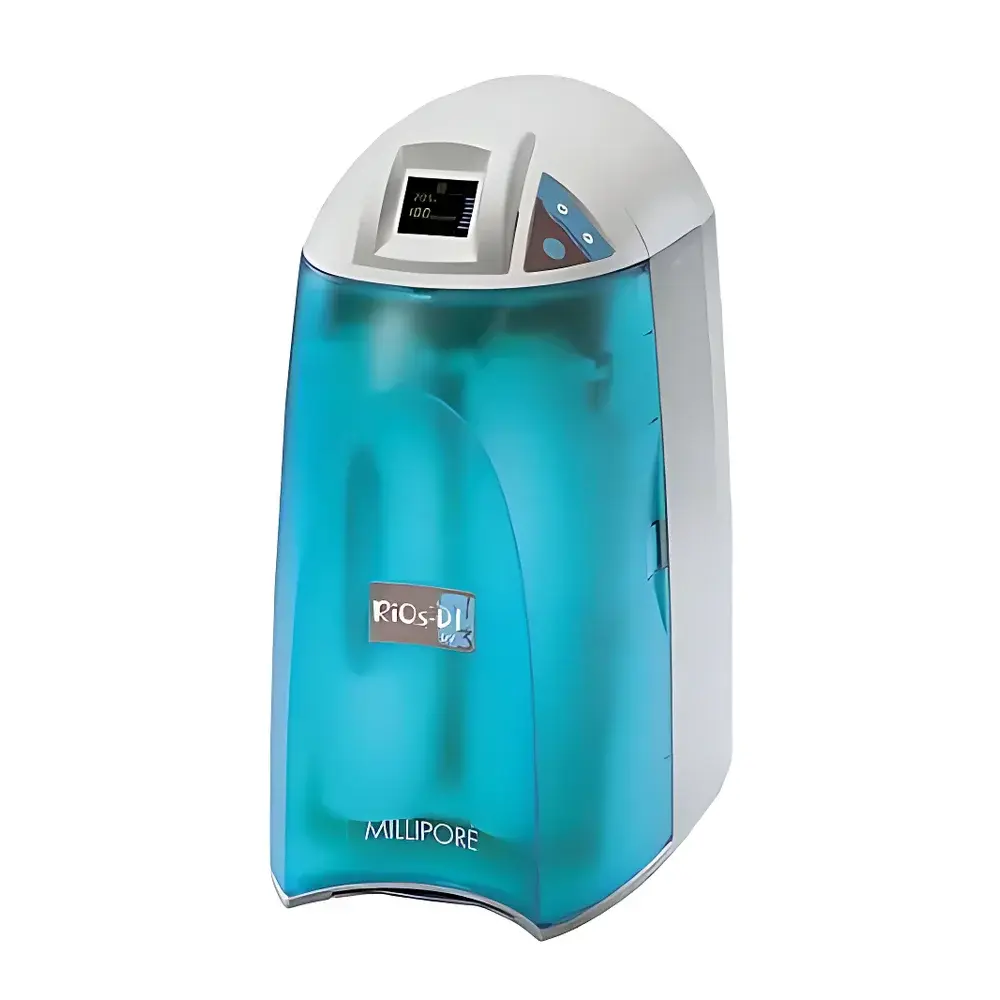
Millipore RiOs 3 Water Purification System
| Brand | Millipore |
|---|---|
| Origin | France |
| Model | RiOs 3 |
| Daily Output Capacity | Up to 30 L/day |
| Product Flow Rate | >2.4 L/h at 15 °C |
| Dimensions (H×W×D) | 50 × 29 × 33 cm |
| Operating Weight | 7.0 kg |
| Integrated Reservoir | 6 L (expandable to 30 L or 60 L) |
| Resistivity Monitoring | Yes (backlit color display) |
| Pre-filter + RO Membrane Cartridge | Integrated single-unit consumable |
| Ion Removal Efficiency | >94% |
| Organic/Bacterial/Particulate Removal Efficiency | >99% |
Overview
The Millipore RiOs 3 Water Purification System is a compact, integrated laboratory-grade purification platform engineered to deliver consistent Type III purified water in compliance with ISO 3696:1987 and ASTM D1193-06 standards. It employs a dual-stage purification architecture comprising pretreatment (activated carbon and sediment filtration) followed by high-rejection thin-film composite reverse osmosis (RO), enabling reliable removal of ionic contaminants (>94%), organic compounds, microorganisms, and particulates (>99%). Designed for laboratories requiring dependable feedwater for downstream applications—including buffer preparation, glassware rinsing, autoclave and humidifier operation, and as pre-treatment for ultra-pure water systems such as Milli-Q® or Synergy®—the RiOs 3 serves as a robust, low-maintenance entry point into the Millipore water purification ecosystem. Its closed-loop design minimizes ambient contamination risk, while its thermally stabilized flow path ensures stable performance across typical lab ambient conditions (15–30 °C).
Key Features
- Integrated single-cartridge consumable combining sediment filter, activated carbon block, and RO membrane—reducing maintenance complexity and minimizing downtime.
- Backlit color LCD display showing real-time resistivity (kΩ·cm), water temperature (°C), and reservoir level—enabling immediate verification of water quality status without manual testing.
- Compact footprint (50 × 29 × 33 cm) with built-in 6 L reservoir; optionally expandable via external 30 L or 60 L storage tanks with level-sensing interface and recirculation loop compatibility.
- Consistent output flow rate exceeding 2.4 L/h at 15 °C—optimized for continuous use in moderate-throughput labs performing daily glassware washing, media preparation, or equipment feedwater supply.
- Low annual maintenance burden: single purification cartridge replacement one to two times per year under standard usage conditions (≤30 L/day), supported by system-generated usage alerts and cartridge life tracking.
- CE-marked and RoHS-compliant construction; electrical safety certified to IEC 61010-1 for laboratory environments.
Sample Compatibility & Compliance
The RiOs 3 is intended for purification of potable municipal or dechlorinated feedwater meeting local drinking water regulations (e.g., WHO Guidelines, EU Directive 98/83/EC). It is not designed for direct use with well water, seawater, or highly turbid or high-hardness sources without prior conditioning. The system complies with ISO 3696:1987 specifications for Type III water (resistivity ≥ 0.2 MΩ·cm at 25 °C, total organic carbon < 200 ppb, bacterial count < 10 CFU/mL), and supports GLP/GMP-aligned documentation practices through optional audit trail-enabled software integration. All wetted materials—including housing, tubing, and cartridge components—are USP Class VI-certified and extractables-tested per USP .
Software & Data Management
While the RiOs 3 operates as a standalone unit with no embedded data logging, its display interface provides timestamped event history (e.g., cartridge replacement, low-level alerts, temperature excursions) accessible via on-device navigation. For laboratories requiring electronic records, the system is compatible with Millipore’s optional E-Connect™ interface module (sold separately), which enables RS232/USB connectivity to LIMS or ELN platforms. When paired, it supports configurable data export in CSV format, user-accessible audit trails, and alignment with FDA 21 CFR Part 11 requirements for electronic signatures and record retention—subject to proper validation protocol execution.
Applications
- Routine laboratory cleaning: manual rinsing, automated glassware washers, and ultrasonic baths.
- Preparation of non-critical reagents, buffers, and culture media where Type III water suffices per CLSI GP17-A3 guidelines.
- Feedwater source for high-purity water systems (e.g., Milli-Q® IQ 7000, Synergy® UV), reducing fouling of downstream ion exchange and UV oxidation stages.
- Operational support for steam sterilizers (autoclaves), environmental chambers, and humidification units requiring low-conductivity feedwater to prevent scale formation.
- General-purpose lab utility water for microscopy slide preparation, pH meter calibration, and spectrophotometer blanking—where particulate and microbial load must remain consistently low.
FAQ
What feedwater quality is required for optimal RiOs 3 performance?
Municipal tap water meeting WHO or EPA drinking water standards is recommended. Feedwater with >1 ppm free chlorine, >200 ppm total dissolved solids, or >1 NTU turbidity should be pre-treated with a dedicated dechlorination or softening unit.
Can the RiOs 3 be connected to a building’s central water supply?
Yes—via standard 3/8″ compression fittings. A pressure regulator (set to 2–6 bar) and particulate pre-filter (5 µm) are mandatory upstream to protect the integrated RO membrane.
Does the system include microbiological monitoring capabilities?
No. While the integrated RO and carbon stages achieve >99% bacterial reduction, the RiOs 3 does not incorporate online TOC or bioburden sensors. Periodic manual testing per ISO 11133 or pharmacopeial methods is advised for critical applications.
Is the 6 L internal tank vented or sealed?
It is a sealed, pressurized reservoir with integrated air filter (0.2 µm hydrophobic PTFE) to prevent airborne contamination while maintaining positive pressure during dispensing.
How often should the integrated cartridge be replaced?
Under typical usage (≤30 L/day, feed TDS < 200 ppm), replacement is required once every 6–12 months—triggered by system alerts based on cumulative volume processed and resistivity drift thresholds.



