
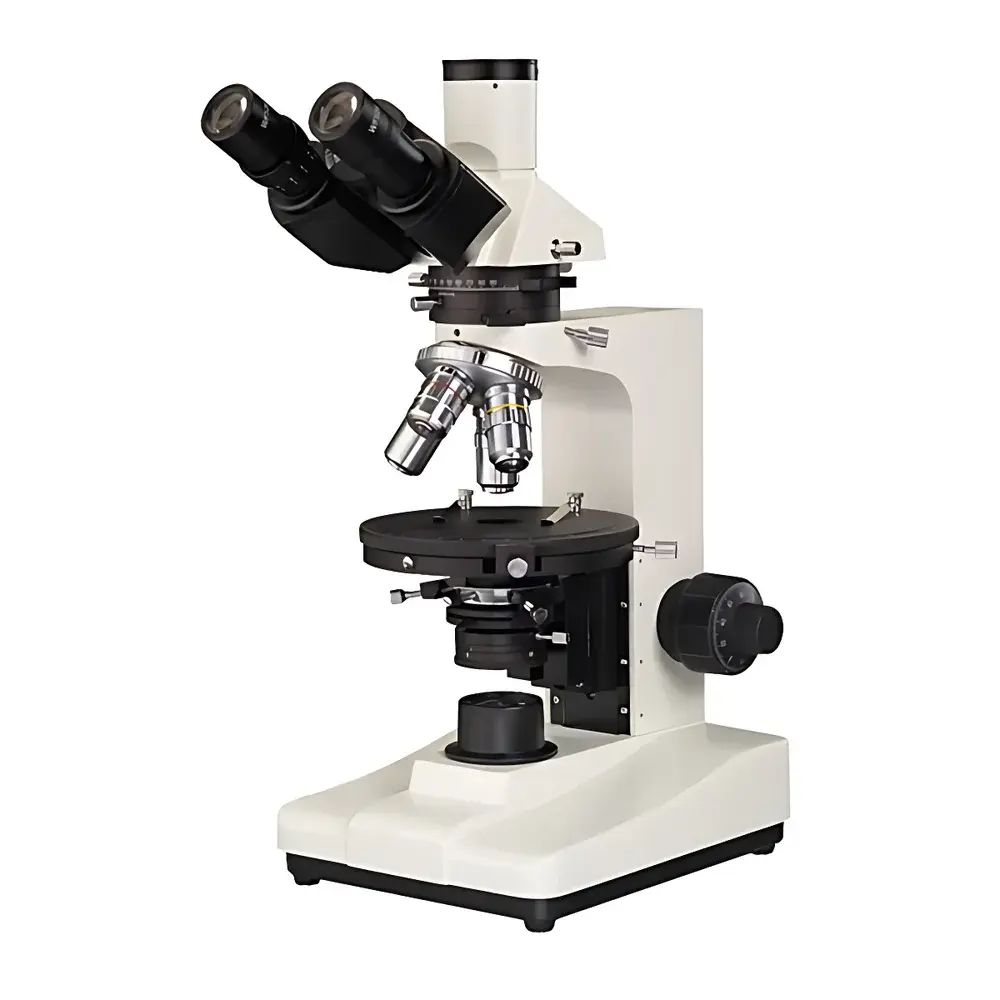
MingHui MHPL1500 Transmitted-Light Polarizing Microscope
| Brand | MingHui |
|---|---|
| Origin | Guangdong, China |
| Manufacturer Type | Direct Manufacturer |
| Model | MHPL1500 |
| Illumination | Transmitted Halogen (6V/20W) |
| Objective Lenses | PL 4×/0.10, PL 10×/0.25, PL 40×/0.65 (spring), PL 60×/0.85 (spring) |
| Eyepieces | Wide-field WF10× (Φ18 mm), Divided 10× (0.10 mm/div) |
Overview
The MingHui MHPL1500 is a high-precision transmitted-light polarizing microscope engineered for quantitative birefringence analysis and crystallographic characterization of anisotropic materials. Based on the fundamental principles of orthogonal polarization optics—employing a linear polarizer (lower), a rotatable analyzer (upper), and compensators—the instrument enables rigorous observation in three primary optical configurations: plane-polarized light (PPL), cross-polarized light (XPL), and convergent polarized light (conoscopic mode). Its optical train is fully strain-free, utilizing stress-relieved, achromatic, plan-apochromatic-corrected polarizing objectives (PL series) and wide-field, parfocal eyepieces to ensure minimal artifact introduction during phase-sensitive measurements. Designed for laboratory-grade reproducibility, the MHPL1500 meets the mechanical and optical stability requirements essential for routine mineral identification, polymer phase morphology assessment, pharmaceutical polymorph screening, and liquid crystal domain mapping.
Key Features
- Strain-free optical pathway: All critical components—including objectives, condenser, prisms, and beam-splitting optics—are manufactured and assembled under controlled thermal and mechanical stress conditions to eliminate spurious birefringence.
- Precision rotating stage: Φ150 mm diameter, 360° calibrated scale with 6′ vernier reading, center-adjustable and lockable—enabling accurate crystal orientation measurement and extinction angle determination per ASTM D4101 and ISO 6721-1.
- Rotatable polarizer and analyzer: Both elements feature dual-scale vernier readouts (12′ resolution), allowing precise angular alignment for retardation quantification and interference figure acquisition.
- Integrated compensator system: Includes removable λ/4 plate and centerable quartz wedge compensator—supporting qualitative and semi-quantitative retardation measurement up to 1670 nm (quartz wedge range).
- Trinocular observation tube: 30° inclined, 100% light-divertible configuration with built-in analyzer—optimized for simultaneous visual observation and high-fidelity digital imaging without optical path compromise.
- Halogen-transmitted illumination: 6 V / 20 W adjustable-intensity source coupled with NA 1.25 Abbe condenser and field diaphragm—ensuring uniform Köhler illumination across all magnifications.
Sample Compatibility & Compliance
The MHPL1500 accommodates standard 26 mm × 76 mm glass slides and 24 mm × 50 mm cover slips (thickness 0.17 mm), compatible with both thin-section petrographic mounts and polymer film specimens. Its optical design supports transmission-mode analysis of transparent or semi-transparent birefringent samples—including geological thin sections, pharmaceutical crystalline APIs, thermotropic and lyotropic liquid crystals, biopolymer gels, and electro-optic thin films. The instrument conforms to key metrological and safety standards relevant to analytical microscopy: ISO 8578 (microscope mechanical tolerances), IEC 61000-6-3 (EMC emissions), and IEC 61010-1 (safety requirements for laboratory equipment). While not FDA-cleared as a medical device, its documentation and traceable calibration procedures support GLP-compliant workflows in QC laboratories adhering to USP <788>, EP 2.9.20, and ISO/IEC 17025 frameworks.
Software & Data Management
The MHPL1500 is fully compatible with industry-standard digital imaging platforms via C-mount adapters (0.4×, 0.5×, 1×) and USB 2.0/3.0 camera interfaces (e.g., MHD500, MHC600 series). Supported software includes open-architecture packages such as NIS-Elements (Nikon), ZEN Blue (Zeiss), and open-source alternatives like ImageJ/Fiji with polarimetric plugins. All image metadata—including polarizer/analyzer angles, objective magnification, exposure parameters, and stage coordinates—can be embedded into TIFF or OME-TIFF files. When paired with compliant cameras and audit-trail-enabled acquisition software, the system satisfies basic requirements for electronic record integrity under FDA 21 CFR Part 11—provided institutional validation protocols are applied to the full imaging workflow.
Applications
- Geosciences: Identification of mineral species, determination of optic sign and axial angle in thin sections, and interpretation of deformation microstructures.
- Materials Science: Characterization of spherulite size/distribution in semi-crystalline polymers (e.g., PP, PET), phase separation in block copolymers, and director alignment in nematic LC cells.
- Pharmaceutical Development: Detection and classification of solid-state forms (polymorphs, hydrates, co-crystals) based on birefringence magnitude, extinction behavior, and interference color patterns.
- Life Sciences: Visualization of collagen fiber orientation in connective tissues, starch granule crystallinity, and chiral supramolecular assemblies in biomaterials.
- Quality Control: Routine verification of optical homogeneity in optical glasses, detection of residual stress in molded plastic components, and incoming inspection of birefringent optical filters.
FAQ
What types of samples can be observed using the MHPL1500 in transmitted-light mode?
Transparent or semi-transparent anisotropic specimens mounted on standard glass slides—such as geological thin sections, polymer films, pharmaceutical crystals, and biological tissues stained for birefringence.
Is the MHPL1500 suitable for quantitative retardation measurement?
Yes—when used with the included quartz wedge compensator and calibrated stage rotation, it supports semi-quantitative retardation estimation (±5 nm accuracy) per ISO 10110-5 guidelines.
Can the microscope be upgraded for reflected-light polarized observation?
No—the MHPL1500 is designed exclusively for transmitted illumination; however, MingHui offers complementary models (e.g., MHPL1500R) with integrated epi-illumination modules for reflective birefringence studies.
Does the system include compliance documentation for regulated environments?
Factory calibration certificates and mechanical tolerance reports are provided; full GxP compliance requires site-specific IQ/OQ/PQ validation using third-party metrology services.
What is the maximum usable magnification for birefringence contrast?
Optimal contrast is maintained up to 600× total magnification (60× objective + 10× eyepiece); higher magnifications may reduce signal-to-noise ratio due to reduced light throughput in XPL mode.




