
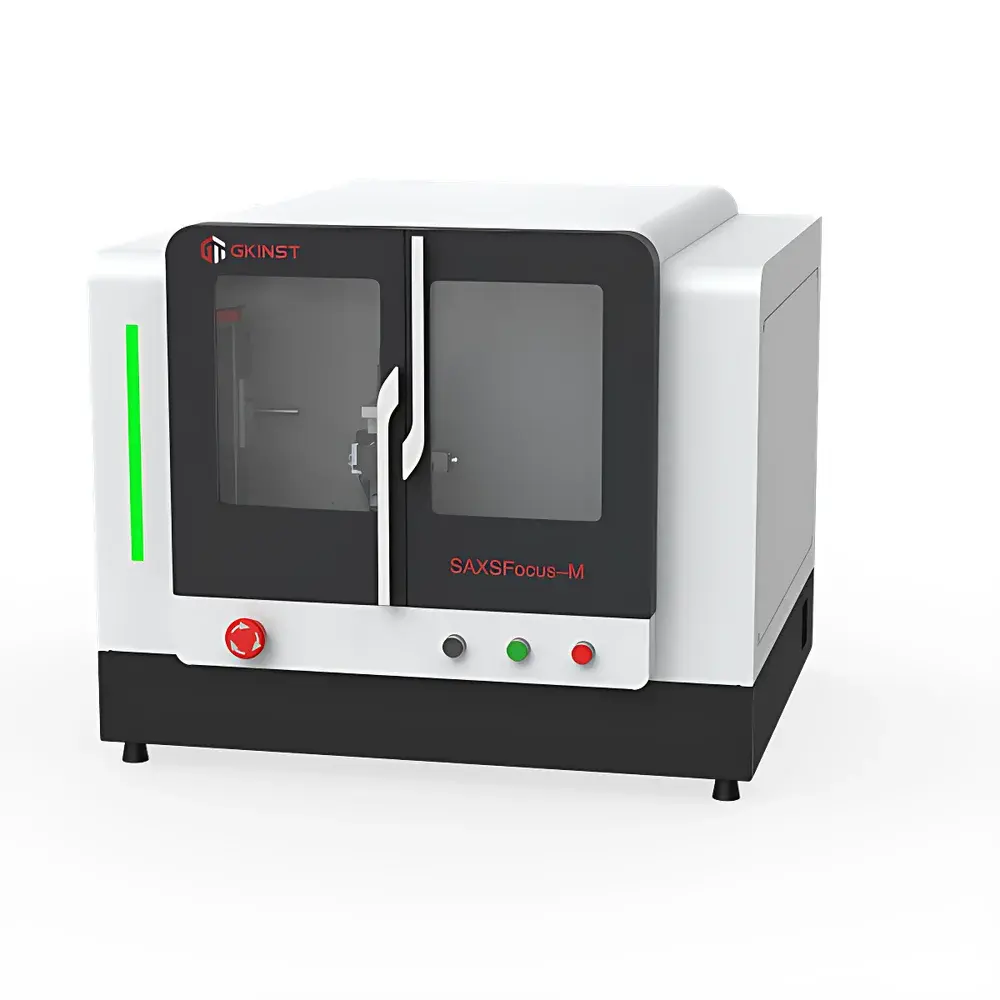
MiniSAXS Desktop Small-Angle X-ray Scattering (SAXS) System
| Brand | GKInst |
|---|---|
| Origin | Anhui, China |
| Manufacturer Type | Authorized Distributor |
| Country of Origin | China |
| Model | MiniSAXS |
| Price Range | USD 140,000 – 280,000 |
| Instrument Type | Small-Angle X-ray Scattering (SAXS) System |
| Measurement Range | 1 nm – 100 nm |
| Available Anode Materials | Cu, Mo, Ag |
| Collimation | Pinhole-based collimation system |
| Filtration | Integrated beam filtration unit |
| Sample Stage | Motorized 3-axis stage with 16-position powder holder and 16-position solid-sample holder |
| Detector | Two-dimensional silicon pixel array single-photon counting detector |
| Pixel Size | 75 µm × 75 µm |
| Readout Mode | Continuous, zero dead time, no readout noise or dark current |
| Dynamic Range | 32-bit |
| Sample-to-Detector Distance (SD) | 40 mm – 350 mm |
| Scattering Vector (q) Range | 0.063 nm⁻¹ – 6.3 nm⁻¹ |
| Dimensions (W×D×H) | 840 mm × 750 mm × 700 mm |
| Power Supply | AC 220 V, 50 Hz (single-phase) |
| Supported Techniques | SAXS, WAXS, GIWAXS, GISAXS |
Overview
The MiniSAXS Desktop Small-Angle X-ray Scattering (SAXS) System is an engineered solution for nanoscale structural characterization in academic laboratories, industrial R&D centers, and quality control environments where space, budget, and operational simplicity are critical constraints. Built upon the physical principles of elastic X-ray scattering, the MiniSAXS measures angular intensity distributions arising from electron density fluctuations in the 1–100 nm range—enabling quantitative analysis of particle size distribution, shape anisotropy, specific surface area, pore architecture, and long-range ordering in disordered or semi-crystalline materials. Unlike synchrotron-based SAXS, this benchtop system integrates a high-brightness microfocus X-ray source with a vacuum-compatible, low-noise 2D silicon pixel detector to deliver laboratory-grade data fidelity without requiring dedicated radiation shielding rooms or cryogenic infrastructure. Its modular optical path—based on pinhole collimation and selectable anode targets (Cu Kα, Mo Kα, Ag Kα)—ensures flexibility across sample classes while maintaining strict q-space calibration traceability.
Key Features
- Compact footprint (0.63 m²) optimized for standard lab benches—no external hutch or floor reinforcement required.
- Microfocus X-ray source delivering stable flux (>1 × 10⁸ photons/s at Cu Kα) with focal spot size <50 µm, enabling high-resolution q-space sampling.
- Single-photon-counting 2D silicon detector with true zero-dead-time readout, eliminating pile-up artifacts and ensuring linear response across six orders of magnitude intensity range.
- Motorized 3-axis sample stage supporting automated batch measurement of up to 32 samples (16 powder + 16 solid), with programmable tilt, rotation, and vertical translation for precise grazing-incidence alignment.
- Integrated beam filtration and harmonic suppression optics to minimize parasitic scattering and improve signal-to-background ratio in low-q regions.
- Full technique support: conventional SAXS, wide-angle X-ray scattering (WAXS), grazing-incidence WAXS (GIWAXS), and grazing-incidence SAXS (GISAXS) — all accessible via software-selectable geometry configurations.
Sample Compatibility & Compliance
The MiniSAXS accommodates a broad spectrum of sample forms—including powders, thin films, gels, colloidal dispersions, fibers, and bulk solids—without mandatory vacuum requirements. Liquid cells, capillary holders, and environmental stages (heating/cooling up to 300 °C) are available as certified accessories. All hardware and firmware comply with IEC 61000-6-3 (EMC emission standards) and IEC 61000-6-2 (immunity). The system supports audit-ready operation under GLP and GMP frameworks through optional timestamped metadata logging, user-access control, and electronic signature integration aligned with FDA 21 CFR Part 11 requirements. Data export formats conform to NeXus/HDF5 standards for interoperability with major third-party analysis tools (e.g., SASView, DAWN, Fit2D).
Software & Data Management
Control and analysis are unified within GKInst SAXS Studio—a Qt-based platform offering real-time detector visualization, automatic beam center calibration, ring subtraction, radial averaging, and absolute intensity normalization using certified glassy carbon or silver behenate standards. Batch processing pipelines support automated background subtraction, solvent correction, and Porod/Kratky transformation. Raw 2D frames and processed 1D curves are stored with embedded experimental metadata (source parameters, SD distance, exposure time, sample ID), enabling full traceability. Export options include ASCII, CSV, and NeXus-compliant HDF5 files. Remote monitoring and scheduled acquisition are enabled via secure HTTPS API, facilitating integration into centralized lab information management systems (LIMS).
Applications
The MiniSAXS serves as a primary structural probe in diverse domains: nanoparticle synthesis optimization (e.g., core-shell metal oxides), polymer blend phase separation kinetics, mesoporous silica framework evolution during templating, protein aggregation profiling in biopharmaceutical formulations, catalyst support morphology under operando conditions, and crystallite orientation mapping in flexible organic photovoltaic films. Its ability to resolve hierarchical structures—from primary particle size (1–5 nm) to domain spacing (20–100 nm)—makes it particularly valuable for correlating processing parameters with functional performance in energy storage materials, food colloids, and biomedical scaffolds.
FAQ
What anode materials are supported, and how do they affect q-range coverage?
Cu (λ = 0.154 nm), Mo (λ = 0.071 nm), and Ag (λ = 0.056 nm) anodes are available. Shorter wavelengths extend the maximum measurable q-value and improve resolution in the high-q region, while longer wavelengths enhance low-q sensitivity for larger nanostructures.
Is vacuum operation required for the sample chamber or detector?
No. Both sample environment and detector operate under ambient air. Optional evacuated flight tubes or helium-purged paths are available for enhanced low-q transmission in demanding applications.
Can the system perform time-resolved SAXS measurements?
Yes—minimum exposure time is 100 ms per frame, and continuous acquisition mode supports kinetic studies with sub-second temporal resolution when coupled with motorized sample injection or thermal ramping stages.
How is instrument calibration maintained over time?
Built-in reference sample holders enable routine verification using NIST-traceable standards (e.g., silver behenate d-spacing = 5.838 nm). Software includes automated calibration workflows with uncertainty propagation reporting per ISO/IEC 17025 guidelines.
What training and technical support options are provided?
GKInst offers on-site installation commissioning, operator certification workshops, and remote application support via secure screen-sharing. Extended warranty and preventive maintenance contracts include annual intensity stability validation and detector gain recalibration.
Related Products





