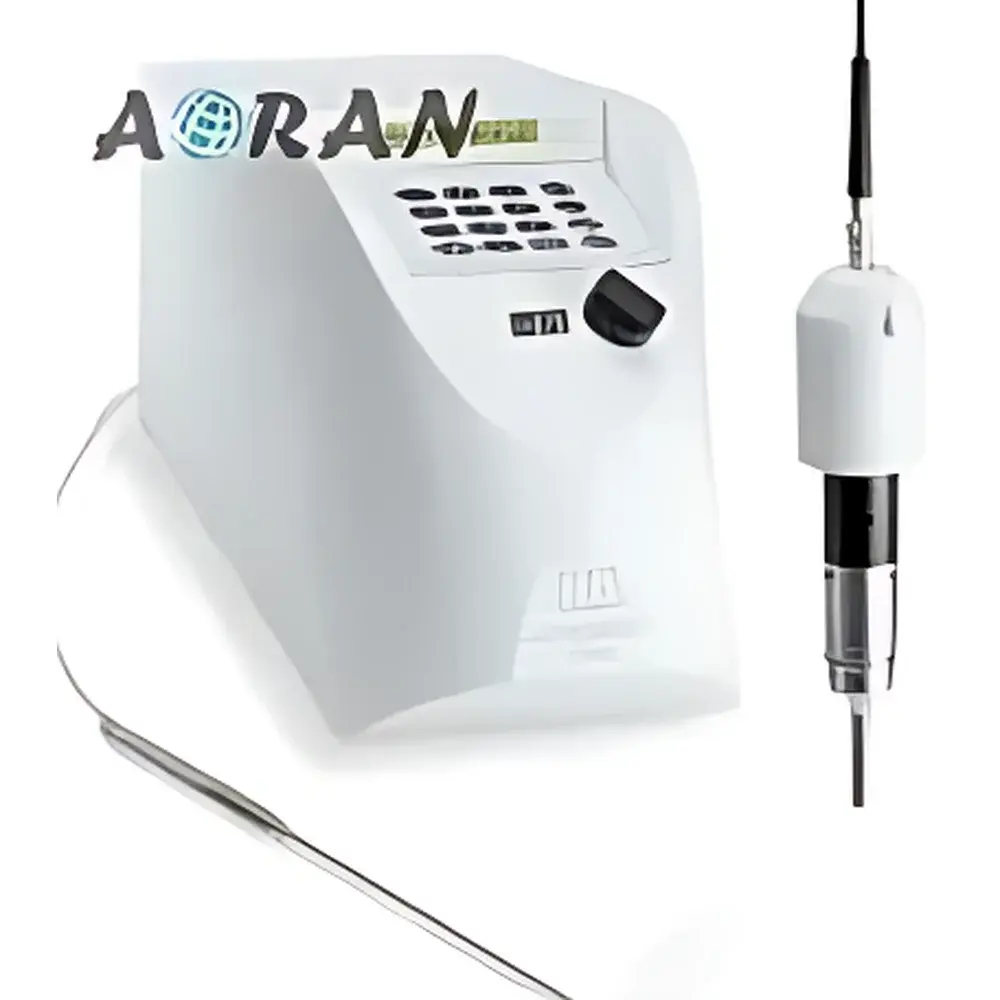
Misonix Sonicator 3000 Ultrasonic Liquid Processor
| Brand | Misonix |
|---|---|
| Origin | USA |
| Model | Sonicator 3000 |
| Maximum Output Power | 600 W |
| Operating Frequency | 20 kHz |
| Sample Volume Range | 0.2–1000 mL |
| Dimensions (W×D×H) | 21.6 × 48.3 × 26.7 cm |
| Weight | 8.0 kg |
| Continuous Operation Time | 1 s – 100 h |
| Adjustable Pulse Duration | 0.5 s – 1 h |
| Standard Probe Types | Tapered (Tapped), Solid, Sapphire-Coated |
| Probe Diameters | 1.6 mm – 25.4 mm |
| Optional Accessories | Cup Horns, Microplate Adapters, Temperature Monitoring Probe, Chilled Circulation Jackets, Amplifiers (2× to 3×), Dual-Output Converters |
Overview
The Misonix Sonicator 3000 is a high-performance ultrasonic liquid processor engineered for reproducible cell disruption, homogenization, emulsification, and sonocatalysis in life science and biopharmaceutical laboratories. It operates on the principle of piezoelectric-driven cavitation: an ultrasonic transducer converts electrical energy into mechanical vibrations at a fixed frequency of 20 kHz, transmitted through interchangeable titanium alloy probes (horns) into liquid samples. This generates intense localized pressure differentials, resulting in transient microcavitation bubbles whose collapse delivers shear forces sufficient to lyse microbial, fungal, and mammalian cells—without significant thermal degradation when pulse-controlled. Though superseded by the Sonicator Q700 platform, the Sonicator 3000 remains widely referenced in legacy protocols, method validations, and regulatory submissions where historical instrument equivalence is required under GLP or GMP frameworks.
Key Features
- Microprocessor-controlled operation with programmable amplitude, duty cycle, and total duration—enabling precise replication of sonication parameters across batches and users.
- Real-time temperature monitoring via integrated thermistor probe (included), allowing user-defined thermal thresholds and automatic duty-cycle modulation to prevent sample overheating—a critical requirement for heat-labile proteins, nucleic acids, and enzyme preparations.
- Modular probe architecture: all standard probes (1/16″ to 1″ diameter) mount interchangeably onto a single converter without recalibration; no mechanical re-alignment or amplitude re-zeroing is necessary.
- Three probe material configurations—tapered (threaded tip replacement), solid (monolithic), and sapphire-coated—offer optimized wear resistance, acoustic transmission efficiency, and compatibility with corrosive or abrasive media.
- Dual-output converter (optional, model 351) enables simultaneous processing of two independent samples using matched or dissimilar probe sizes—ideal for comparative lysis studies or parallel QC testing.
- Amplifier attachments (models 328A–328C) provide calibrated mechanical gain (2× to 3×), extending effective amplitude range for viscous or highly resistant samples while maintaining waveform fidelity.
Sample Compatibility & Compliance
The Sonicator 3000 supports a broad spectrum of biological and chemical matrices: bacterial pellets (E. coli, Bacillus spp.), yeast suspensions (S. cerevisiae), tissue homogenates, viral lysates, nanoparticle dispersions, and organic-inorganic emulsions. Its non-contact cup horn systems (models 431A–431C) isolate hazardous agents—including BSL-2/3 pathogens and cytotoxic compounds—within sealed vessels, eliminating aerosol generation and cross-contamination risk. All operational parameters—including time-stamped amplitude logs, temperature traces, and probe identity—are recordable via external data acquisition interfaces. While the Sonicator 3000 predates FDA 21 CFR Part 11 electronic record requirements, its analog/digital hybrid control architecture permits integration with validated LIMS or ELN platforms for audit-trail-compliant documentation per ISO/IEC 17025 and USP Analytical Instrument Qualification guidelines.
Software & Data Management
The Sonicator 3000 features a front-panel LCD interface with dedicated keys for amplitude (% of full scale), pulse-on/pulse-off timing, and elapsed runtime. No proprietary software is bundled; however, analog output ports (0–5 V DC) enable connection to third-party DAQ systems (e.g., National Instruments LabVIEW, MATLAB Data Acquisition Toolbox) for synchronized multi-parameter logging—including real-time temperature, power draw, and acoustic emission signatures. Method templates may be archived as ASCII text files for version-controlled protocol sharing. For laboratories transitioning from Sonicator 3000 to Q700, Misonix provides backward-compatible parameter mapping tables to ensure continuity in SOPs and regulatory filings.
Applications
- Cell lysis for recombinant protein extraction (e.g., His-tagged inclusion bodies in E. coli BL21(DE3))
- Nucleic acid shearing prior to NGS library preparation (fragment size distribution controllable via amplitude and pulse duration)
- Preparation of stable nanoemulsions for drug delivery formulation development
- Soil microbiome analysis—disruption of clay-bound microbial aggregates without DNA shearing artifacts
- Cleaning and activation of chromatography columns and microfluidic devices
- Accelerated solvent extraction (ASE) of phytochemicals from plant tissues under ambient conditions
FAQ
Is the Sonicator 3000 still supported by Misonix for service and spare parts?
Yes—Misonix maintains a limited inventory of critical components (converters, probes, temperature sensors) and offers calibration and repair services for legacy instruments under extended support agreements.
Can the Sonicator 3000 be used for inactivating viruses in biosafety applications?
It is not validated as a primary viral inactivation tool; however, its cup horn configuration (model 431B/C) is routinely employed in containment labs for preparative lysis of inactivated virus stocks under BSL-2 containment.
What is the recommended maintenance interval for the transducer and converter assembly?
Misonix recommends annual performance verification—including impedance sweep analysis and amplitude linearity check—using factory-certified test loads, especially after >500 hours of cumulative operation.
How does probe erosion affect sonication efficiency over time?
Titanium probe tip erosion alters nodal positioning and reduces peak cavitation intensity; visual inspection and periodic amplitude verification (using calibrated hydrophone or calorimetric assay) are advised every 200 hours for high-duty-cycle applications.
Are there documented ASTM or ISO methods referencing the Sonicator 3000?
While no ASTM standard is instrument-specific, ISO 11348-3 (water quality—determination of inhibition of luminescence of Vibrio fischeri) and ASTM D7579 (standard practice for ultrasonic dispersion of nanomaterials) cite 20 kHz bath and probe systems consistent with Sonicator 3000 operating parameters.