
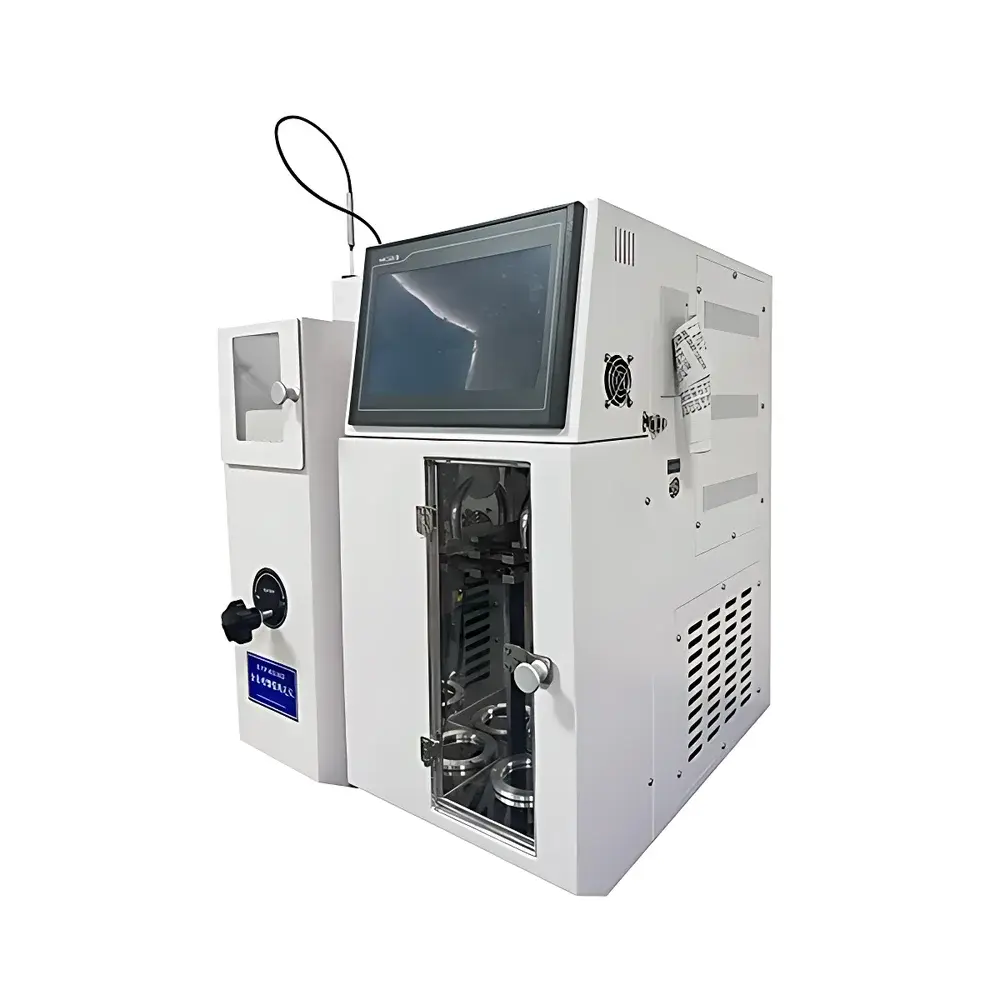
MITONG SKY2001-I Automatic Petroleum Distillation Apparatus
| Brand | MITONG |
|---|---|
| Origin | Shanghai, China |
| Model | SKY2001-I |
| Distillation Temperature Range | 0–400 °C |
| Receiver Bath Temperature Control | 0–60 °C (±0.1 °C) |
| Cold Bath Temperature Control | 0–60 °C (±0.1 °C) |
| Heating Power | 0–1200 W (continuously adjustable) |
| Total Power Consumption | 2000 W |
| Input Voltage | 220 V ±10%, 50 Hz ±1 Hz |
| Display | 10.4″ integrated LCD touch screen |
| Interface Ports | USB, RS-232, Ethernet |
| Volume Measurement Points | 99 programmable recovery points |
| Refrigeration Method | Semiconductor cooling |
| Compliance | GB/T 6536–2010, ISO 3405, ASTM D86, IP 123, SY/T 5648 |
Overview
The MITONG SKY2001-I Automatic Petroleum Distillation Apparatus is a precision-engineered laboratory instrument designed for standardized distillation analysis of petroleum-based liquids in accordance with internationally recognized test methods. It implements the principles of atmospheric batch distillation under controlled heating and condensation conditions, measuring key volatility parameters—including initial boiling point (IBP), final boiling point (FBP), and volume recovery at specified temperature intervals—through real-time tracking of vapor temperature, condensed liquid volume, and receiver bath thermal environment. The apparatus is specifically calibrated and validated to meet the procedural requirements of GB/T 6536–2010, ISO 3405, ASTM D86, and IP 123, ensuring data comparability across global quality control laboratories and regulatory submissions.
Key Features
- Integrated 10.4-inch industrial-grade LCD touchscreen interface running a full Windows OS, enabling intuitive method setup, real-time parameter visualization, and interactive curve plotting.
- High-resolution optical sensor array coupled with micro-stepping motor drive for precise, non-contact volumetric measurement of distillate collection—supporting up to 99 user-defined recovery points per test run.
- Intelligent adaptive heating control: dynamically modulates electric furnace power (0–1200 W, continuously variable) based on real-time vapor temperature feedback to maintain prescribed ASTM/ISO heating rate profiles.
- Dual independent thermal control zones: semiconductor-cooled receiver bath (0–60 °C, ±0.1 °C stability) and cold bath (0–60 °C, ±0.1 °C), both equipped with PID algorithms and environmental compensation logic for consistent condensation efficiency.
- Automated endpoint detection logic compliant with GB/T 6536–2010 termination criteria, including dry point identification, residual volume assessment, and overheat safety cutoff.
- Comprehensive I/O architecture: native support for USB mass storage, RS-232 serial communication, and TCP/IP Ethernet connectivity for LIMS integration, remote diagnostics, and firmware updates.
- Configurable method libraries with secure local storage for ≥1000 test records; supports custom program creation for specialized feedstocks such as aviation turbine fuels or heavy naphthas.
Sample Compatibility & Compliance
The SKY2001-I is validated for use with a broad spectrum of volatile hydrocarbon mixtures, including but not limited to: straight-run gasoline, reformulated gasoline blends, aviation gasoline (AVGAS), jet fuel (Jet A/A-1), kerosene, diesel fuel (EN 590, ASTM D975), light naphthas, solvent naphthas (ASTM D235), and crude assay fractions. All operational protocols conform to the mechanical, thermal, and metrological specifications defined in GB/T 6536–2010, ISO 3405:2017, ASTM D86–22, and IP 123:2019. Instrument design and software architecture support audit-ready operation under GLP and GMP frameworks, with optional electronic signature capability and full 21 CFR Part 11–compliant data integrity features available via firmware extension.
Software & Data Management
The embedded Windows-based application provides complete lifecycle management of distillation workflows—from method definition and calibration validation to raw data export and report generation. Test sequences are stored with timestamped metadata, including ambient conditions, operator ID, instrument calibration status, and version-controlled method parameters. Export formats include CSV, PDF, and XML for traceable integration into enterprise QA/QC systems. Audit trail functionality logs all user actions, configuration changes, and system events with immutable timestamps. Optional network deployment enables centralized method distribution and remote supervision across multi-site laboratory networks.
Applications
This apparatus serves critical roles in refinery process optimization, fuel formulation R&D, third-party certification testing, and regulatory compliance verification. Typical use cases include: verifying distillation cut points during crude fractionation; evaluating volatility characteristics of oxygenated gasoline blends; assessing thermal stability of jet fuels under simulated flight conditions; validating solvent purity for pharmaceutical excipient manufacturing; and supporting ASTM D86-based specifications for marine distillate fuels. Its reproducibility—verified per ASTM D6300—supports routine QC testing with ≤0.5 °C standard deviation for IBP and ≤1.2 °C for 90% recovery point across replicate runs.
FAQ
What standards does the SKY2001-I comply with?
It fully satisfies GB/T 6536–2010, ISO 3405:2017, ASTM D86–22, IP 123:2019, and SY/T 5648 technical specifications.
Can the instrument operate unattended for extended tests?
Yes—its automated endpoint logic, thermal fault monitoring, and emergency shutdown protocols enable safe overnight operation without manual intervention.
Is external cooling water required?
No—the semiconductor refrigeration system eliminates dependency on chilled water loops or glycol circulators, reducing infrastructure complexity and maintenance overhead.
How is data integrity ensured for regulated environments?
With optional 21 CFR Part 11 mode enabled, the system enforces role-based access control, electronic signatures, and tamper-evident audit trails meeting FDA and EMA requirements.
What sample volume is required per test?
Standard test procedure requires 100 mL of representative, homogenized sample, pre-conditioned to room temperature and free of suspended water or particulates.



