
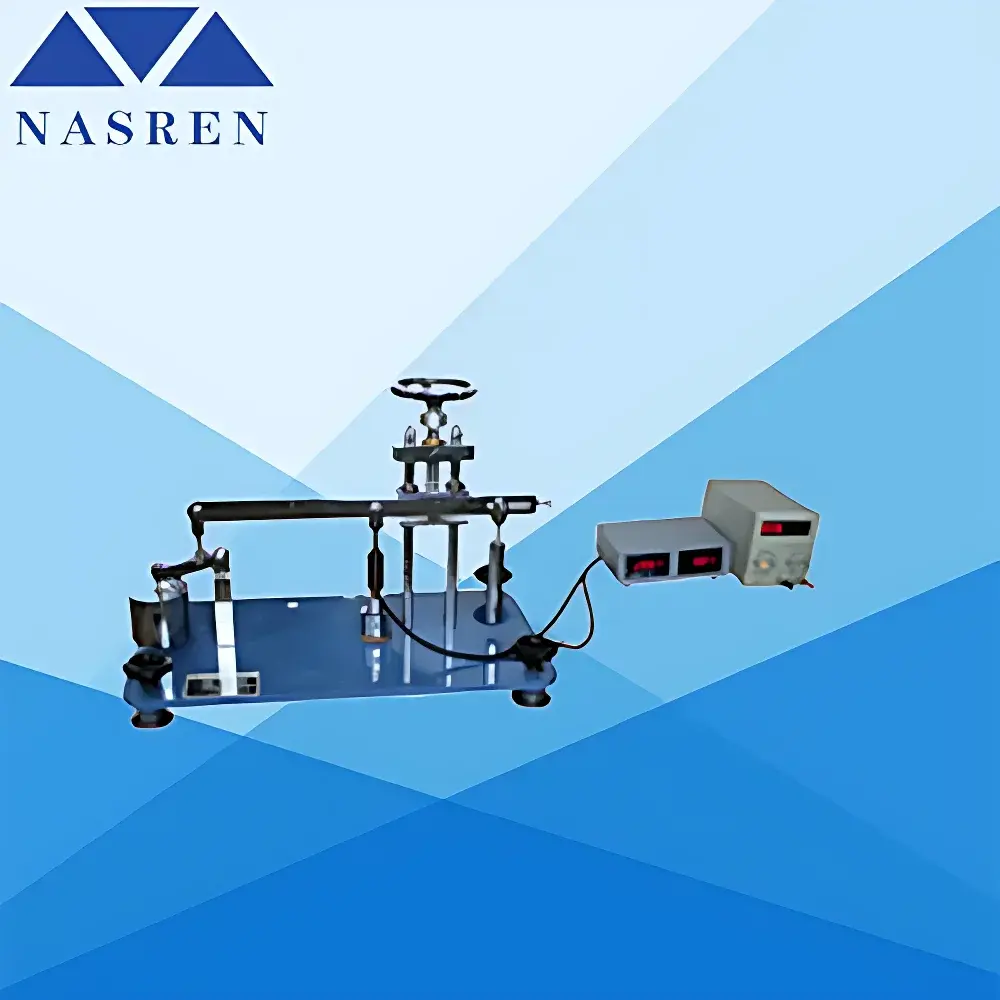
MITONG SYD-24521 Coke Resistivity Tester
| Brand | MITONG |
|---|---|
| Origin | Shanghai, China |
| Model | SYD-24521 |
| Compliance | GB/T 24521–2009 |
| Sample Chamber Internal Diameter | 16.3 ± 0.05 mm |
| Compaction Mass | 6 kg (main weight), 1 kg (auxiliary weight) |
| Standard Steel Column Diameter | Φ16.3 ± 0.03 mm |
| Sieve Apertures | 0.315 mm and 0.500 mm (100 mm diameter × 50 mm height) |
| Particle Size Ranges | 0.315–0.500 mm (Φ2.5 mm sieve), 0.500–1.000 mm (Φ4 mm sieve) |
| Leveling Sensitivity | 1 mm/m (200 mm spirit level) |
Overview
The MITONG SYD-24521 Coke Resistivity Tester is a precision laboratory instrument engineered for the standardized measurement of electrical resistivity in carbonaceous materials used in metallurgical and electrode manufacturing processes. It operates on the four-terminal (Kelvin) method principle, eliminating lead resistance and contact potential errors to ensure high reproducibility in bulk resistivity determination. Designed strictly in accordance with the Chinese national standard GB/T 24521–2009, “Method for Determination of Electrical Resistivity of Coke,” this tester delivers traceable, repeatable results for raw and processed carbon feedstocks—including calcined petroleum coke, foundry coke, metallurgical coke, graphite powders, baked anode scraps, and calcined anthracite. Its fixed-diameter cylindrical sample chamber (16.3 ± 0.05 mm internal diameter), paired with calibrated compaction masses (6 kg primary, 1 kg auxiliary), ensures consistent volumetric density during measurement—a critical parameter influencing resistivity outcomes per ASTM D3417 and ISO 11713 guidelines.
Key Features
- Modular split-unit architecture: separates control electronics from the mechanical compaction assembly, reducing thermal coupling and enhancing long-term stability.
- Integrated LED digital current display with auto-zero function and 0.1 mA resolution—enabling real-time monitoring of applied current during resistivity calculation (ρ = R × A / L).
- Adjustable leveling feet with locking nuts, coupled with a certified 200 mm spirit level (sensitivity 1 mm/m), guarantee precise horizontal alignment essential for uniform powder compaction.
- Electrostatically applied epoxy-polyester full-spray coating across all structural components, providing corrosion resistance against carbon dust abrasion and ambient industrial humidity (tested per ISO 9227 salt spray for >500 h).
- Dedicated calibration tool set: includes a reference steel column (Φ16.3 ± 0.03 mm), dual-sieve stack (0.315 mm and 0.500 mm apertures, 100 mm × 50 mm), and particle size–matched sieves (Φ2.5 mm and Φ4 mm) for strict adherence to GB/T 24521–2009 sample preparation protocols.
Sample Compatibility & Compliance
The SYD-24521 is validated for use with granular, non-friable carbonaceous solids exhibiting particle size distributions within 0.315–1.000 mm, as defined by mandatory pre-sieving steps in GB/T 24521–2009. It supports routine QC testing in coke plants, carbon anode producers, ferroalloy smelters, and R&D laboratories engaged in electrode material development. All mechanical dimensions—including sample chamber geometry, compaction force application path, and electrode contact surface flatness—conform to metrological requirements outlined in the standard. While GB/T 24521–2009 remains the primary compliance benchmark, measurement uncertainty profiles align with ISO/IEC 17025–2017 general requirements for testing laboratories when operated under controlled environmental conditions (23 ± 2 °C, RH ≤ 60 %).
Software & Data Management
This benchtop resistivity tester operates as a standalone hardware system without embedded microprocessor control or digital data export. All measurements are manually recorded using external calibrated multimeters (recommended: 6½-digit DMM with 4-wire ohms capability) in conjunction with the built-in current display. Users maintain traceability through paper-based or LIMS-integrated logbooks, documenting test date, operator ID, sample batch number, compaction mass, measured voltage drop, applied current, and calculated resistivity (in µΩ·m). For laboratories operating under GLP or GMP frameworks, manual entry into validated electronic notebooks satisfies FDA 21 CFR Part 11 requirements when paired with documented SOPs and audit trails.
Applications
- Quality assurance of calcined petroleum coke entering aluminum smelting anode production lines.
- Batch-to-batch consistency verification of metallurgical coke supplied to blast furnace operations.
- Resistivity screening of graphite powders prior to extrusion or vibration molding of EDM electrodes.
- Research-grade evaluation of carbon material modifications—e.g., oxidation treatment, binder addition, or heat-treatment temperature variation—on bulk electron transport properties.
- Technical support for ISO 50001 energy management systems by correlating coke resistivity with calcination efficiency and thermal history.
FAQ
What standards does the SYD-24521 comply with?
It is designed and verified exclusively for GB/T 24521–2009, the People’s Republic of China national standard for coke resistivity determination.
Can it measure powdered graphite or carbon black?
No—it is restricted to free-flowing, coarse granular carbon materials (0.315–1.000 mm); fine powders or agglomerated nanocarbons require alternative instrumentation such as van der Pauw or impedance spectroscopy systems.
Is electrical calibration certification included?
The unit ships with mechanical calibration tools only; users must source NIST-traceable multimeters and document calibration intervals per their internal QA procedures.
What environmental conditions are required for valid testing?
Testing must occur in a temperature-stabilized environment (23 ± 2 °C), free from electromagnetic interference and air currents that could disturb powder settling.
How often should the sample chamber be cleaned?
After every three consecutive tests—or immediately following any sample showing visible residue—to prevent cross-contamination and maintain dimensional integrity of the 16.3 mm bore.




