
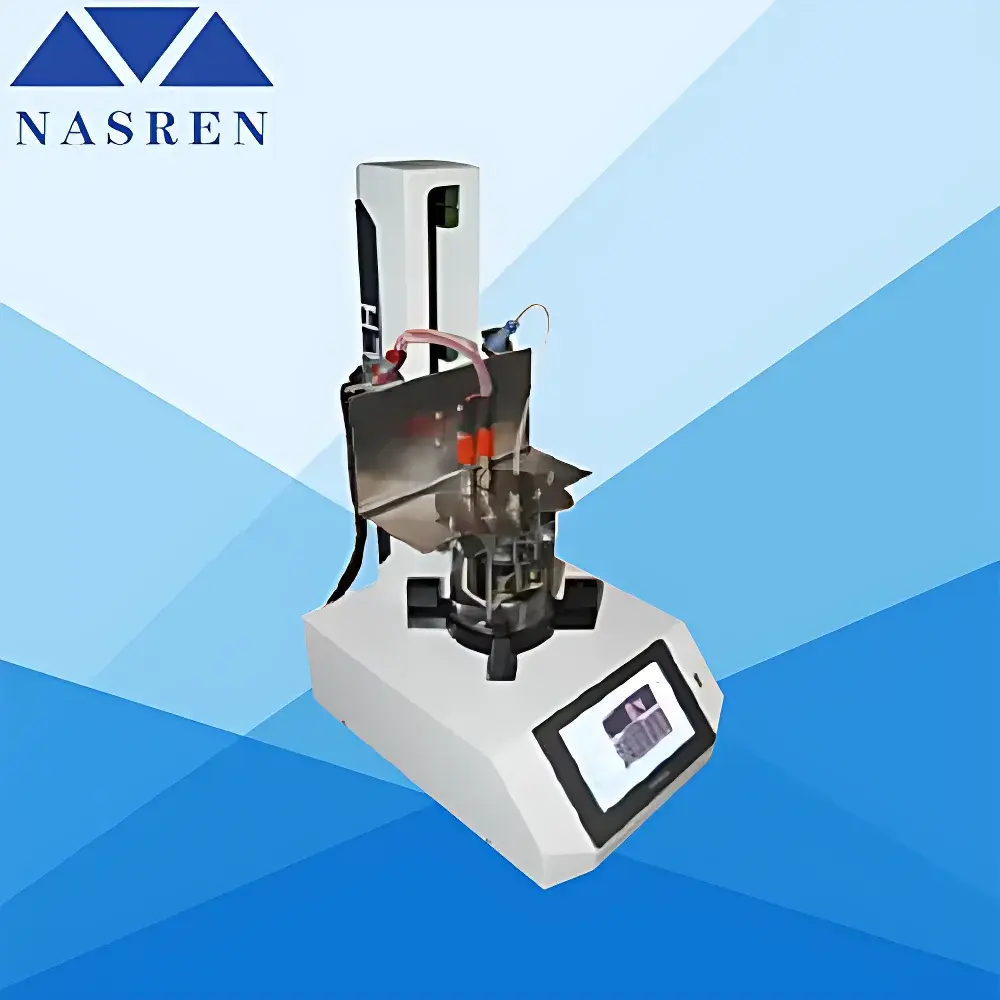
MITONG SYP-2102H Fully Automated Plaster Softening Point Tester
| Brand | MITONG (Shanghai Mitong Instrument Co., Ltd.) |
|---|---|
| Origin | Shanghai, China |
| Model | SYP-2102H |
| Measurement Range | 5–80 °C (water bath) / 32–162 °C (glycerol bath) |
| Temperature Resolution | 0.1 °C |
| Heating Rate | 1.0–1.5 °C/min |
| Sample Capacity | 2 specimens simultaneously |
| Bath Vessel Dimensions | Ø110 mm × 130 mm H |
| Stirring | Adjustable magnetic stirrer |
| Data Storage | 200 test records (.csv export via USB) |
| Power Supply | 220 VAC ±10%, 50 Hz |
| Max. Power Consumption | 800 W |
| Net Weight | 12.0 kg |
| Dimensions (L×W×H) | 390 mm × 300 mm × 575 mm |
| Compliance | Chinese Pharmacopoeia 2020 Edition, General Chapter 2102 |
Overview
The MITONG SYP-2102H Fully Automated Plaster Softening Point Tester is a precision thermal analysis instrument engineered to determine the softening point of traditional Chinese medicinal plasters in strict accordance with the Chinese Pharmacopoeia (2020 Edition), Volume IV, General Chapter 2102 — Determination of Softening Point of Plasters. It implements the ring-and-ball method under controlled heating conditions: two standardized plaster specimens are placed in brass rings, loaded with steel balls, and immersed in a thermally regulated liquid medium (distilled water or glycerol). As temperature rises at a defined linear rate (1.0–1.5 °C/min), the softened plaster deforms under gravitational load until the descending ball contacts a lower support plate. The average temperature at which both specimens reach this endpoint defines the softening point — a critical quality attribute correlating directly with adhesive performance, structural integrity, and batch-to-batch consistency.
Key Features
- Integrated touchscreen HMI with real-time graphical animation of test progression — enabling intuitive operation and immediate visual confirmation of specimen deformation dynamics.
- Laser-based optical detection system with dual-beam alignment for precise, non-contact determination of ball descent; immune to ambient light interference and offering high repeatability (±0.1 °C typical inter-run deviation).
- Microprocessor-controlled heating module featuring slope-interpolation algorithm for stable, programmable ramp rates — eliminating overshoot and ensuring compliance with pharmacopoeial thermal profiles.
- Stepper-motor-driven vertical positioning system with lead-screw actuation ensures smooth, repeatable lowering of the test platform, guaranteeing consistent optical path geometry relative to the lower reference plate.
- Separate variable-speed magnetic stirrer maintains uniform thermal distribution across the bath volume (Ø110 mm × 130 mm beaker), minimizing radial and axial temperature gradients per ISO 11357-3 requirements for thermal transition testing.
- Dual-channel independent measurement capability supports parallel evaluation of two samples — enhancing throughput without compromising data traceability or statistical validity.
Sample Compatibility & Compliance
The SYP-2102H accommodates standard pharmacopoeial brass rings (inner diameter 15.9 mm, height 6.4 mm) and 9.5 mm-diameter steel balls (mass 3.5 g), conforming to CP 2020 specifications. It supports both aqueous (5–80 °C) and high-temperature glycerol baths (32–162 °C), enabling characterization of low-melting herbal plasters as well as resin-rich formulations. All operational parameters — including ramp rate, dwell time, and endpoint logic — are configurable within validated firmware. The instrument meets essential requirements for GLP-compliant laboratories: audit-trail-capable data logging (200-test internal memory), CSV export via USB interface, optional thermal printer output, and RS-485/Modbus RTU communication for integration into LIMS or centralized QC networks. While not certified to FDA 21 CFR Part 11 out-of-the-box, its data structure and timestamped record format support retrospective validation under GMP Annex 11 and WHO TRS 992 guidelines.
Software & Data Management
Embedded firmware provides full-cycle test control, from initialization and thermal equilibration to endpoint detection and result calculation. Each test record stores ambient temperature, start/end times, ramp rate verification points, raw laser signal timestamps, and final softening point values. Data is retained with persistent memory (non-volatile flash), accessible via on-screen browser or exported as comma-separated values (.csv) for offline statistical analysis (e.g., Cp/Cpk, trend charts). Optional mini-printer output delivers hard-copy reports with instrument ID, operator tag, date/time stamp, and pass/fail flags against user-defined specification limits. Remote monitoring and configuration are supported through Modbus RTU over RS-485 — facilitating centralized calibration management and multi-instrument synchronization in production QA environments.
Applications
- Quality control of transdermal herbal plasters during manufacturing and release testing.
- Stability studies assessing thermal degradation effects on adhesive matrix integrity over shelf life.
- R&D formulation screening — evaluating polymer blend ratios, tackifier content, or solvent evaporation impact on softening behavior.
- Regulatory submission support for NMPA registration dossiers requiring CP 2020 Chapter 2102 compliance evidence.
- Contract laboratory services for third-party pharmacopoeial testing and method transfer verification.
FAQ
What pharmacopoeial standards does the SYP-2102H comply with?
It is fully aligned with the Chinese Pharmacopoeia 2020 Edition, General Chapter 2102, and technically compatible with ASTM D36 and ISO 4625 methodologies for ring-and-ball softening point determination.
Can the instrument be calibrated traceably to national standards?
Yes — temperature sensors are field-calibratable using NIST-traceable reference thermometers; calibration offsets can be entered directly into the system for real-time correction.
Is the laser detection system sensitive to ambient lighting or vibration?
No — the collimated infrared laser pair operates at a fixed wavelength with digital signal thresholding and motion-triggered sampling, ensuring robust performance in typical QC lab environments (IEC 61326-1 Class A immunity).
How is data integrity ensured during power interruption?
All active test data is written to non-volatile memory at 10-second intervals; upon restart, the system resumes logging from the last saved state without loss of critical endpoint information.
Does the instrument support IQ/OQ documentation packages?
Standard factory documentation includes hardware specifications, electrical safety test reports, and basic operational qualification protocols; full GMP-compliant IQ/OQ/PQ templates are available upon request for regulated users.





