
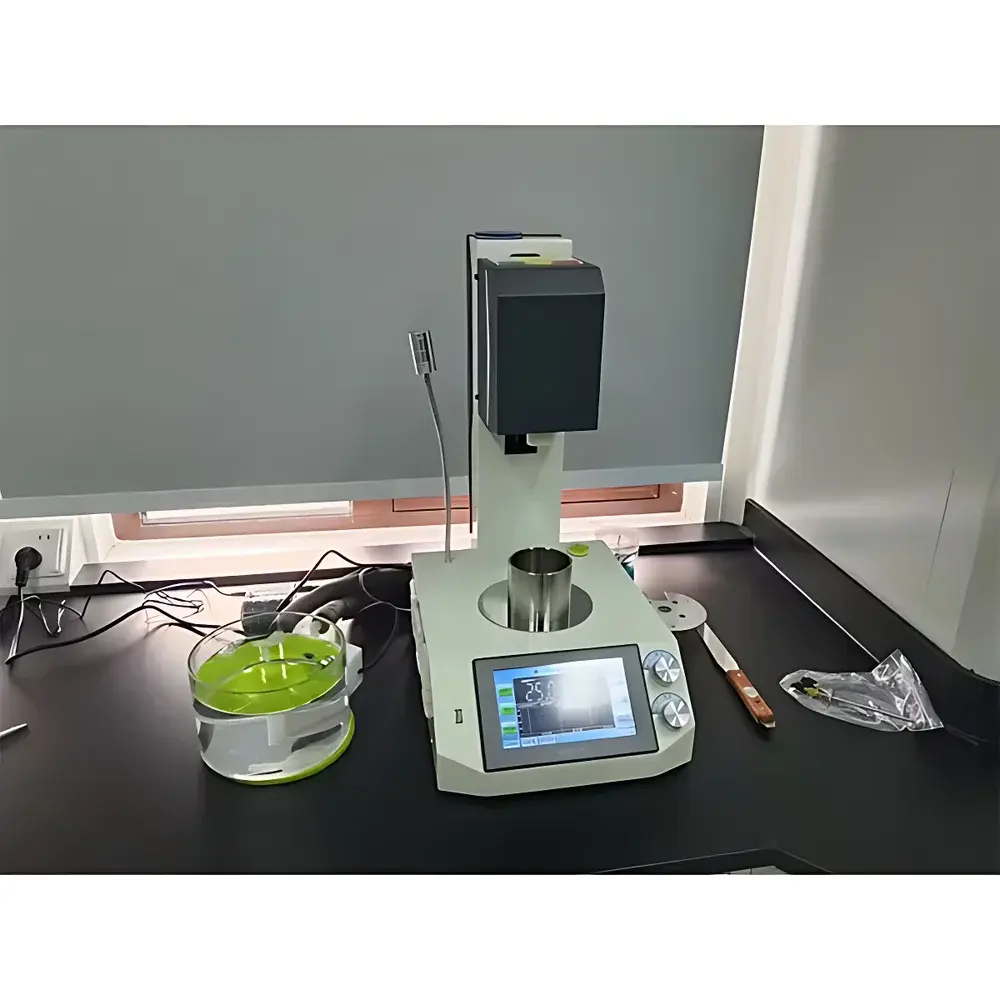
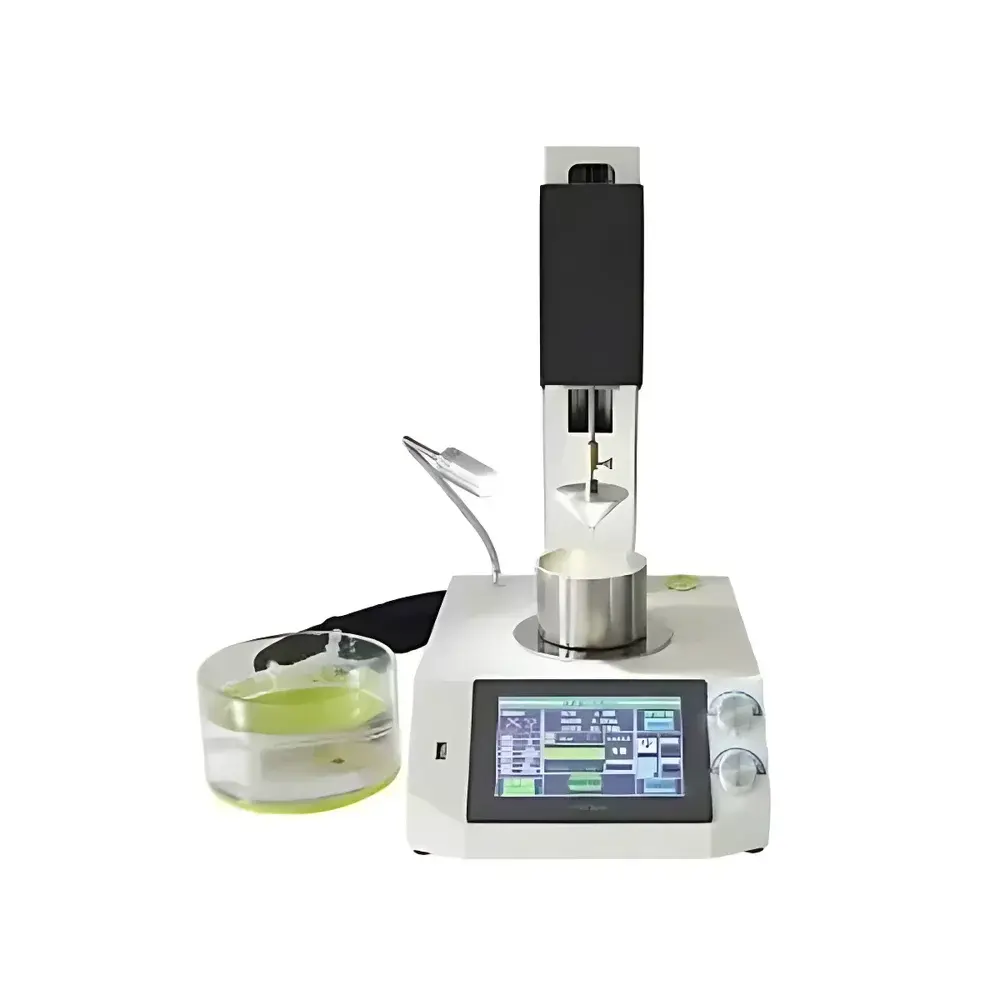
MITONG SYP-22459D Automatic Cone Penetrometer for Refractory Mortars
| Brand | MITONG |
|---|---|
| Origin | Shanghai, China |
| Model | SYP-22459D |
| Penetration Range | 0–650 dmm (0.1 mm increments) |
| Minimum Readout | 0.1 dmm |
| Resolution | 0.01 mm |
| Penetration Accuracy | ±1 dmm |
| Temperature Control Range | 0.00–50.00 °C (±0.1 °C stability) |
| Timing Range | 0–250 s (±0.1 s accuracy) |
| LVDT Displacement Sensor | 0–66 mm range, ≤±0.1 mm repeatability |
| Standard Cone Assembly | Total mass 102.5 g ±0.05 g, cone rod mass 47.5 g ±0.05 g (conforms to GB/T 22459.1–2008) |
| Data Storage | 200 test records |
| Communication | RS-485 (MODBUS RTU), USB data export |
| Power Supply | 220 VAC ±10%, 50 Hz |
| Dimensions | 390 × 310 × 575 mm (L×W×H) |
| Net Weight | 12.5 kg |
Overview
The MITONG SYP-22459D Automatic Cone Penetrometer is an electromechanical testing instrument engineered for precise, repeatable measurement of consistency in refractory mortars and other semi-solid or viscoelastic materials. It operates on the principle of standardized cone penetration—where a calibrated conical probe of defined geometry and mass is allowed to descend into a sample under gravity for a fixed duration at controlled temperature. The depth of penetration (expressed in tenths of a millimeter, or “dmm”) serves as a quantitative index of material softness, plasticity, or structural yield behavior. Designed in strict compliance with GB/T 22459.1–2008 (“Refractory Mortars – Part 1: Consistency Test Method – Cone Penetration Method”), the instrument integrates a thermally stabilized water bath, high-resolution LVDT displacement sensing, and programmable timing logic to ensure metrological traceability and inter-laboratory reproducibility. Its architecture supports both routine quality control in refractory manufacturing and comparative rheological screening across diverse material classes—including ceramic slurries, food pastes, bituminous binders, and pharmaceutical ointments.
Key Features
- Fully automated penetration cycle: motor-driven vertical positioning, gravity-initiated cone descent, and real-time displacement capture—eliminating operator-induced variability.
- Integrated Peltier-based thermostatic bath with PID-controlled heating/cooling; maintains sample temperature within ±0.1 °C across 0.00–50.00 °C range—critical for temperature-sensitive consistency evaluation per ASTM D5–D217 and ISO 2137 equivalents.
- High-fidelity LVDT sensor (0–66 mm range, 0.01 mm resolution, ≤±0.1 mm linearity error) mounted in frictionless, decoupled configuration to prevent mechanical hysteresis during cone retraction.
- Modular cone assembly compliant with GB/T 22459.1: total mass 102.5 g ±0.05 g (cone + rod), cone angle 30°, tip diameter 0.3 mm—ensuring geometric and inertial equivalence with international reference standards.
- Touchscreen HMI with intuitive workflow navigation, real-time graphical feedback, and on-device result review; supports multi-language UI localization via firmware update.
- Dual-mode data handling: local storage of 200 test records with timestamp, temperature, time, and penetration value; export via USB flash drive in CSV format for LIMS integration.
- RS-485 serial interface (MODBUS RTU protocol) enables centralized monitoring and remote command execution in networked QC environments—compatible with SCADA systems and laboratory automation platforms.
Sample Compatibility & Compliance
The SYP-22459D accommodates standard cylindrical sample containers (e.g., 50 mm diameter × 40 mm height) used in refractory mortar testing, while also supporting interchangeable fixtures for alternative geometries required by food (e.g., ISO 6720 cheese hardness), asphalt (ASTM D5), or cosmetic (ISO 16128) applications. All thermal, temporal, and mechanical parameters adhere to the metrological requirements of GB/T 22459.1–2008, and its operational envelope aligns with ISO/IEC 17025–2017 calibration traceability frameworks. The instrument’s temperature control system satisfies GLP-relevant stability criteria for regulated testing environments, and its digital audit trail (via timestamped internal logs and MODBUS transaction history) supports FDA 21 CFR Part 11 readiness when paired with validated software.
Software & Data Management
The embedded firmware implements deterministic real-time control of all hardware subsystems—including stepper motor sequencing, PID thermal regulation, LVDT signal acquisition, and touchscreen rendering—without reliance on external OS dependencies. Optional PC software (Windows-compatible, USB or RS-485 connected) provides advanced functionality: batch report generation, statistical process control (SPC) charting (X̄-R, Cpk), trend analysis across multiple instruments, and export to Excel or PDF formats. All data fields are immutable post-acquisition; modification requires explicit administrative override with electronic signature logging—enabling compliance with ALCOA+ principles (Attributable, Legible, Contemporaneous, Original, Accurate, Complete, Consistent, Enduring, Available).
Applications
- Quality assurance of refractory installation mortars: verification of workability prior to application in furnace linings, kiln repairs, and metallurgical containment systems.
- R&D evaluation of binder formulations: quantifying effects of alumina content, organic additives, or moisture on green-state rheology.
- Food texture profiling: comparative assessment of spreadability in dairy-based emulsions (butter, margarine), confectionery gels (caramel, marshmallow), and fermented products (yogurt, sour cream).
- Asphalt binder grading: preliminary consistency screening aligned with ASTM D5 procedures for penetration-grade bitumen classification.
- Pharmaceutical semi-solids: characterization of ointment base consistency per USP <911> guidelines for topical dosage forms.
FAQ
What standards does the SYP-22459D comply with?
It is fully compliant with GB/T 22459.1–2008 and functionally equivalent to ASTM D5, ISO 2137, and EN 1427 for cone penetration testing.
Can the instrument be calibrated externally?
Yes—displacement calibration uses NIST-traceable gauge blocks; temperature calibration employs certified PT100 reference probes; both procedures are documented in the included calibration manual.
Is the cone assembly interchangeable with other penetrometers?
No—the cone and rod are a matched pair manufactured to GB/T 22459.1 tolerances; substitution with non-MITONG components invalidates conformance and voids calibration validity.
Does the system support GLP-compliant audit trails?
Yes—internal logging captures operator ID (if configured), test timestamp, environmental conditions, and raw sensor outputs; USB exports retain full metadata for regulatory submission.
What maintenance is required for long-term accuracy?
Annual verification of LVDT linearity, thermal bath uniformity, and cone mass is recommended; no user-serviceable consumables beyond routine cleaning of the cone tip and sample cup holder.




