
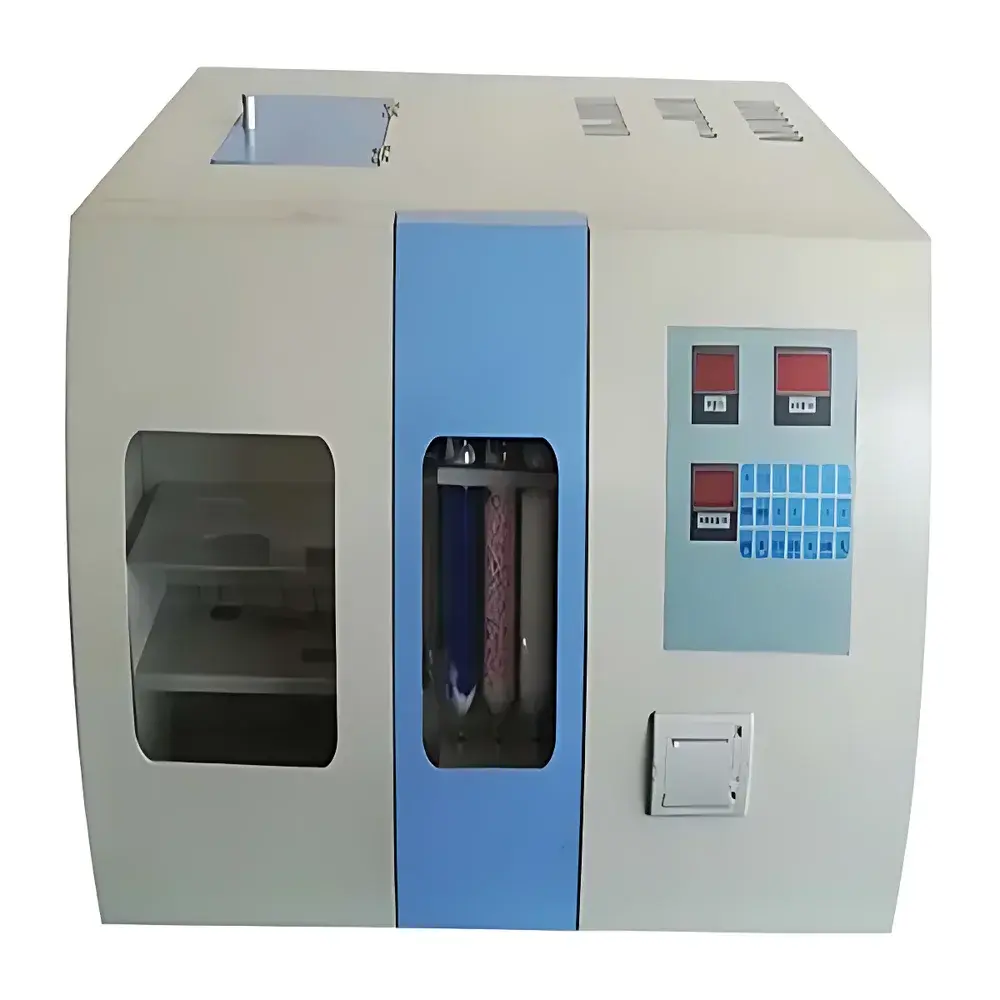
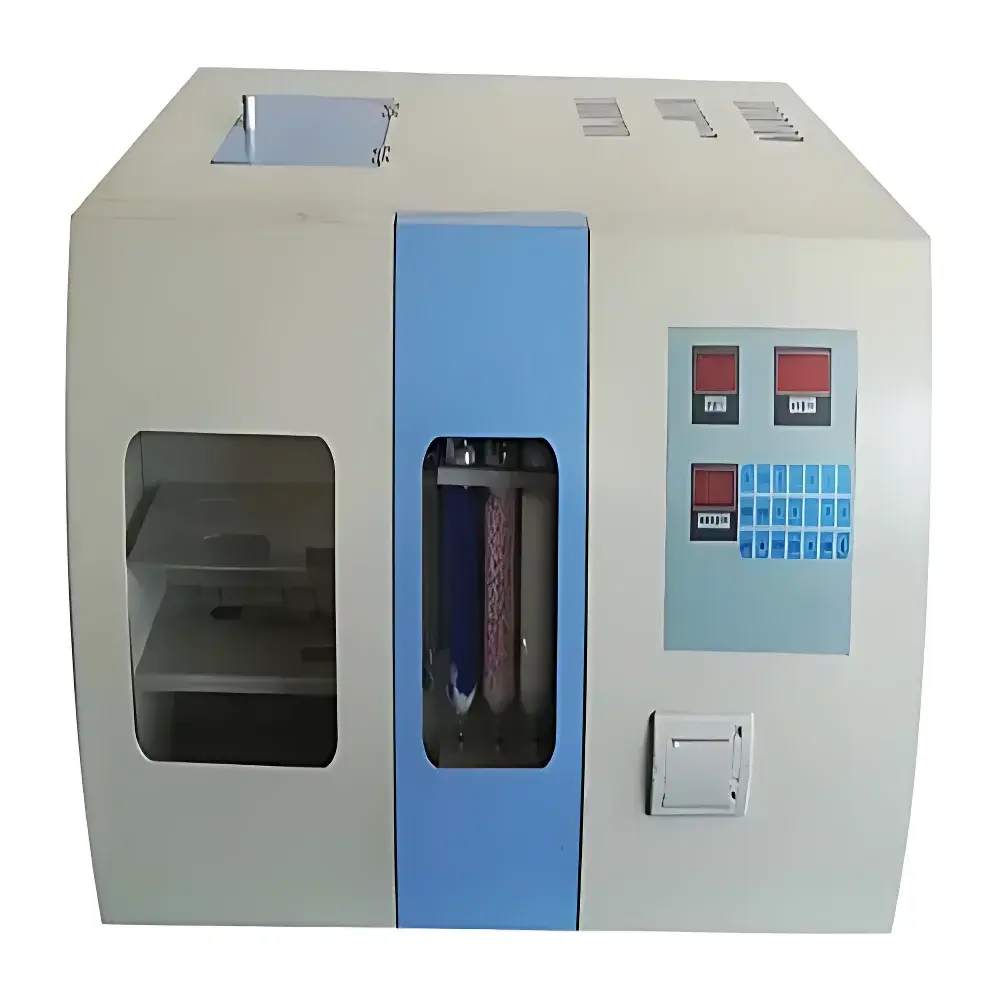
MITONG SYP-476A Automatic Carbon-Hydrogen Analyzer for Coal Analysis
| Brand | MITONG |
|---|---|
| Model | SYP-476A |
| Origin | Shanghai, China |
| Measurement Range (H) | 0–20 wt% |
| Measurement Range (C) | 0–100 wt% |
| Combustion Furnace Temp | 850 °C ±3 °C |
| Conversion Furnace Temp | 350 °C ±3 °C |
| Temperature Control Accuracy | ±1 °C |
| H-Determination Time | 10 min |
| C-Determination Time | 15 min |
| Electrolytic Cell Dimensions | 250 mm length × 5 mm ID × 8 mm OD |
| Electrolysis Voltage (Coating) | 10 V |
| Operating Voltage | 24 V |
| Max Electrolysis Current | 600 mA |
| Endpoint Current | ≤65 mA |
| Heating Rate | 25–30 °C/min |
| Power Supply | 220 V AC, 50 Hz |
| Rated Power | 3 kW |
| Heating Element | Ni-Cr Resistance Wire |
| Temperature Sensor | K-Type Thermocouple |
| Sample Size | ≤0.2 mm (80 mesh) |
| Sample Capacity | 1 per run |
| Compliance | GB/T 476–2008 |
Overview
The MITONG SYP-476A Automatic Carbon-Hydrogen Analyzer is a dedicated instrumental system engineered for precise quantitative determination of carbon and hydrogen mass fractions in solid fossil fuels—primarily brown coal, bituminous coal, anthracite, and coal-water slurries—according to the rigorous requirements of GB/T 476–2008, the Chinese national standard aligned with international combustion-based elemental analysis principles. The instrument operates on two complementary gravimetric and coulometric measurement pathways: carbon is quantified via absorption of evolved CO₂ in a pre-weighed alkali-asbestos or sodium hydroxide–asbestos absorbent, with mass gain directly proportional to carbon content; hydrogen is determined through controlled high-temperature combustion in a purified oxygen stream, followed by quantitative electrolysis of the resulting water vapor after conversion to phosphoric acid via reaction with P₂O₅-coated electrolytic cell walls. This dual-path architecture ensures traceable, reproducible results without reliance on calibration curves, supporting method validation under GLP-compliant laboratory environments.
Key Features
- Integrated dual-furnace design: A high-stability quartz combustion furnace (850 °C ±3 °C) and a precisely regulated catalytic conversion furnace (350 °C ±3 °C), both featuring independent PID-controlled silicon-controlled rectifier (SCR) power modules with dual-loop (voltage + current) feedback for thermal stability and protection against overshoot or thermal shock.
- Robust mechanical construction: CNC-machined housing with acid-resistant phosphating, dual-layer wind-cooled structural design, and high-temperature mirror-finish electrostatic powder coating (up to 500 °C operational surface tolerance), ensuring long-term corrosion resistance and ease of maintenance in industrial lab settings.
- Automated workflow execution: Fully programmable sequence control—from sample introduction and oxygen purging to combustion, gas transfer, absorption, electrolysis, and endpoint detection—minimizing operator intervention and inter-run variability.
- Electrolytic cell optimized for H-determination: 250 mm-long tubular cell with 5 mm internal diameter, internally coated with uniform P₂O₅ film, actively cooled to maintain consistent electrolysis efficiency and reduce drift during extended operation.
- Dual-redundant safety architecture: Integrated overcurrent, overvoltage, phase-loss, thermocouple break, and soft-start protection circuits, compliant with IEC 61000-4 electromagnetic compatibility standards for continuous-duty analytical instrumentation.
Sample Compatibility & Compliance
The SYP-476A is validated exclusively for solid organic matrices with particle size ≤0.2 mm (80 mesh), including but not limited to raw coals, washed coals, coke breeze, and stabilized coal-water slurries. It is unsuitable for volatile-rich samples (e.g., peat, biomass with >15% volatiles), halogen-containing materials, or inorganic carbonates unless pretreated per Clause 6.2 of GB/T 476–2008. All performance specifications—including accuracy (±0.15 wt% for H, ±0.30 wt% for C), repeatability (RSD <0.3% for H, <0.2% for C across triplicate runs), and linearity across full dynamic ranges—are verified against certified reference materials (CRMs) traceable to NIM (National Institute of Metrology, China). The system satisfies documentation requirements for ISO/IEC 17025 accreditation when operated with full audit trail logging and procedural SOPs.
Software & Data Management
Data acquisition and report generation are handled via embedded firmware with RS-232/USB interface support for external PC integration. Raw signals—including thermocouple voltage, electrolysis current integrals, absorption weight deltas, and timing events—are timestamped and stored in non-volatile memory. Print output includes sample ID, date/time stamp, furnace temperatures, electrolysis charge (Coulombs), CO₂ absorption mass (mg), calculated C/H percentages, and operator signature field. While the base unit does not include FDA 21 CFR Part 11-compliant electronic signatures or role-based access control, optional third-party LIMS-compatible drivers enable secure data export in CSV or XML format for integration into validated enterprise systems under GMP/GLP frameworks.
Applications
- Quality control laboratories in coal mining and power generation facilities performing routine proximate–ultimate analysis.
- Research institutes conducting coal rank classification, combustion behavior modeling, and carbon sequestration feedstock evaluation.
- Third-party testing organizations accredited to CNAS (China National Accreditation Service) for issuing legally binding test reports under GB/T 476–2008.
- Educational laboratories teaching ASTM D3178 / ISO 625-compliant elemental analysis methodologies, where hands-on understanding of coulometric and gravimetric fundamentals is required.
FAQ
What standards does the SYP-476A comply with?
It is fully compliant with GB/T 476–2008, which is technically equivalent to ISO 625:1996 and ASTM D3178–19, governing carbon and hydrogen determination in coal by combustion methods.
Can the instrument analyze petroleum coke or activated carbon?
Yes—provided samples are ground to ≤0.2 mm and free of metallic catalyst residues or binder additives that may interfere with CO₂ absorption or P₂O₅ electrolyte stability.
Is calibration required before each analysis?
No routine calibration is needed; however, daily verification using a certified coal CRM (e.g., GBW11100 series) is mandatory to confirm system accuracy and meet GB/T 476–2008 Section 8.2 verification requirements.
What maintenance intervals are recommended?
P₂O₅ coating renewal every 200–300 analyses; absorbent cartridge replacement after each 10 runs or upon visible saturation; quartz furnace tube inspection quarterly; thermocouple calibration annually or after mechanical shock.
Does the system support multi-sample batch processing?
No—the SYP-476A is a single-position analyzer. For higher throughput, parallel deployment of multiple units or integration with an automated sample carousel (not supplied) is required.





