
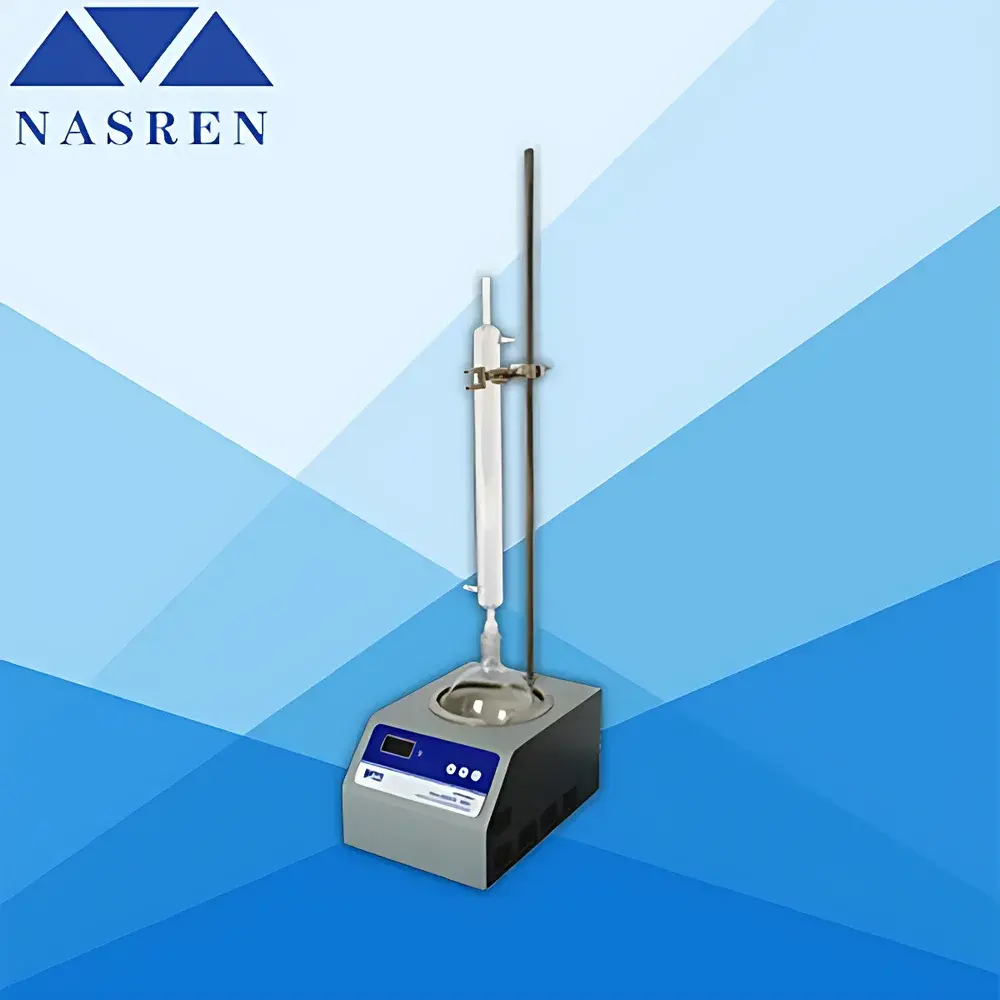
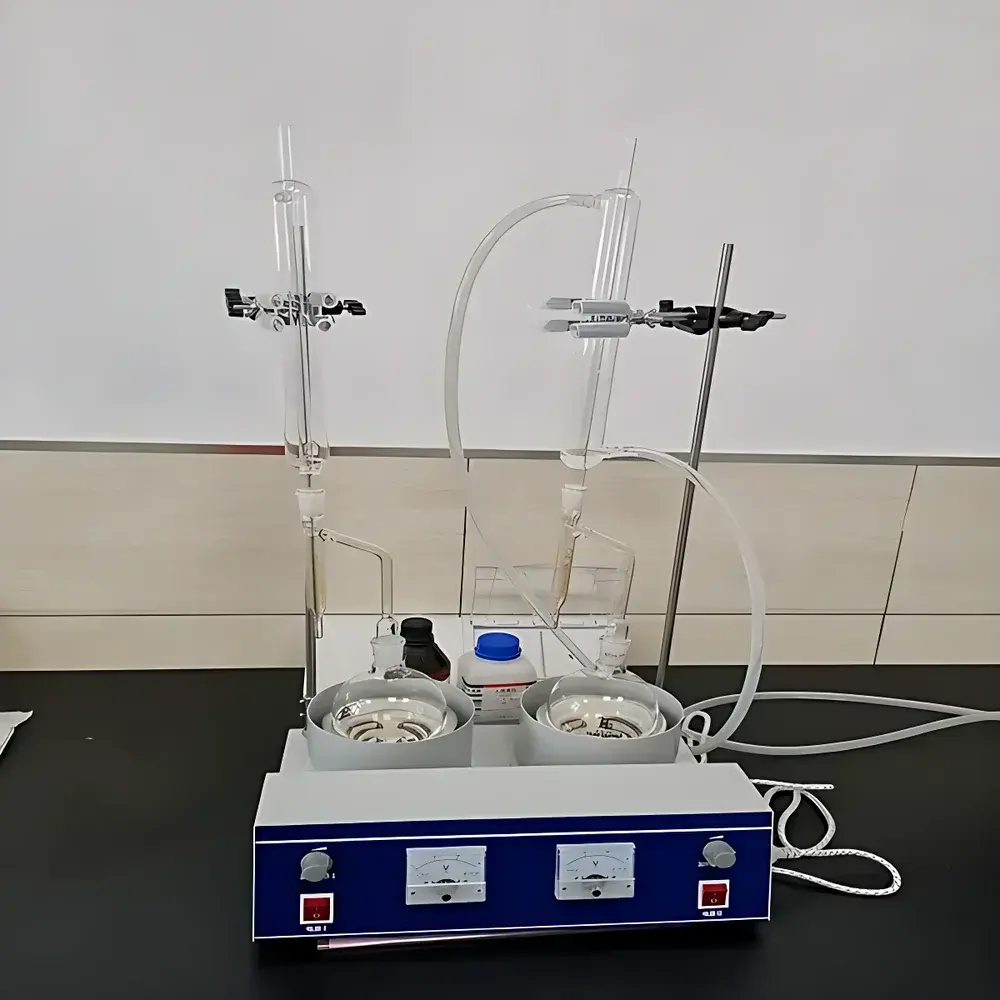
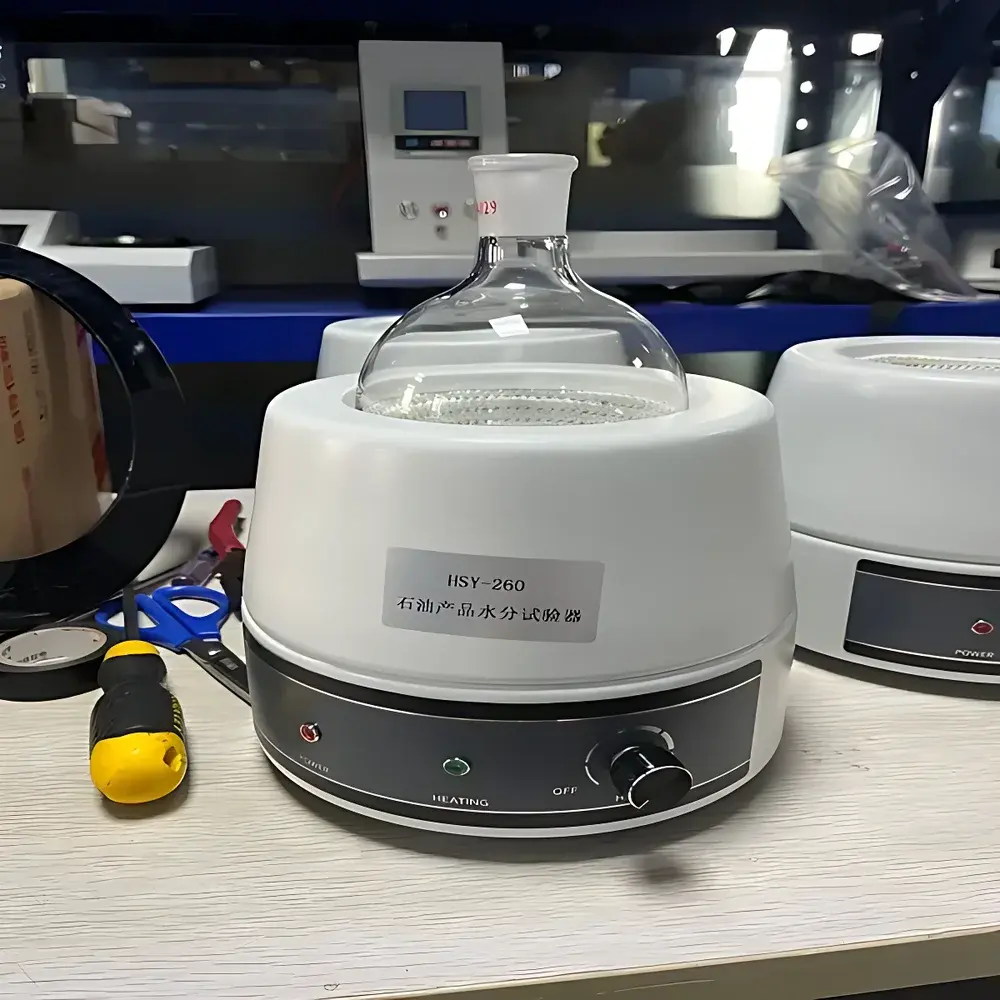
MITONG SYP1015-IV Petroleum Products Moisture Determination Apparatus
| Brand | MITONG |
|---|---|
| Origin | Shanghai, China |
| Model | SYP1015-IV |
| Power Supply | AC 198–242 V, 49–51 Hz |
| Equivalent Output Voltage Range | 0–220 V |
| Heating Power | 350 W |
| Display | 3.5-digit segmented LCD |
| Control Core | 8-bit microcontroller |
| Mains Compensation | Yes (voltage-fluctuation compensation via proportional heating control) |
| Triggering Method | Zero-crossing solid-state switching |
| Compliance | GB/T 260, ASTM D95 |
| Measurement Result Format | mass percent (%) |
| Operating Environment | Ambient temperature |
| Power Consumption | 350 W |
Overview
The MITONG SYP1015-IV Petroleum Products Moisture Determination Apparatus is a dedicated distillation-based moisture analyzer engineered for precise quantification of water content in crude oil, refined fuels, lubricants, and other hydrocarbon-based petroleum products. It operates in strict accordance with the standardized distillation methodology defined in GB/T 260 (Chinese National Standard) and ASTM D95 (Standard Test Method for Water in Petroleum Products by Distillation). Unlike manual voltage-regulated predecessors, the SYP1015-IV implements digital voltage input and real-time equivalent output voltage monitoring via an integrated 8-bit microcontroller-based control system. The instrument employs a closed-loop heating strategy that dynamically compensates for line voltage fluctuations—ensuring consistent thermal energy delivery to the distillation flask regardless of grid instability. This mains compensation functionality preserves setpoint integrity and measurement reproducibility across variable electrical supply conditions typical in industrial laboratory environments.
Key Features
- Digital voltage programming interface with direct keyboard input and real-time display of equivalent RMS output voltage on a 3.5-digit segmented LCD
- Zero-crossing solid-state triggering for heater control—minimizing electromagnetic interference (EMI) and eliminating harmonic distortion on the AC supply line
- Active mains voltage compensation algorithm that continuously monitors input AC voltage and adjusts duty cycle proportionally to maintain constant effective heating power
- Microcontroller-driven thermal regulation enabling programmable heating profiles and stable distillation kinetics
- Robust industrial-grade architecture designed for continuous operation under ambient laboratory conditions (15–30 °C, <80% RH)
- Compliance-ready design supporting documented test procedures required for QC laboratories operating under ISO/IEC 17025 or internal quality management systems
Sample Compatibility & Compliance
The SYP1015-IV is validated for use with liquid petroleum products including gasoline, diesel fuel, kerosene, jet fuel, transformer oils, and base lubricating oils—provided samples meet the viscosity and volatility criteria outlined in ASTM D95. It is not intended for highly viscous residues (e.g., asphalt, heavy fuel oil >1000 cSt), emulsified systems, or samples containing volatile solvents incompatible with open distillation. The apparatus conforms to the mechanical and procedural requirements of both GB/T 260 and ASTM D95, including specified condenser geometry, receiver calibration, and reflux ratio control. While the unit itself does not generate electronic audit trails, its deterministic analog-digital control architecture supports traceable manual recordkeeping aligned with GLP principles. For regulated environments requiring 21 CFR Part 11 compliance, external data logging with time-stamped operator entries is recommended.
Software & Data Management
The SYP1015-IV operates as a stand-alone hardware platform without embedded software or network connectivity. All operational parameters—including target equivalent voltage and heating duration—are configured manually via front-panel keypad entry. Measurement results are reported as mass percent (%) following standard distillation gravimetry or volumetric receiver reading per ASTM D95 Section 8. Data recording is performed externally using laboratory notebooks or LIMS-integrated worksheets. The absence of firmware updates or proprietary drivers simplifies validation protocols and reduces cybersecurity surface area—a key consideration for legacy-system integration in refinery QC labs.
Applications
- Quality control testing of incoming crude oil batches for water ingress prior to desalting
- Final product verification of diesel and jet fuel against maximum allowable water limits (e.g., ASTM D975, D1655)
- Monitoring moisture accumulation in in-service turbine and transformer oils per IEC 60814 or ASTM D1533
- Research-scale evaluation of dehydration efficiency in solvent extraction or membrane separation processes
- Educational demonstration of classical distillation-based moisture analysis in university chemistry and petroleum engineering curricula
FAQ
Does the SYP1015-IV support automated data export to Excel or LIMS?
No. It is a non-networked, microcontroller-based instrument with no USB, RS-232, or Ethernet interface. Data must be recorded manually.
Can it measure water content below 0.01 wt%?
No. Per ASTM D95 limitations, the practical detection threshold is approximately 0.03 wt% for typical 100 mL sample volumes. Lower concentrations require Karl Fischer titration (ASTM D6304).
Is calibration certificate included with shipment?
A factory calibration verification report is provided; however, user-performed periodic verification using certified reference standards (e.g., water-in-toluene standards) is required per ISO/IEC 17025 Clause 6.5.
What maintenance is required for long-term reliability?
Annual inspection of condenser tubing integrity, cleaning of heating mantle contacts, and verification of LCD contrast and keypad responsiveness are recommended. No consumables beyond standard glassware (ASTM D95-compliant distillation apparatus) are required.





