
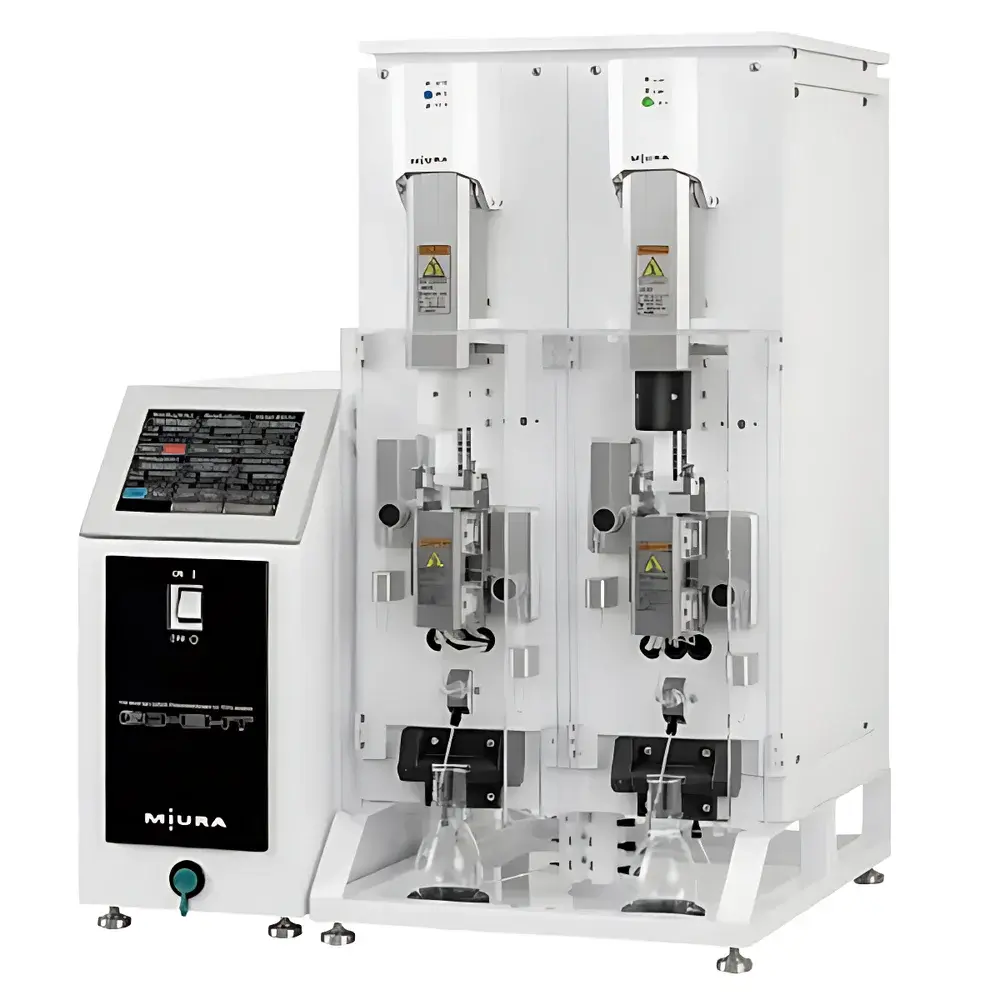
Miura GO-2EHT Dual-Channel Fully Automated Dioxin/PCBs Sample Preparation System
| Brand | Miura |
|---|---|
| Origin | Japan |
| Model | GO-2EHT |
| Certification | EN 61010-1, UL 61010-1:2012, CAN/CSA C22.2 No. 61010-1-12:2012, EN 55011:2009+A1:2010, EN 61000-6-2:2005, RoHS Directive 2011/65/EU, IEC 62321, BS EN IEC 63000:2018 |
| Solvent Consumption per Sample | <100 mL (90 mL n-hexane + 5 mL toluene) |
| Final Fraction Volume | 1–2 mL |
Overview
The Miura GO-2EHT is a dual-channel, fully automated sample preparation system engineered specifically for the rigorous isolation and purification of dioxins (PCDD/Fs) and polychlorinated biphenyls (PCBs) from complex environmental and biological matrices. It operates on the principle of thermally assisted solid-phase extraction (SPE), leveraging chemically modified silica gel columns with surface functionalities optimized for selective retention of planar halogenated aromatic compounds under controlled temperature and solvent gradient conditions. Unlike conventional manual or semi-automated cleanup methods—such as multilayer silica, alumina, or Florisil column chromatography—the GO-2EHT integrates precise thermal modulation (typically 40–80 °C) during elution to enhance analyte desorption kinetics while suppressing co-elution of non-planar interferences (e.g., lipids, sterols, phthalates, and chlorinated pesticides). This results in chromatograms with markedly reduced baseline noise and improved signal-to-noise ratios for target congeners, directly supporting compliance with stringent regulatory detection limits mandated by EPA Method 1613B, EN 1948, ISO 18073, and EU Commission Regulation (EU) 2017/644.
Key Features
- Dual independent purification channels enable parallel processing of two samples or sequential method validation without cross-contamination risk.
- Valve-free fluidic architecture eliminates mechanical wear, dead volume, and carryover—critical for trace-level dioxin analysis where ng/kg or pg/g reporting is required.
- Thermally regulated column oven (programmable 30–90 °C) enhances chemical interaction between analytes and functionalized silica, improving selectivity for PCDD/Fs and non-ortho-substituted PCBs.
- Optimized solvent economy: consumes only 90 mL n-hexane and 5 mL toluene per sample—no dichloromethane required—reducing hazardous waste generation and operational cost.
- Single-use, pre-packed purification columns and disposable PTFE tubing ensure batch-to-batch consistency and eliminate cleaning validation burdens.
- Automated fraction collection delivers final eluate in 1–2 mL volume—ready for direct injection into HRGC-HRMS systems without rotary evaporation or nitrogen blow-down steps.
- Configurable method editor supports user-defined protocols compliant with laboratory-specific SOPs, EPA, ISO, or EU reference methods.
Sample Compatibility & Compliance
The GO-2EHT accommodates diverse sample types including soil, sediment, fly ash, fish tissue, milk fat, human serum, and wastewater extracts following initial lipid removal (e.g., via GPC or acid digestion). Its purification performance meets the acceptance criteria defined in ISO/IEC 17025-accredited laboratories for dioxin analysis, including recovery rates ≥70% for all 17 toxic PCDD/F congeners and ≥60% for indicator and dioxin-like PCBs. The system conforms to electrical safety standards EN 61010-1, UL 61010-1:2012, and CAN/CSA C22.2 No. 61010-1-12:2012; electromagnetic compatibility is verified per EN 55011 (Class B), EN 61000-6-2 (immunity), and FCC Part 15 Subpart B. RoHS Directive 2011/65/EU and IEC 62321-compliant material declarations are provided for full supply chain transparency.
Software & Data Management
The embedded control software provides audit-trail-enabled operation logs—including column lot numbers, solvent batch IDs, temperature profiles, flow rates, and fraction collection timestamps—supporting GLP and FDA 21 CFR Part 11 compliance when deployed with validated networked configurations. All method parameters are digitally signed and version-controlled; historical runs are exportable in CSV or XML format for LIMS integration. Raw method files and calibration records are archived locally and accessible via secure web interface. Miura’s online portal allows registered users to verify certificate of conformance, column performance reports, and firmware revision history using unique serial identifiers.
Applications
- Regulatory monitoring of PCDD/Fs and dl-PCBs in foodstuffs per EU Regulation (EC) No 1881/2006 and (EU) 2017/644.
- Environmental surveillance programs targeting incinerator emissions, contaminated land remediation, and aquatic ecosystem assessments.
- Human biomonitoring studies requiring high-fidelity exposure assessment at sub-pg/g levels in adipose tissue or breast milk.
- Method development and inter-laboratory comparison studies under ILAC-G13 or QUASIMEME frameworks.
- QC/QA workflows in ISO/IEC 17025-certified dioxin testing laboratories seeking automation-driven reproducibility (RSD <8% across 10 replicates).
FAQ
Does the GO-2EHT support EPA Method 1613B without modification?
Yes—the system is pre-configured with validated methods aligned to EPA 1613B requirements, including specified solvent sequences, temperature ramps, and fraction cut points. Column chemistry and flow dynamics have been verified against SRM 1946 and 1947 reference materials.
Can I use custom purification columns with this system?
No—only Miura-certified, pre-packed GO-EHT columns are supported to maintain method integrity, traceability, and regulatory defensibility. Third-party columns void warranty and invalidate compliance claims.
Is remote monitoring or troubleshooting available?
The system includes Ethernet connectivity and supports secure remote diagnostics via Miura’s authorized service portal, subject to customer IT policy approval and TLS 1.2+ encryption.
What maintenance is required beyond column replacement?
No routine mechanical maintenance is needed. The valve-free design eliminates pump seal wear, rotor valve calibration, or solvent line flushing protocols. Annual performance verification using certified reference standards is recommended.
How does the GO-2EHT handle high-lipid samples like fish oil or sewage sludge?
It requires upstream lipid removal (e.g., sulfuric acid treatment or GPC) prior to GO-2EHT injection. The system itself is not designed for gross lipid load reduction but excels at post-lipid cleanup specificity enhancement.



