
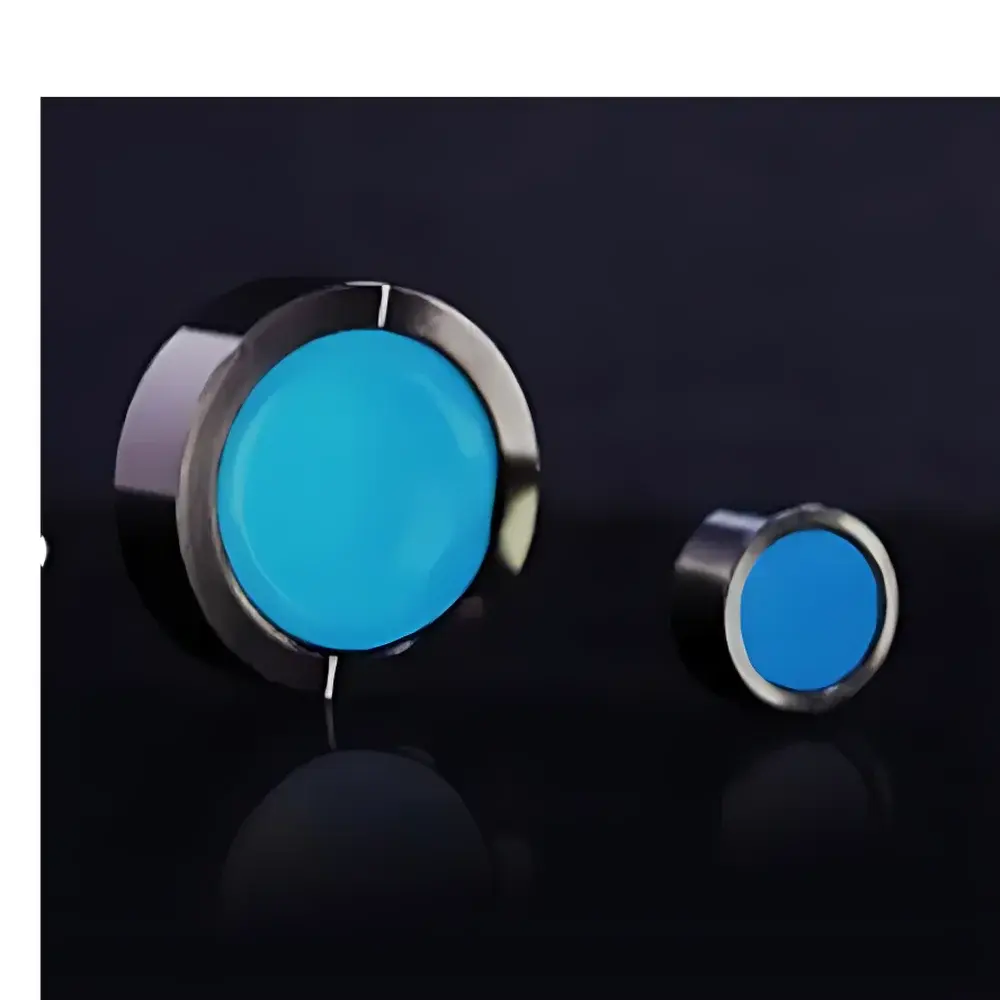
MiXran Meg1134 Air-Gap Zero-Order Quarter-Wave Plate
| Brand | MiXran |
|---|---|
| Model | Meg1134 |
| Type | Zero-Order Quarter-Wave Plate (λ/4) |
| Construction | Air-Gap Retarder |
| Design Wavelengths | 257 nm to 1550 nm |
| Aperture | ≥8.0 mm (for Ø12.7 mm plates) or ≥15.0–18.0 mm (for Ø25.4 mm plates) |
| Thickness | 6.35 mm or 7.92 mm |
| Incident Angle | 0° |
| Surface Quality | λ/10 @ 633 nm |
| Wavefront Distortion | <λ/4 over clear aperture |
| Substrate Material | Fused Silica (UV-grade for ≤355 nm |
| Coating | Broadband AR coating (R<0.25% per surface, specified per wavelength band) |
| Damage Threshold | >5 J/cm² (10 ns, 10 Hz, 1064 nm) |
Overview
The MiXran Meg1134 is a high-precision air-gap zero-order quarter-wave plate engineered for demanding polarization control applications across ultraviolet, visible, and near-infrared spectral regions. Unlike true zero-order waveplates fabricated by crystal wedge bonding or ion-beam etching, the Meg1134 employs a precisely spaced, optically contacted air gap between two matched fused silica substrates—effectively decoupling retardation from temperature-induced birefringence drift and angular sensitivity. This architecture delivers stable λ/4 retardation with minimal temperature dependence (<0.005 nm/°C typical), low wavefront distortion (<λ/4 PV over clear aperture), and exceptional broadband performance when paired with wavelength-specific anti-reflection coatings. Designed for integration into laser cavities, ellipsometry systems, quantum optics setups, and polarization-sensitive metrology platforms, the Meg1134 operates at normal incidence (0° AOI) and maintains phase accuracy within ±λ/30 across its specified design bandwidth.
Key Features
- Air-gap zero-order construction ensures intrinsic thermal stability and reduced sensitivity to beam divergence and alignment drift compared to multi-order equivalents.
- Multiple standard configurations available: Ø12.7 mm and Ø25.4 mm clear apertures, with substrate thicknesses of 6.35 mm (standard) or 7.92 mm (enhanced mechanical rigidity for high-power handling).
- Wavelength-specific broadband AR coatings optimized for 257 nm, 266 nm, 343 nm, 355 nm, 400 nm, 532 nm, 632.8 nm, 780 nm, 800 nm, 850 nm, 1030 nm, 1064 nm, and 1550 nm—each achieving R < 0.25% per surface.
- Fused silica substrates meet MIL-O-13830A scratch-dig specifications (20–10) and are polished to λ/10 surface flatness at 633 nm.
- Retardation uniformity better than ±1.5° across the clear aperture, verified via imaging polarimetry and calibrated photoelastic testing.
- Compatible with vacuum environments (outgassing tested per ASTM E595); no organic adhesives or epoxies used in assembly.
Sample Compatibility & Compliance
The Meg1134 is suitable for use with continuous-wave (CW) and pulsed laser sources—including excimer, diode-pumped solid-state (DPSS), fiber, and ultrafast Ti:sapphire systems—provided fluence remains below specified damage thresholds. It complies with ISO 10110-7 for optical element surface quality and ISO 14997 for retardation specification reporting. For regulated laboratory environments, documentation supports traceability to NIST-traceable interferometric calibration standards. While not inherently FDA-regulated, the component satisfies material biocompatibility requirements (USP Class VI) for non-contact optical subsystems in analytical instrumentation per ICH Q5D guidelines. No RoHS exemptions apply; all materials conform to Directive 2011/65/EU Annex II.
Software & Data Management
As a passive optical component, the Meg1134 does not incorporate embedded electronics or firmware. However, full technical documentation—including spectral transmittance curves, retardation vs. temperature plots, and wavefront error maps—is provided in machine-readable CSV and PDF formats compatible with LabVIEW, MATLAB, and Zemax OpticStudio import workflows. Calibration reports include uncertainty budgets per GUM (JCGM 100:2018) and support GLP-compliant instrument qualification protocols (IQ/OQ/PQ). Digital asset packages are delivered via secure customer portal with audit-trail logging and version-controlled revision history.
Applications
- Polarization state generation and analysis in Mueller matrix ellipsometers and spectroscopic reflectometers.
- Optical isolation in high-finesse interferometers and gravitational wave detection front-ends.
- Circular polarization conversion for cold atom trapping (e.g., MOTs using 780 nm or 1064 nm light) and quantum memory interfaces.
- Harmonic generation cavity control (e.g., SHG, THG) requiring precise intracavity polarization management.
- Calibration reference for polarimetric sensors in aerospace and remote sensing payloads (e.g., Earth observation spectropolarimeters).
- Time-resolved pump-probe experiments where temporal dispersion must be minimized—air-gap design eliminates group delay dispersion inherent in polymer or crystalline multi-order plates.
FAQ
What distinguishes an air-gap zero-order waveplate from a true zero-order or multi-order design?
Air-gap zero-order plates achieve nominal λ/4 retardation through precise physical spacing between two birefringent substrates, eliminating the temperature and wavelength sensitivity of multi-order devices while avoiding the fabrication complexity and cost of true zero-order crystals.
Can the Meg1134 be used at non-normal incidence?
No—it is optimized for 0° angle of incidence. Off-axis use introduces ellipticity errors and shifts the effective retardation; alternative designs (e.g., tilted-waveplate mounts or achromatic variants) are recommended for oblique applications.
Is custom wavelength or aperture size available?
Yes—MiXran offers OEM customization including non-standard diameters (Ø5 mm to Ø50 mm), extended NIR coatings (up to 2000 nm), and vacuum-compatible mounting options with kinematic alignment features.
How is retardation accuracy verified for each unit?
Each Meg1134 plate undergoes full-aperture imaging polarimetry using a calibrated rotating analyzer system traceable to NIST SRM 2085, with results documented in individual serial-numbered calibration certificates.
Does the air gap pose contamination or long-term stability risks?
No—the gap is hermetically sealed during optical contact bonding under cleanroom conditions (ISO Class 5), preventing moisture ingress or particulate accumulation over operational lifetimes exceeding 10 years under typical lab conditions.




