
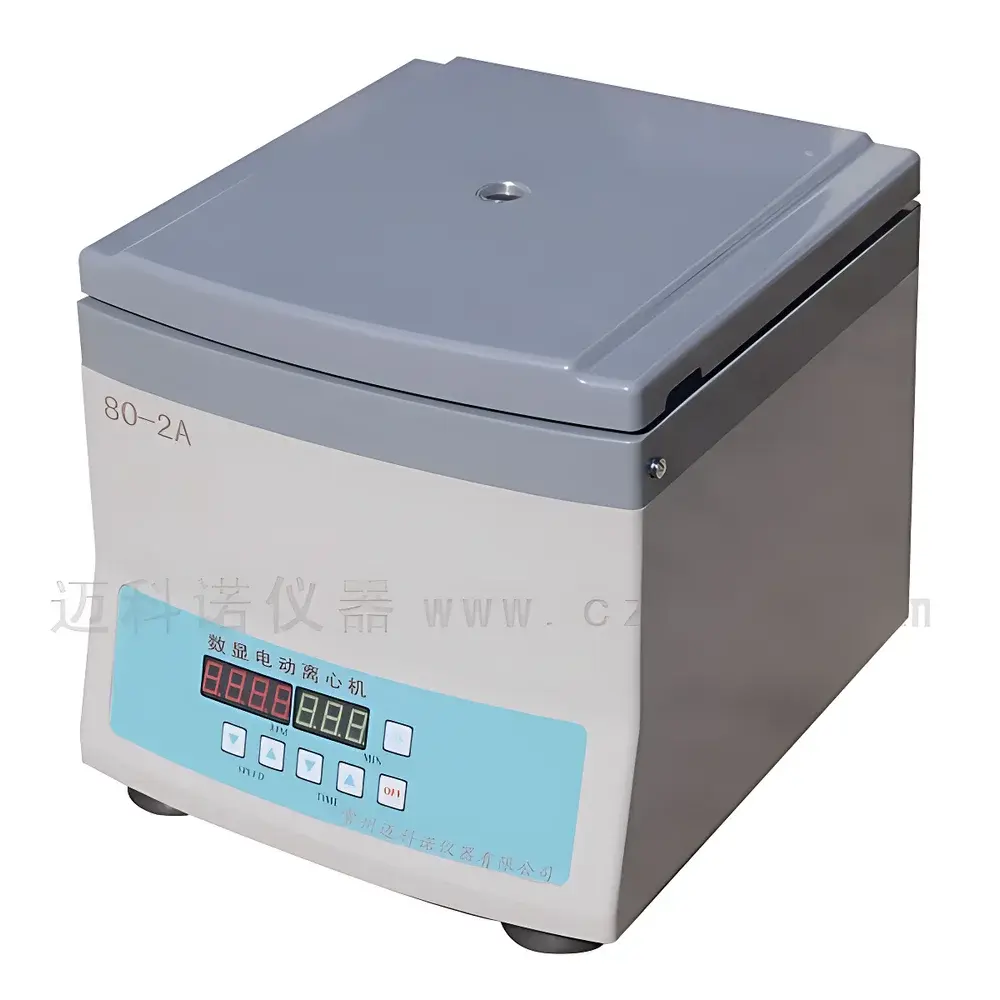
MKN 80-2A Digital Display Electric Centrifuge
| Brand | MKN |
|---|---|
| Model | 80-2A |
| Max Speed | 0–4000 rpm |
| Relative Centrifugal Force (RCF) | 2325 × g |
| Capacity | 12 × 20 mL (or 12 × 15 mL) |
| Timer Range | 0–99 min |
| Power | 135 W |
| Noise Level | ≤60 dB(A) |
| Voltage/Frequency | AC 220 V, 50 Hz, 2 A |
| Construction | High-strength engineering plastic housing |
| Control System | Microprocessor-based digital control with touch panel interface |
| Safety Features | Mechanical door lock, imbalance protection, safety interlock switch |
| Compliance | Designed for general laboratory use in accordance with IEC 61010-1 (Safety Requirements for Electrical Equipment for Measurement, Control, and Laboratory Use) |
Overview
The MKN 80-2A Digital Display Electric Centrifuge is a benchtop, microprocessor-controlled centrifugation system engineered for routine separation tasks in life science, clinical, pharmaceutical, food, and environmental laboratories. It operates on the principle of sedimentation under centrifugal force—accelerating particle settling based on differences in density, size, and shape within a liquid suspension. With a maximum rotational speed of 4000 rpm and an achievable RCF of 2325 × g, the unit delivers consistent, reproducible separation performance for applications including plasma isolation from whole blood, cell pellet formation, precipitate recovery, and clarification of colloidal or particulate suspensions. Its compact footprint, low-noise operation (≤60 dB[A]), and lightweight yet rigid high-strength plastic chassis make it suitable for shared lab environments where space efficiency and operator comfort are critical.
Key Features
- Digital real-time display of rotational speed (rpm) and remaining run time—enabling precise parameter monitoring and process repeatability.
- Microprocessor-based control architecture with intuitive touch-panel interface for rapid parameter entry and program recall.
- Integrated mechanical door lock and electromagnetic safety interlock—preventing rotor operation unless the lid is fully closed and secured.
- Automatic imbalance detection and shutdown—halting operation immediately upon sensing load asymmetry to protect rotor integrity and user safety.
- Brushless centrifugal motor with optimized thermal management—ensuring stable torque delivery across the full speed range and extended service life.
- Fixed-angle rotor configuration supporting twelve 15 mL or 20 mL conical tubes—compatible with standard polypropylene and glass centrifuge tubes meeting ISO 8573-1 Class 3 purity requirements.
Sample Compatibility & Compliance
The 80-2A accommodates common tube formats used in routine biosample processing, including 15 mL and 20 mL conical centrifuge tubes (e.g., Falcon®-style). It is not intended for ultracentrifugation, sealed tube applications requiring vacuum or inert gas environments, or hazardous material handling without supplemental containment. The device complies with IEC 61010-1:2010 for electrical safety in laboratory equipment and meets EMC emission limits per CISPR 11 Group 1, Class B. While not certified for GLP/GMP-regulated workflows out-of-the-box, its digital timer, non-volatile parameter storage, and operational consistency support traceable method execution when integrated into validated SOPs. Users performing regulated assays should verify suitability against internal quality standards and applicable regional directives (e.g., EU Directive 2014/30/EU on electromagnetic compatibility).
Software & Data Management
This model operates as a standalone instrument without external software connectivity or data export capability. All settings—including speed, time, and start/stop commands—are entered directly via the front-panel interface and retained in non-volatile memory between power cycles. No firmware updates or remote diagnostics are supported. For laboratories requiring audit trails or electronic recordkeeping, manual logbook entries—including date, operator ID, sample identifier, rotor type, speed, time, and observed outcomes—are recommended to satisfy basic documentation needs under ISO/IEC 17025 Clause 7.5.2 (Control of Records) or FDA 21 CFR Part 11 Annex A (if used in regulated environments with supplementary procedural controls).
Applications
- Separation of serum or plasma from whole blood specimens in clinical diagnostics and biobanking workflows.
- Pelleting mammalian or microbial cells during culture harvest and downstream lysate preparation.
- Clarification of crude enzyme extracts, antibody supernatants, or fermentation broths prior to chromatographic analysis.
- Recovery of precipitated nucleic acids or proteins following ethanol or ammonium sulfate fractionation.
- Sedimentation-based quality control testing of suspensions in food microbiology and environmental water analysis (e.g., total suspended solids estimation).
FAQ
What is the maximum relative centrifugal force (RCF) this centrifuge can generate?
The MKN 80-2A achieves a maximum RCF of 2325 × g at 4000 rpm with the standard fixed-angle rotor.
Is this centrifuge suitable for use with sealed tubes or hazardous samples?
No—it lacks a sealed rotor chamber or biosafety certification; users must implement secondary containment (e.g., sealed buckets or aerosol-tight tubes) when handling biohazardous or volatile substances.
Does the unit support programmable multi-step runs or gradient protocols?
No—this is a single-speed, single-timer centrifuge designed for straightforward, repeatable batch separations.
Can the rotor be autoclaved?
The aluminum rotor is compatible with standard autoclaving (121°C, 15 psi, 20 min), but repeated sterilization may affect surface finish and balance over time; visual inspection and periodic balancing are advised.
What maintenance is required to ensure long-term reliability?
Routine cleaning of the chamber and rotor with 70% ethanol, periodic inspection of the door latch mechanism and rubber gasket integrity, and annual verification of speed accuracy using a calibrated tachometer are recommended practices.



