
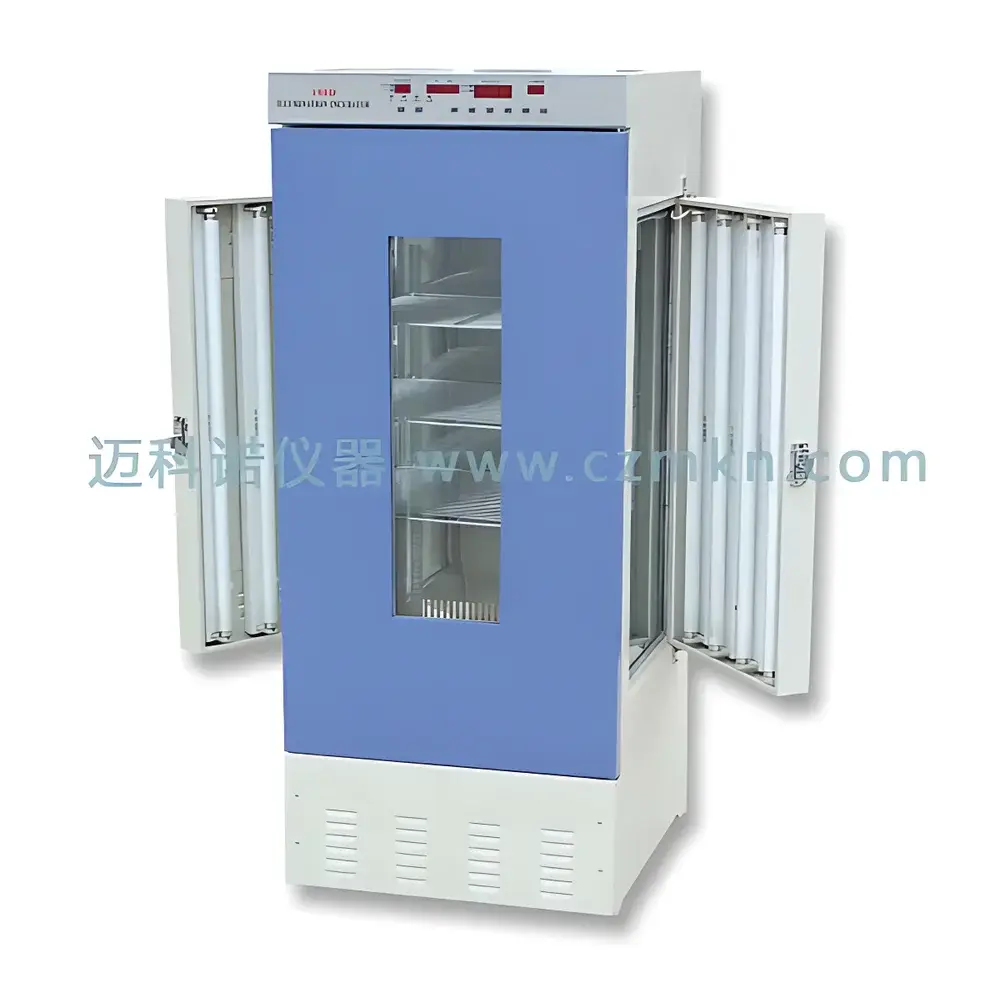
MKN GPX-150 Digital Display Plant Growth Chamber
| Brand | MKN |
|---|---|
| Model | GPX-150 |
| Capacity | 150 L |
| Power Supply | AC 220 V ±10%, 50 Hz ±2% |
| Temperature Control Range | 10–50 °C (with full illumination), 5–50 °C (dark) |
| Temperature Accuracy | ±1 °C |
| Temperature Uniformity | ±1 °C |
| Illuminance | ≥5000 lx |
| Operating Ambient Temperature | 0–40 °C |
| Relative Humidity | ≤85% RH |
| Construction | Cold-rolled steel exterior with powder coating, stainless steel interior chamber |
| Insulation | Polyurethane foam |
| Lighting System | Replaceable energy-saving fluorescent lamps |
| Viewing Window | Double-layer hollow glass door |
| Air Circulation | Optimized forced-air convection system |
| Safety Features | Compressor delay protection, power failure recovery logic |
| Compliance | Designed to support GLP-compliant environmental simulation workflows |
Overview
The MKN GPX-150 Digital Display Plant Growth Chamber is a precision-engineered environmental control system designed for reproducible, long-term cultivation of photobiological samples under tightly regulated temperature and light conditions. Based on the principle of active thermal regulation combined with uniform radiant illumination, it integrates a dual-mode (heating/cooling) Peltier-free refrigeration system with microprocessor-based PID temperature control and calibrated photometric output. Unlike generic incubators, this chamber is specifically configured for plant physiology, seed germination, photoperiodic studies, BOD incubation, and microbial culture under defined light regimes—meeting core experimental requirements in academic botany labs, agricultural research institutes, and pharmaceutical stability testing environments where diurnal cycling or constant-light protocols are mandated.
Key Features
- Microprocessor-controlled temperature regulation with LED digital display ensures real-time visibility of setpoint and actual chamber temperature, delivering ±1 °C accuracy and ±1 °C uniformity across the 150 L working volume.
- Dual-range thermal operation: 10–50 °C under full illumination; 5–50 °C in darkness—enabling flexible protocol design for both photomorphogenic and thermosensitive assays.
- High-intensity illumination system delivers ≥5000 lx at working height using replaceable energy-efficient fluorescent tubes, with side-access lighting panels facilitating rapid lamp maintenance without chamber disassembly.
- Robust chamber architecture features a corrosion-resistant stainless steel interior and powder-coated carbon steel outer casing, optimized for cleanroom-compatible operation and long-term durability in shared lab facilities.
- Forced-air convection system engineered to minimize vertical and horizontal thermal gradients—critical for consistent growth response across multi-tier sample trays.
- Integrated safety logic includes compressor time-delay restart (≥3 min), over-temperature cutoff, and brownout recovery—ensuring equipment longevity and data continuity during utility fluctuations.
- Double-glazed hollow glass viewing door provides thermal insulation while enabling non-invasive visual monitoring without compromising environmental integrity.
Sample Compatibility & Compliance
The GPX-150 accommodates standard botanical growth vessels (e.g., Petri dishes, Magenta boxes, tissue culture flasks, and multi-well plates), as well as BOD bottles and microbiological slant tubes. Its temperature and illumination profiles comply with method requirements outlined in ASTM D5210 (aerobic biodegradability), ISO 11737-1 (microbial enumeration), and USP / (microbial limits testing). While not certified to IEC 61000-4 electromagnetic immunity standards out-of-box, its analog-digital hybrid control architecture meets essential functional safety expectations for Class II laboratory equipment operating within ambient conditions ≤40 °C and ≤85% RH. The chamber supports documentation practices aligned with GLP Annex 11 principles through manual logbook integration and optional external data logging via RS-232 interface (available upon request).
Software & Data Management
The GPX-150 operates via embedded firmware with no proprietary software dependency—eliminating driver conflicts and OS compatibility constraints. All operational parameters (setpoint, real-time temperature, illumination status, elapsed run time) are continuously displayed on a high-contrast LED panel. For audit-ready recordkeeping, users may manually transcribe readings into electronic lab notebooks (ELNs) compliant with 21 CFR Part 11 when paired with timestamped digital cameras or external thermograph loggers. Optional analog voltage output (0–5 V) is available for connection to third-party SCADA or LabVIEW-based acquisition systems—enabling traceable, time-synchronized environmental logging without vendor lock-in.
Applications
- Controlled-environment plant phenotyping: germination rate analysis, photoperiod response screening, stress acclimation studies (e.g., heat/drought/light intensity gradients).
- Environmental microbiology: aerobic biodegradation assays (BOD₅), activated sludge respiration testing, and fungal sporulation kinetics under defined irradiance.
- Pharmaceutical stability: ICH Q1A-compliant accelerated storage trials requiring light exposure per Option 2 (near-UV/visible spectrum).
- Educational laboratories: undergraduate botany practicums, ecology field simulation modules, and genetics coursework involving photoreceptor mutant characterization.
- Algal and cyanobacterial cultivation: batch culture optimization under reproducible PAR-equivalent illumination conditions.
FAQ
Does the GPX-150 support programmable light/dark cycles?
No—the unit maintains constant illumination or darkness per manual selection; cyclical photoperiod control requires external timer relays or third-party environmental controllers.
Is humidity control available on this model?
No—humidity is unregulated and ambient-dependent; users requiring RH modulation should consider the GPX-150H variant or supplementary desiccant/humidification accessories.
What is the expected service life of the fluorescent lighting array?
Under continuous operation at rated voltage, lamps typically retain ≥90% initial illuminance for 6,000–8,000 hours; replacement intervals depend on usage intensity and spectral fidelity requirements.
Can the chamber be validated for ISO/IEC 17025-compliant calibration?
Yes—third-party metrology providers can perform temperature mapping (per ISO 14644-3) and illuminance profiling (per CIE S 023/E:2013) using NIST-traceable sensors; MKN supplies mounting fixtures and access ports to facilitate probe placement.
Is the unit suitable for GMP-regulated production environments?
It is intended for R&D and quality control testing—not for direct manufacturing process use; however, its construction, repeatability, and documentation readiness make it appropriate for supporting GMP-related stability and method development studies.






