
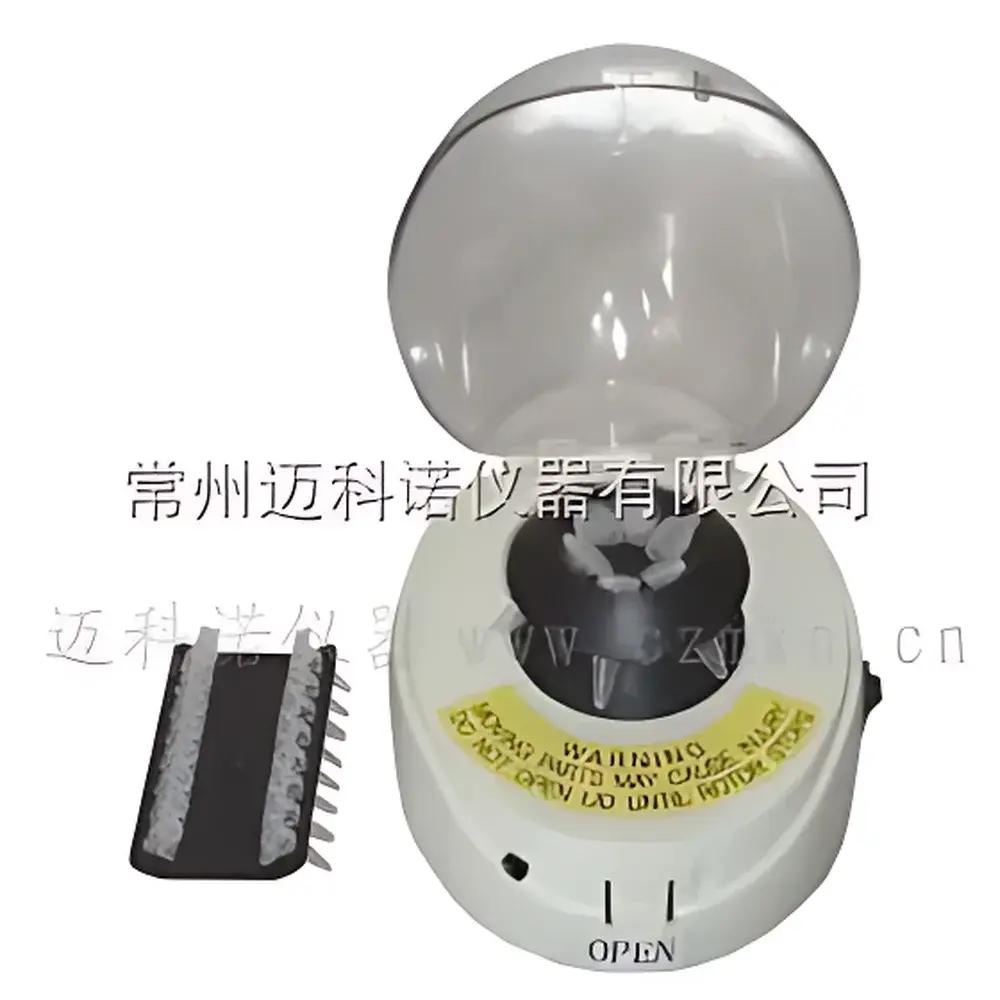
MKN Mini-100 Palm-Sized Microcentrifuge
| Brand | MKN |
|---|---|
| Model | Mini-100 |
| Maximum Speed | 10,000 rpm |
| Relative Centrifugal Force (RCF) | 3,250 × g |
| Sample Capacity | 6 × 1.5 mL / 2.0 mL tubes |
| Dual rotor configuration | 2 × 8 × 0.2 mL PCR strip rotors + 6 × 0.2 mL adapters + 6 × 0.5 mL adapters |
| Noise Level | <50 dB(A) |
| Drive System | Brushless DC motor |
| Rotor Material | Carbon-fiber reinforced composite |
| Dimensions | Compact palm-sized footprint (typical: 125 × 125 × 140 mm) |
| Weight | ~1.2 kg |
Overview
The MKN Mini-100 Palm-Sized Microcentrifuge is an ultra-compact, benchtop-ready centrifugation solution engineered for rapid micro-volume sample processing in resource-constrained or high-throughput laboratory environments. Utilizing a brushless DC motor coupled with a lightweight carbon-fiber rotor assembly, it delivers precise rotational control and mechanical stability at speeds up to 10,000 rpm—generating a maximum relative centrifugal force of 3,250 × g. Its design adheres to fundamental principles of angular momentum conservation and radial acceleration physics, enabling efficient sedimentation of nucleic acids, cellular debris, and particulate matter from microliter-scale biological samples. Unlike conventional centrifuges requiring dedicated bench space and external power conditioning, the Mini-100 operates directly from standard 100–240 V AC input with integrated thermal protection and automatic rotor recognition logic—making it suitable for use in biosafety cabinets, mobile labs, field-deployable diagnostic units, and teaching laboratories where spatial efficiency and operational simplicity are critical.
Key Features
- Compact palm-sized form factor (approx. 125 × 125 × 140 mm) optimized for crowded workbenches and laminar flow hoods
- Carbon-fiber composite rotor engineered for high tensile strength-to-weight ratio and long-term fatigue resistance under repeated acceleration cycles
- Patented acoustic damping architecture achieving noise emission <50 dB(A) at full speed—compliant with ISO 7779 and EN ISO 11201 for low-noise laboratory equipment
- Dual-configuration rotor system supporting simultaneous processing of 6 × 1.5/2.0 mL microtubes and two 8-position 0.2 mL PCR strip carriers
- Interchangeable tube adapters (6 × 0.2 mL, 6 × 0.5 mL) ensuring compatibility with common low-profile PCR tubes, spin columns, and capillary vials
- Microprocessor-controlled acceleration/deceleration profiles minimizing sample disturbance during spin-up and braking phases
- Auto-stop function triggered by lid opening or abnormal vibration detection per IEC 61000-6-2 EMC immunity requirements
Sample Compatibility & Compliance
The Mini-100 accommodates standard microcentrifuge consumables including polypropylene and polyethylene tubes rated for ≤3,250 × g. It supports routine applications involving DNA/RNA purification columns, enzyme reaction cleanup, cell lysate clarification, and antibody elution steps. All rotor configurations comply with ISO 15197:2013 Annex C for mechanical safety of handheld medical devices and meet CE marking requirements under Directive 2014/30/EU (EMC) and 2014/35/EU (LVD). While not certified for clinical diagnostics under IVDR, its performance consistency aligns with CLSI EP15-A3 guidelines for precision evaluation of small-volume centrifugation systems used in pre-analytical sample preparation.
Software & Data Management
The Mini-100 operates as a standalone instrument without embedded firmware-based data logging or network connectivity. However, its fixed-speed operation (10,000 rpm ± 150 rpm) and repeatable RCF output enable integration into validated workflows governed by GLP and GMP frameworks. Users may document run parameters—including duration, rotor type, and tube loading pattern—in electronic lab notebooks (ELNs) such as LabArchives or Benchling. For audit readiness, laboratories can implement manual log entries referencing batch-specific calibration certificates traceable to NIST-traceable tachometer standards (e.g., Fluke 80PK-12), satisfying FDA 21 CFR Part 11 requirements when paired with appropriate procedural controls.
Applications
- Routine pelleting of PCR products prior to electrophoresis or sequencing library prep
- Quick-spinning of spin-column-based nucleic acid extraction kits (e.g., QIAamp, Zymo Research)
- Clarification of bacterial or yeast lysates in molecular cloning workflows
- Centrifugal separation of immunoassay reagents in point-of-care test development
- Micro-volume solvent extraction in analytical chemistry sample prep (e.g., protein precipitation with acetonitrile)
- Student laboratory instruction on centrifugal force principles and safe microtube handling protocols
FAQ
What is the maximum recommended operating time per cycle?
Continuous operation is rated for up to 15 minutes at full speed; extended runs require ≥5-minute cooldown intervals to maintain motor thermal stability.
Is rotor balancing required before each run?
Yes—symmetrical tube loading across the rotor axis is mandatory to prevent vibration-induced bearing wear and ensure compliance with ISO 21501-4 rotor imbalance thresholds.
Can this centrifuge be used with refrigerated samples?
No—this is a non-refrigerated unit; ambient temperature operation only. Samples requiring cold preservation must be pre-chilled and processed rapidly.
Does the Mini-100 support programmable timed runs?
It features a mechanical timer dial calibrated for 0–30 minute intervals with ±10-second accuracy at 20°C ambient.
Are replacement rotors and adapters available through authorized distributors?
Yes—original MKN-certified carbon-fiber rotors (P/N: MKN-RTR-M100-CF) and adapter sets (P/N: MKN-ADP-M100-02/05) are supplied with serial-numbered traceability documentation.



